
Last-Minute Legal Stay Blocks Deportation for Driver in Humboldt Broncos Tragedy
The wound left by the Humboldt Broncos bus crash has never fully healed. On an April evening in 2018, a collision at a rural Saskatchewan intersection shattered families, ended 16 young lives, and altered dozens more forever. Now, years after the criminal proceedings concluded, the legal saga has taken another sharp turn. A federal judge has stepped in at the eleventh hour to halt the deportation of Jaskirat Singh Sidhu, the truck driver who caused the catastrophe. The decision has reignited a national conversation about remorse, punishment, and what it truly means to serve a sentence.
The Court’s Intervention Explained
The deportation order against Sidhu was not a surprise. Under Canadian immigration law, permanent residents convicted of serious crimes face removal from the country once their prison sentence is complete. Sidhu’s removal had been scheduled to move forward when his legal team filed an urgent application in Federal Court. They argued that sending him to India would cause irreparable harm, not just to Sidhu himself but to the broader principles of procedural fairness.
The judge hearing the matter agreed that there were serious issues to be weighed. A stay was granted, effectively freezing the deportation process while a deeper legal review takes place. This is not an acquittal or a pardon—it is a pause button. The court must now examine whether Sidhu was given a proper opportunity to present his case to immigration authorities, and whether the decision to deport him followed all necessary legal channels.
Key questions the Federal Court will explore include:
- Was the pre-removal risk assessment conducted fairly?
- Did immigration officials properly consider Sidhu’s humanitarian and compassionate grounds for staying?
- Does deportation in this specific case violate Canada’s obligations under international law or the Charter?
The last-minute nature of the stay underscores how close Sidhu came to being removed from Canada. It also highlights the tension between finality in criminal justice and the ongoing rights of permanent residents.
Revisiting the Tragedy: What Happened on April 6, 2018
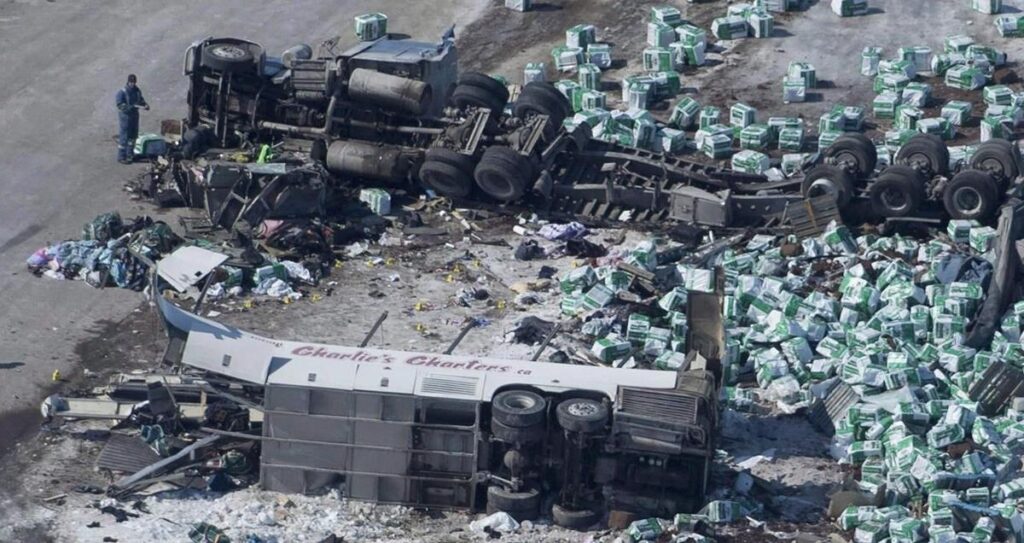
Jaskirat Singh Sidhu was driving a semi-trailer truck along Highway 335 in Saskatchewan. He had been on the road for only a few weeks, newly employed by a small trucking company. At the intersection with Highway 35, a stop sign was clearly posted, but Sidhu’s truck did not stop. It barreled through and slammed into a bus carrying the Humboldt Broncos, a junior hockey team bound for a playoff game.
The force of the collision tore the bus apart. Sixteen people were killed, including players, coaches, a trainer, a statistician, and a radio broadcaster. Thirteen others sustained serious injuries, many life-altering. The nation mourned in a display of collective grief that saw hockey sticks left on porches from coast to coast.
Sidhu, a permanent resident who had moved to Canada from India with his wife, survived the crash. In the immediate aftermath, he was taken into custody and eventually faced a mountain of criminal charges.
Prison Time and the Long Shadow of Criminality
In early 2019, Sidhu pleaded guilty to 16 counts of dangerous driving causing death and 13 counts of dangerous driving causing bodily harm. By admitting his guilt, he avoided a lengthy trial and spared the victims’ families the ordeal of reliving the crash in court. The sentencing judge handed down an eight-year prison term, widely recognized as one of the harshest penalties for a dangerous driving case in Canadian history.
For many, that sentence felt both severe and insufficient. No prison term could bring back the dead or restore the shattered lives. Sidhu served his time, but under the Immigration and Refugee Protection Act, a permanent resident convicted of an offense carrying a maximum sentence of at least 10 years—or who is sentenced to a term longer than six months—faces inadmissibility on grounds of serious criminality. The dangerous driving charges easily met this threshold.
Once Sidhu finished his custodial sentence, the Canada Border Services Agency moved to enforce the deportation order that flows almost automatically from such a conviction. His immigration status, once secure, was now in grave jeopardy.
Humanitarian and Compassionate Grounds: The Case for Staying
Sidhu’s lawyers are not arguing that he is innocent. They are not minimizing the devastation he caused. Instead, they are asking immigration authorities and the courts to weigh a different set of factors.
Remorse and Rehabilitation
Sidhu has consistently expressed deep remorse. During his sentencing hearing, he apologized directly to the families, his voice breaking. He did not attempt to shift blame onto the trucking company, the road conditions, or anyone else. In prison, he was described as a model inmate who participated in programming and sought counselling. Supporters point to his lack of any prior criminal record—this was not a career criminal but a man who made a catastrophic mistake.
Family Ties and Irreparable Harm
Sidhu’s wife is a Canadian citizen. She has no independent ties in India, and the couple has built their life together in Canada. Deporting Sidhu would mean tearing apart a family unit, a consequence that humanitarian and compassionate arguments are designed to prevent. His lawyers contend that forcing his wife to either relocate to a country she barely knows or live separated from her husband constitutes irreparable harm.
Procedural Fairness Concerns
The core of the legal challenge rests on whether Sidhu received a fair shake during the deportation process. Immigration officers exercise considerable discretion when weighing humanitarian grounds. Sidhu’s legal team argues that the decision to deport was made without a full and fair assessment of the compassionate factors. They say the process was rushed, that his genuine rehabilitation was not given sufficient weight, and that the officer’s reasoning was flawed.
The Federal Court will now scrutinize that process. If it finds that the decision was unreasonable or procedurally unfair, the deportation order could be set aside, and the matter sent back for a new determination.
A Community and Families Divided
Perhaps no aspect of this case is more emotionally charged than the responses of the victims’ families. There is no single, unified voice. Some have publicly stated they forgive Sidhu and do not wish to see him deported. They argue that he has suffered enough, that his remorse is real, and that sending him to India would not honour the memory of those they lost. For these families, mercy and compassion hold greater value than retribution.
Others feel strongly that deportation is an appropriate consequence. They point out that Sidhu, as a guest in the country, violated the most fundamental trust by causing mass death through his neglect. Canada has the right, they say, to remove serious offenders, and the fact that his actions destroyed so many lives should not be softened by his eventual display of remorse. For them, justice remains incomplete if Sidhu is allowed to stay.
This sharp divide reflects the complexity of the human psyche and the deeply personal nature of grief. The Federal Court’s ruling cannot resolve that divide; it can only address the legal merits.
The Broader Immigration Debate
Sidhu’s case has become a flashpoint in a wider discussion about Canada’s immigration and justice systems. For advocates of stricter enforcement, it is a textbook example of why serious criminals, even those who have served their time, should not retain the privilege of permanent residency. They argue that deportation protects public safety and upholds the integrity of the immigration system.
For advocates of reform, the case raises uncomfortable questions about double punishment. Sidhu was already sentenced by a criminal court. Deportation, they contend, is a separate and often disproportionate penalty, one that does not take rehabilitation or family unity into account. They note that a Canadian citizen who committed the same offense would face prison, but never the threat of being exiled from their home. Permanent residents, they argue, should not be treated as forever conditional.
The case also draws attention to the trucking industry’s regulatory failures. Sidhu was a poorly trained, under-supervised driver operating a dangerous machine. While this does not excuse his actions, it contextualizes them within a system that failed to protect the public. Some observers ask whether deportation is an easy scapegoat that lets systemic issues off the hook.
What Comes Next
The stay is temporary. The Federal Court will now hear the full substantive application. Timelines remain uncertain, but both sides will file extensive written arguments, and a hearing will likely be scheduled in the coming months. The judge could uphold the deportation order, meaning Sidhu would eventually be removed unless a further appeal succeeds. Alternatively, the court could quash the deportation decision and order a new assessment by immigration officials.
During this period, Sidhu remains in Canada under strict conditions. He is not free of the legal cloud hanging over him, but he avoids, for now, the permanent separation that deportation would bring.
The outcome will depend on legal technicalities, but its reverberations will be deeply human. A judge must navigate between the black letter of immigration law and the colourful realities of forgiveness, loss, and belonging. The nation will watch, not just because it remembers the Broncos, but because the case forces a difficult question: how do we hold someone accountable without losing our humanity? The answer, when it comes, will shape Canadian law and the public’s sense of justice for years to come.

