
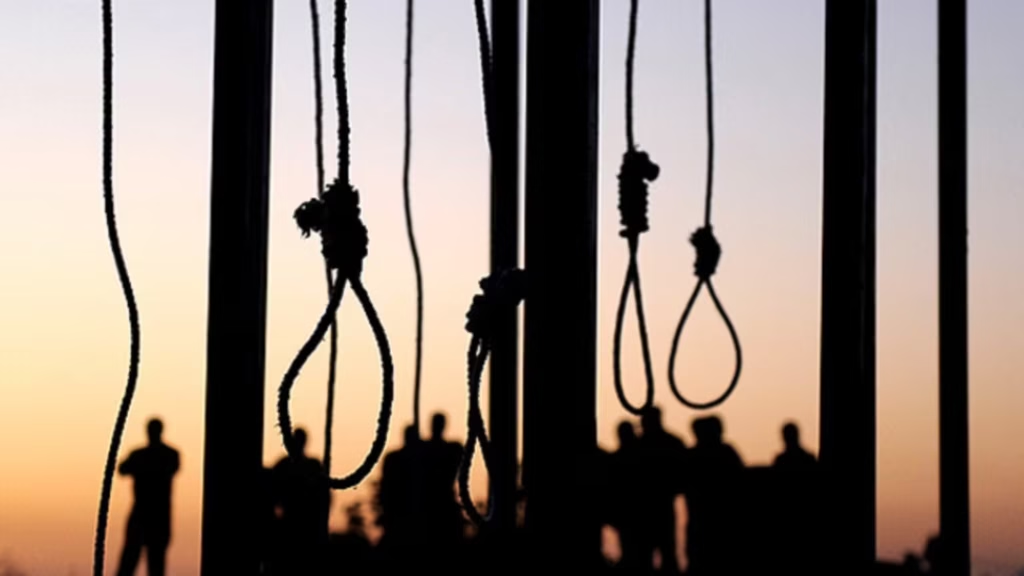
Executions in Iran Spike Under Cover of War: Hidden Death Row Stories Emerge
The roar of airstrikes and the chaos of regional conflict have provided a devastating cover for Iran’s judicial system. While the world’s gaze fixes on war maps and diplomatic cables, a quieter horror has unfolded inside Iranian prisons.
Activists, lawyers, and grieving families are now assembling a grim archive—not of official court documents, but of smuggled letters, contraband phone recordings, and whispered testimonies from death row. These artifacts reveal a chilling pattern: the state is using the fog of war to accelerate executions with breathtaking speed and secrecy.
The War as a Smokescreen: Why Executions Surge
Iran’s recent military engagements have created what human rights organizations call a “perfect storm” for the judiciary. With international journalists, UN monitors, and human rights bodies distracted by active hostilities, the prison system has moved with unusual haste.
The key factors driving this surge include:
- Reduced international scrutiny: News cycles are dominated by battlefield reports, not prison statistics
- Overburdened legal defenses: Lawyers cannot access clients or challenge rulings during wartime conditions
- “National security” charges become easier: Any dissent is quickly rebranded as collaboration with the enemy
- Accelerated appeal processes: What might take months is now compressed into days
One victim’s final message, scrawled on a scrap of toilet paper and smuggled out by a fellow inmate, read simply:
“They are hanging us while the bombs fall. No one will notice.”
That single line captures the cold calculus of institutional violence hidden behind geopolitical noise.
Letters from the Edge of the Gallows
The most powerful evidence comes not from court records, but from the victims themselves. Handwritten notes—often written in haste—offer a window into final moments the regime would prefer to erase.
These letters share haunting commonalities:
- Names and dates: Victims record their identity, knowing the state may deny their existence
- Final wishes: Messages to spouses, children, and parents asking forgiveness or expressing love
- Accusations against torturers: Specific names, units, and methods described in chilling detail
- Requests for burial information: Pleas to authorities that are rarely honored
One particularly devastating letter was written by a 24-year-old political prisoner to his infant daughter:
“Do not let them bury my name with my body. Remember that I laughed with you, that I held you. That is the truth. The rest is lies they will tell.”
The letter was found days after his execution, hidden inside a hollowed-out book in the prison library.
Video Testimonies Defying Erasure
Even more powerful are the video recordings captured on contraband smartphones. These clips circulate through encrypted channels before reaching human rights groups, offering visceral proof of what is happening.
In one widely shared video, a man in his early thirties speaks directly to the camera. His voice is steady, almost calm. He mentions his wife by name, describes his son’s first steps, and expresses hope that the world will someday understand.
“I am not a terrorist,” he says. “I am a teacher. I spoke against injustice. That is my crime.”
The recording ends abruptly. His family later confirmed he was executed the same day.
These videos serve a dual purpose:
- As memorials: Preserving the face, voice, and humanity of someone the state wanted erased
- As indictments: Documenting the conditions, guards, and court language behind the sentence
The “Wartime Expediency” Defense
Iranian judicial authorities rarely acknowledge these executions publicly. When pressed, they cite a phrase that appears frequently in smuggled records: “wartime expediency.”
This justification allows courts to:
- Bypass standard appeals procedures
- Deny family notification until after execution
- Refuse return of bodies for burial
- Prosecute individuals under vague charges like “sowing corruption on earth”
Human rights lawyers note that this charge is so broadly defined it can apply to political speech, protest, or even social media activity. During wartime, its use expands dramatically.
A Pattern of Systematic Secrecy
The numbers tell a disturbing story. Reports from multiple human rights organizations suggest executions in Iran have increased by an estimated 40–60% during recent hostilities. Without independent access to prison records—denied by authorities—verification relies on grassroots networks and smuggled evidence.
Key obstacles include:
- Refusal to disclose burial sites: Families are told only that “remains have been disposed of according to law”
- No official execution lists: The state does not publish names or totals
- Intimidation of witnesses: Guards and inmates risk punishment for sharing information
- Blocked international access: UN investigators and monitors are denied entry
The Human Cost of a Hidden Justice
Behind every smuggled letter and grainy video is a family left in limbo. Mothers do not know where their sons are buried. Wives receive calls confirming deaths they cannot prove. Children grow up with stories instead of memories.
One grandmother, speaking through an encrypted channel, described receiving her son’s final letter:
“He wrote that he was not afraid. But I am afraid—afraid the world will forget him. That all these letters and videos will become just noise. That no one will ask why.”
Why These Stories Matter
These letters and videos do more than document atrocities. They resist erasure. Each message, each recording, is an act of defiance against a system designed to make people disappear without a trace.
They serve as:
- Historical records for future generations
- Potential legal evidence for international courts
- Moral testimony reminding the world that real lives are being lost
The World’s Responsibility
The pattern is stark: when war dominates headlines, prison walls grow taller. When attention shifts to battlefields, executions increase.
The letters and videos from Iran’s death row are not only a plea for remembrance—but for action.
International condemnation has followed, but without access, it has limited impact. The system continues to operate in the shadows, shielded by global distraction.
As one victim wrote in his final hours:
“Do not let the bombs drown out our voices. We are not numbers. We are not statistics. We are people who loved, who laughed, who hoped. Do not let them take that too.”
The messages continue to emerge. The videos continue to circulate. And somewhere, inside a prison cell, another person is writing their final words—hoping someone, somewhere, is still watching.

