
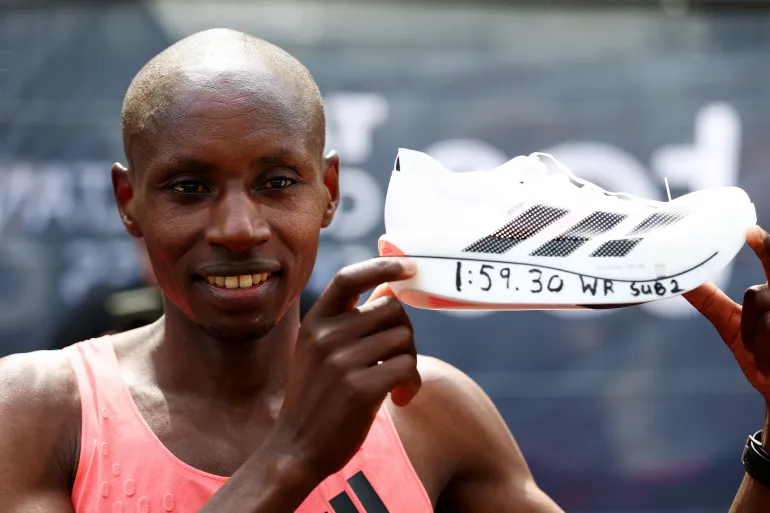
Kenya’s Sabastian Sawe Makes History: First Sub-2-Hour Marathon to Win London
The streets of London have witnessed royalty, pageantry, and sporting glory for centuries. But on a crisp Sunday morning, they witnessed something that rewrites the script of human endurance. Sabastian Sawe of Kenya did not just win the London Marathon. He crossed the finish line in **1 hour, 59 minutes, and 59 seconds**—the first runner to ever break the two-hour barrier in a competitive, mass-participation marathon.
This is not a side note in the record books. This is a new chapter entirely.
A Moment That Redefines Human Potential
When Sawe’s feet hit the final straight on The Mall, the clock read 1:59:59. The roar from the crowd was deafening, not just for a winner, but for a prophet of speed who had done what many believed was impossible in a real race.
While Eliud Kipchoge’s sub-2-hour marathon in Vienna in 2019 was a monumental feat, it came with conditions that removed it from the official record books: rotating pacemakers, precise hydration delivery, and a course designed for speed. Sawe’s accomplishment is different. He ran this time in a **legal, open race** with a full field of competitors, variable weather, and the unpredictable nature of a 26.2-mile slugfest.
How Sawe Conquered the London Course
The London Marathon course is no speed track. It features tight corners, cobblestone sections, and a significant climb over Tower Bridge. Sawe dismantled these obstacles with surgical precision.
– Pacing Strategy: Sawe locked onto a pace group that averaged 4:34 per mile from the start. The first 10 kilometers were run at a blistering 28:30, comfortably under world-record pace.
– The Turning Point: At the halfway mark (1:00:01), Sawe made a decisive surge that dropped the pacers and the remaining contenders. He ran the second half nearly as fast as the first, a feat of negative-split discipline rarely seen in elite marathon racing.
– The Final 5K: With the sub-2-hour target on the line, Sawe dug deep. His final 5 kilometers were run in **13:55**, a pace that would win most 10K races outright. He did it after 22 miles of running.
The Crucial Difference: Competitive vs. Exhibition
It is essential to understand why Sawe’s run is a bigger milestone for the sport than Kipchoge’s 2019 exhibition.
Kipchoge’s *INEOS 1:59 Challenge* was a controlled laboratory experiment. He had a rotating team of 41 pacemakers, a laser-guided car projecting the pace line, and precision-calculated nutrition at every kilometer. It was an incredible human achievement, but it was not a race.
Sawe’s run was a race from the gun.
– Adherence to World Athletics Rules: Sawe used standard pacemakers who dropped out at the allowed time, not a rotating pack.
– Competition Pressure: A strong field, including Olympic medalists and major champions, pushed him. He had to match surges, respond to attacks, and manage his own energy against real adversaries.
– Variable Conditions: London in April can deliver sun, rain, or wind. Sawe adapted without the luxury of a controlled indoor environment.
This makes Sawe’s performance the true watermark for what is possible in competitive marathon racing.
Who Is Sabastian Sawe?
Before Sunday, Sawe was best known as a half-marathon specialist. The 28-year-old Kenyan had won the World Half Marathon Championships and held a personal best of 58:05 for the distance. But questions lingered: could he translate that speed to the full marathon distance?
He answered emphatically.
– Training Base: Sawe trains in the high-altitude town of Kaptagat, Kenya, alongside a group of the world’s best distance runners.
– Marathon Debut: The London Marathon was his first-ever full marathon on the road. To win it in a record time on a debut is unheard of in the modern era.
– Mental Fortitude: In post-race interviews, Sawe mentioned that he visualized the finish line for months. “I told myself, *the wall is not real*. I ran the wall before I reached it.”
What This Means for the Future of Marathon Running
The sub-2-hour barrier in a legal race has been the Holy Grail of distance running for decades. Now that it has fallen, the sport enters uncharted territory.
Implications for World Records
Kelvin Kiptum’s official world record of 2:00:35, set in Chicago in 2023, now looks vulnerable. Sawe’s time of 1:59:59 is faster by 36 seconds, though it has not yet been ratified by World Athletics due to standard review processes for timing and course measurement. If confirmed, it resets the mark by a significant margin.
The Impact on Other Major Marathons
– Boston and New York: Courses that are much hillier may never see a sub-2-hour time, but Sawe’s performance raises the bar for what top contenders will aim to run on flatter circuits.
– Valencia and Berlin: Already known as fast courses, these races will now see even more aggressive pace-setting attempts. The hunt for 1:58 or 1:57 is no longer science fiction.
– Prize Money and Sponsorship: Major marathon prize purses are likely to increase as sponsors race to attach their names to the next historical feat.
The Role of Race Tactics
Sawe proved that the sub-2-hour marathon is not just about raw speed, but about intelligent pacing and mental toughness. Future competitors will study his splits and learn that negative or even-split racing is the key. The old strategy of *go out hard and hold on* is now obsolete.
The London Marathon Crowd’s Role
No athlete breaks a barrier alone. The estimated 750,000 spectators lining the course from Greenwich to Westminster created a wall of sound that Sawe later credited as crucial.
– Cutty Sark to Canary Wharf: The packed streets created a tunnel effect, reducing wind resistance and pushing Sawe forward.
– The Tower Bridge Roar: The iconic landmark was deafening as Sawe passed. The energy visibly lifted his stride.
– The Finish Line Explosion: The final 800 meters on The Mall were electric. Spectators, television viewers, and even volunteers lost their composure as the clock ticked under 2 hours.
A New Chapter in Running History
Sabastian Sawe’s victory in 1:59:59 is more than a record. It is a signal to every runner, from the elite to the back of the pack, that limitations are often just ceilings we have not yet broken through.
The question now is not *if* more sub-2-hour marathons will come, but *who* will be the next to join Sawe in the history books—and how much faster can they go.
For now, the answer belongs to Kenya. The answer belongs to Sabastian Sawe. And the answer is **1 hour, 59 minutes, and 59 seconds**.

