Chaos in the Ballroom: What the Newly Released Video Reveals About the Correspondents’ Dinner Attack
It was meant to be a lighthearted evening—a longstanding tradition where journalists, politicians, and public figures temporarily set aside rivalry for speeches, humor, and ceremony. Instead, it became a high-risk security incident inside one of the most symbolically visible gatherings in American political media.
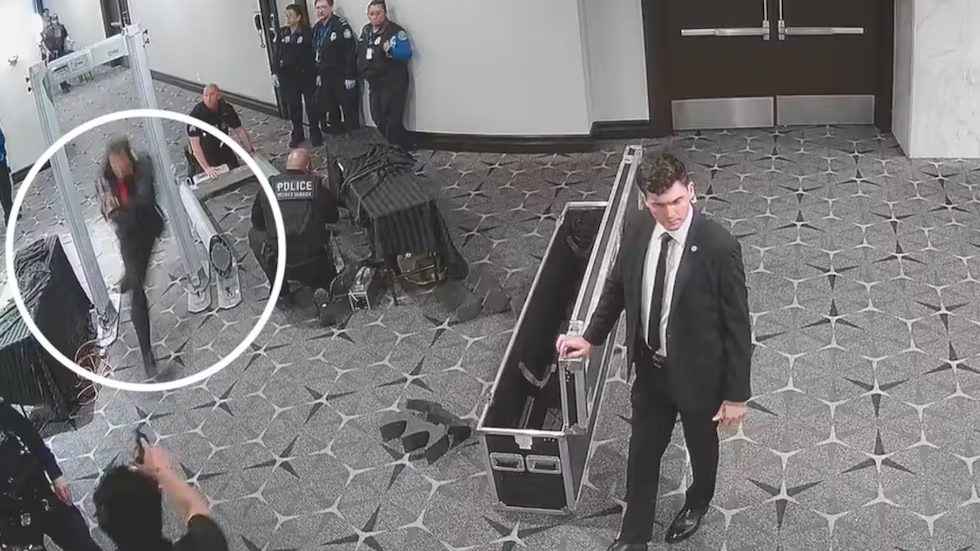
Prosecutors have now released security footage showing the moment an armed man breached the correspondents’ dinner, turning a formal celebration into a rapid emergency response situation. The video is more than documentation; it is now central evidence in a case that raises serious questions about event security protocols and the vulnerability of high-profile press gatherings.
Below is what the footage reveals, why it was made public, and what it signals for future security planning.
The Raw Footage: A Timeline of the Breach
The video, compiled from multiple internal security cameras, reconstructs the sequence of events in stark detail.
Entry Point: A Critical Security Gap
One of the most concerning revelations is how the suspect entered the venue. Prosecutors identify him as 42-year-old Marcus Tolland, who gained access through a rear service corridor connected to the kitchen.
Key observations from the footage:
- No formal screening appears to have been conducted at the service entrance
- Staff members did not initially challenge his presence
- The weapon remained concealed beneath outer clothing until he reached the main ballroom
Security analysts reviewing the footage have focused heavily on this entry point, describing it as a structural vulnerability rather than an isolated lapse.
Movement Inside the Venue: Calm and Calculated
The suspect’s behavior inside the ballroom stands out for its apparent composure. Rather than immediate confrontation, the footage shows deliberate movement through the crowd.
He is seen:
- Pausing near a beverage station and scanning the room
- Walking past guests without engaging or drawing attention
- Fixing his attention on the head table before reaching toward his coat
Security experts note that this type of movement is consistent with targeted attack planning rather than spontaneous violence, particularly in venues where high-profile individuals are concentrated in a single space.
The Response: A 47-Second Containment Window
The most critical phase of the footage begins when guests first identify the threat. A nearby attendee reacts audibly, triggering immediate disruption.
Within seconds:
- Guests overturn tables and take cover
- Security personnel converge from multiple directions
- The suspect is physically restrained before reaching the stage area
The entire sequence—from entry into the main room to subdual—lasted approximately 47 seconds.
Security consultant Diane Marchetti described the response as both effective and revealing:
“The intervention was fast enough to prevent casualties. But the fact that the breach occurred at all is the operational failure that needs examination.”
Why Prosecutors Released the Footage
The decision to release the video early is unusual but deliberate, according to the District Attorney’s office. Officials cite transparency and public accountability given the high-profile nature of those present.
Transparency and Public Confidence
Authorities state the release serves multiple purposes:
- Reducing misinformation in the immediate aftermath
- Encouraging additional witnesses or recordings to surface
- Providing clarity on how quickly the situation was contained
Legal Strategy Considerations
Prosecutors also appear to be shaping the evidentiary narrative ahead of trial. The defense has indicated it may pursue diminished responsibility arguments based on mental health.
The footage, however, is being used to support claims of structured intent, including:
- Purposeful navigation through restricted areas
- Targeted movement toward key individuals
- Controlled behavior prior to intervention
Charges Filed
Marcus Tolland currently faces multiple charges, including:
- Attempted first-degree assault with a deadly weapon
- Criminal trespass of a secured venue
- Illegal possession of a firearm in a restricted area
- Resisting arrest with force
Prosecutors are still evaluating whether attempted murder charges will be added, pending forensic confirmation of the weapon’s readiness at the time of the incident.
Security Failures Under Review
The footage has prompted broader scrutiny of event security practices, particularly at high-profile political and media gatherings.
Analysts highlight three key vulnerabilities:
1. Service Entrance Oversight
Secondary access points, such as kitchens and loading areas, often lack the same screening rigor as main entrances. In this case, that gap appears central to the breach.
2. Institutional Complacency
The correspondents’ dinner has long operated under informal security norms relative to its guest profile. Experts argue that legacy assumptions about safety no longer align with current threat environments.
3. Coordination Breakdown
The footage suggests a lack of clear communication between private security teams and law enforcement personnel, leading to uncertainty in threat identification and response roles.
Industry Response and Expected Reforms
In the aftermath, several media and event organizations are reviewing their security protocols. Early proposed measures include:
- Mandatory screening at all entry points, including service corridors
- Joint training exercises between private security and law enforcement
- Unannounced security audits for high-profile events
Security professionals note that many of these protocols already exist in other high-risk event categories but have not been consistently applied to press-related gatherings.
A Near Miss With Long-Term Consequences
The correspondents’ dinner will likely return next year, but under significantly heightened security conditions.
While no fatalities occurred, the footage has already reshaped discussions around risk perception in journalistic and political spaces. It underscores a broader shift: even symbolic, tradition-rich events are no longer exempt from modern threat realities.
The released video is now both evidence and instruction. It documents a breach, a rapid response, and a narrow outcome—but also exposes systemic weaknesses in how secure environments are defined and maintained.
As the legal process moves forward, the footage is expected to remain central to both courtroom arguments and institutional reform debates.
The trial is scheduled for late spring. Until then, the video stands as a stark reminder of how quickly a controlled, ceremonial setting can shift into an emergency response scenario.