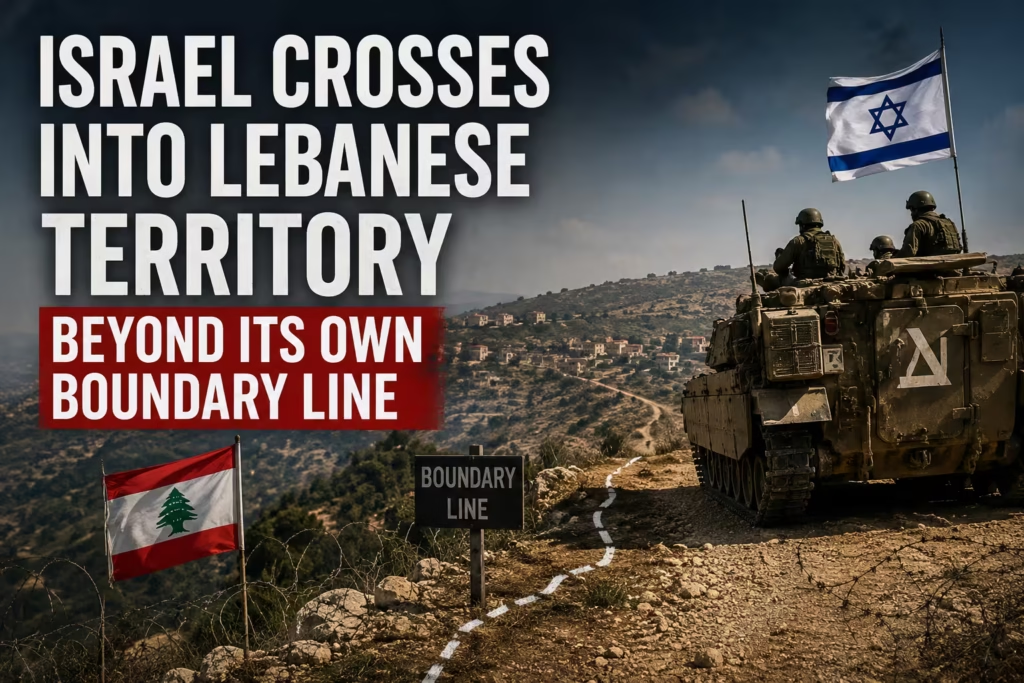
Israel Crosses Into Lebanese Territory Beyond Its Own Boundary Line
On May 27, 2026, Israel’s military confirmed it has pushed past the so-called “Yellow Line” — a demarcation it set for itself inside Lebanese territory after a ceasefire took effect in April 2025.
This is not a minor tactical shift. It marks a direct escalation in one of the Middle East’s most volatile conflict zones.
So what exactly is happening on the ground? And what does it mean for Lebanon, Israel, and the broader region?
What Is the Yellow Line?
The Yellow Line is not a formal international boundary. Israel drew it unilaterally — roughly 5 to 10 kilometers inside Lebanese territory — after a ceasefire with Hezbollah was established in April 2025.
Think of it as a self-imposed operational limit. Israeli troops have been conducting operations within that zone, demolishing structures, occupying villages, and establishing a buffer area.
The line runs parallel to — but is distinct from — the UN-demarcated Blue Line, which marks the official Lebanon-Israel frontier established after Israel’s withdrawal from Lebanon in 2000.
Key differences between the two lines:
- The Blue Line is internationally recognized and UN-demarcated
- The Yellow Line was drawn by Israel as an internal military boundary
- Israeli troops crossed the Yellow Line to enter deeper Lebanese territory on May 26, 2026
What Triggered the Move?
Israeli Prime Minister Benjamin Netanyahu confirmed the push directly.
He said Israel is “deepening its operations in Lebanon” and that the military “is operating with large forces in the field and capturing controlling areas.”
His stated reason: fortifying a security strip to protect communities in northern Israel.
Israeli Defense Minister Israel Katz had already warned weeks earlier that Israel would occupy more territory if the Lebanese government could not disarm Hezbollah — as required under the November 2024 ceasefire agreement.
Hezbollah, for its part, did not stay quiet. The group launched explosive drones, rockets, and artillery at Israeli forces advancing toward the southern Lebanese town of Zawtar al-Sharqiya.
The Israeli military responded by striking more than 100 Hezbollah sites across southern Lebanon and the eastern Bekaa Valley in a single overnight operation — targeting storage facilities, command centers, and observation posts.
What Does This Mean for Lebanon’s Civilians?
The numbers are stark.
Since Israel resumed its offensive on March 2, 2026, Lebanon’s health ministry reports cumulative casualties of 3,213 dead and 9,737 wounded as of May 26. The World Health Organization puts the death toll from Israeli strikes since the truce at least 608.
Rescue workers pulled a dozen bodies from rubble following a single wave of overnight strikes targeting southern and eastern Lebanon.
The civilian situation raises several direct questions:
- Where are displaced families in southern Lebanon supposed to go as the buffer zone expands?
- Who holds accountability when military operations extend beyond agreed boundaries?
- Does international humanitarian law apply differently when a ceasefire is technically still in effect?
Nearly one million people have been displaced across Lebanon since hostilities resumed. More than 100 of those killed have been minors, according to the Lebanese Health Ministry.
The Litani River: Why This Boundary Matters
The Litani River runs across southern Lebanon and has long served as a de facto military boundary in the Israel-Hezbollah conflict.
UN Security Council Resolution 1701, passed after the 2006 war, called for Hezbollah to withdraw north of the Litani. Israel’s latest clashes with Hezbollah are occurring directly along this river line.
According to Axios, Israel’s broader objective is to take control of the entire area south of the Litani River to dismantle Hezbollah’s military infrastructure. If accurate, this represents a significant territorial ambition — not a temporary buffer.
International Reaction: A Growing Chorus of Concern
France’s President Emmanuel Macron has directly warned Netanyahu not to launch a full ground offensive in Lebanon.
The Centre for Information Resilience, which tracks verified open-source footage from the conflict, notes that Israel’s activity in Lebanon combines “sustained airstrikes with increasingly visible ground incursions” — and that civilian casualties and displacement are growing.
The ceasefire agreed in November 2024 is widely considered shattered. The question now is whether any diplomatic mechanism can slow what appears to be a steady, escalatory military campaign.
What You Should Watch Next
If you are tracking this conflict — whether for policy, journalism, or personal reasons — these are the specific developments worth following:
- Whether Israeli troops advance further north, toward or past the Litani River
- Any formal Lebanese government response or request for UN intervention
- How Iran-related ceasefire negotiations affect Hezbollah’s posture on the ground
- The next UN Security Council session addressing Resolution 1701 compliance
- Casualty figures from both Lebanese health authorities and the WHO
The Yellow Line was Israel’s own creation. Crossing it is Israel’s own decision. What that decision produces — for civilians, for the ceasefire, for the region — is still unfolding.