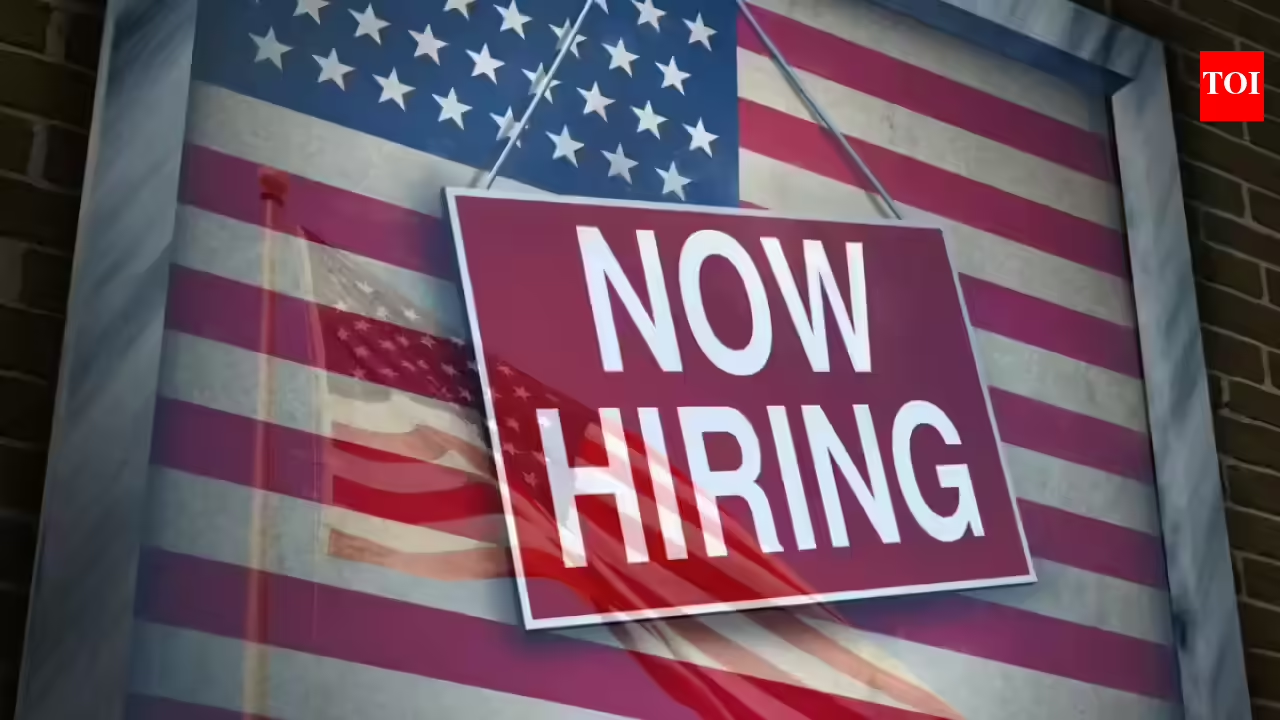
The US economy is entering a sensitive phase as growing signs of employment weakness begin to influence market mood, investor behavior, and policy expectations. Once considered the strongest pillar of economic resilience, the labor market is now showing subtle but meaningful cracks that are reshaping sentiment across financial markets.
While job creation remains positive on the surface, underlying trends such as slowing hiring, rising jobless claims, and softer wage growth are fueling concerns that economic momentum may be fading. For investors, businesses, and policymakers alike, employment data has become the central lens through which the broader US economic outlook is being assessed.
Labor Market Signals Are Losing Momentum
Recent employment indicators suggest that the US labor market is no longer as tight as it once was. Hiring activity has moderated, job openings have declined, and layoffs are becoming more frequent across select industries, particularly technology, retail, and manufacturing.
Although headline employment figures continue to show net job gains, the pace has slowed noticeably. This deceleration matters because employment strength has been the backbone supporting consumer spending and economic growth over the past several years.
As that support weakens, confidence across markets is beginning to shift.
Why Employment Weakness Matters More Than Ever
Employment data carries outsized importance in the current environment because it directly influences Federal Reserve policy, consumer behavior, and corporate earnings. A strong labor market allows households to absorb higher prices and interest rates. A weakening one does not.
As job security becomes less certain, consumers tend to pull back on discretionary spending. This change in behavior can ripple quickly through the economy, affecting everything from retail sales to housing demand.
Markets are now increasingly sensitive to any sign that employment conditions are deteriorating faster than expected.
Investor Sentiment Turns Cautious
Financial markets have reacted cautiously to signs of employment softness. Equity investors are reassessing growth expectations, while bond markets are recalibrating interest rate forecasts.
Risk appetite has diminished as traders weigh the possibility that weakening employment could signal a broader economic slowdown. Defensive sectors have gained attention, while cyclical stocks tied closely to economic growth face renewed pressure.
This shift in sentiment underscores how closely market mood is tied to labor market confidence.
The Federal Reserve’s Policy Dilemma
The Federal Reserve finds itself navigating a delicate balance. On one hand, cooling employment conditions may help ease inflationary pressures. On the other, too much weakness risks tipping the economy toward stagnation or recession.
Employment data is now a key input in shaping expectations around interest rate cuts. If job growth continues to slow, pressure will mount for policymakers to ease financial conditions. However, premature easing could reignite inflation risks.
This tension keeps markets in a state of uncertainty, amplifying reactions to each new labor report.
Wage Growth and Consumer Confidence
Another critical aspect of employment weakness is the slowdown in wage growth. While wages are still rising, the rate of increase has moderated compared to previous years.
Slower wage growth reduces consumers’ ability to absorb higher living costs, particularly in housing, healthcare, and food. As real income growth stalls, consumer confidence tends to weaken, further dampening economic activity.
This dynamic reinforces concerns that employment softness could evolve into a broader demand slowdown.
Sector-Level Employment Pressures
Employment weakness is not evenly distributed across the economy. Certain sectors are experiencing more pronounced stress, reflecting shifts in demand, automation, and post-pandemic normalization.
Technology firms have continued to streamline operations, while manufacturing faces pressure from slowing global demand. Retail and logistics are also adjusting to changing consumption patterns.
These sector-level trends contribute to a sense that labor market strength is becoming increasingly fragile.
Small Businesses Feel the Strain
Small and medium-sized businesses are particularly sensitive to labor market changes. Rising costs, tighter credit conditions, and softer demand make hiring decisions more cautious.
Many small businesses report difficulty maintaining payrolls while managing margins under pressure. This hesitancy reduces job creation at the grassroots level, which historically has been a key driver of employment growth.
As small business confidence weakens, broader employment trends often follow.
Implications for the Broader Economy
Employment weakness does not exist in isolation. It interacts with housing, consumer spending, and business investment in complex ways. A softer labor market can cool inflation, but it can also slow growth more than intended.
If hiring slows too sharply, the economy risks entering a self-reinforcing cycle of reduced spending and lower investment. This possibility explains why markets are increasingly focused on labor data as a leading indicator of economic health.
The US economic mood is now closely tied to how employment trends evolve in the coming months.
Global Context Adds Pressure
The US labor market does not operate in a vacuum. Slowing global growth, geopolitical uncertainty, and weaker demand from key trading partners all contribute to domestic employment challenges.
As multinational companies adjust to global conditions, hiring decisions are affected domestically. This interconnectedness amplifies the impact of global shocks on US employment and sentiment.
In this environment, even modest labor market weakness can feel more significant.
What Markets Are Watching Next
Looking ahead, investors and policymakers will closely monitor indicators such as jobless claims, labor force participation, and hours worked. These metrics often provide early signals of deeper labor market shifts.
Any acceleration in job losses or sharper slowdown in hiring could intensify concerns about economic momentum. Conversely, stabilization in employment data may help restore confidence.
For now, uncertainty remains the dominant theme.
A Shift in Economic Narrative
The narrative surrounding the US economy is changing. Where strength and resilience once dominated, caution and reassessment now take center stage. Employment weakness has become the lens through which broader risks are evaluated.
This shift does not necessarily imply an imminent recession, but it does suggest that the margin for error has narrowed significantly. Policymakers, businesses, and investors must now navigate a more fragile environment.
Conclusion: Employment at the Heart of Market Psychology
The growing focus on employment weakness in the US reflects deeper concerns about sustainability, growth, and stability. As labor market momentum cools, market mood becomes more defensive, and policy expectations shift.
Whether this weakness evolves into a more serious slowdown remains uncertain. What is clear is that employment data will continue to shape sentiment, drive volatility, and influence decision-making across the economy.
For now, the labor market is no longer just a data point — it is the emotional core of the US economic narrative.