
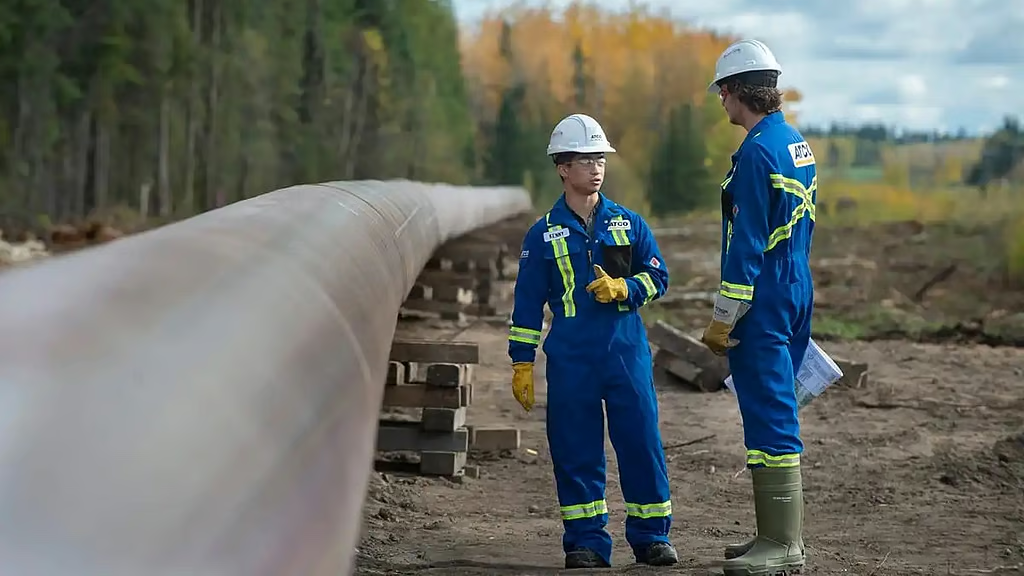
Can a New Pipeline Revitalize Canada’s Struggling Economy?
The question hangs in the air like the scent of pine and uncertainty across much of Canada. As headlines chronicle rising living costs, housing unaffordability, and lagging productivity, a familiar, yet contentious, proposal often resurfaces as a potential economic engine: the construction of new energy pipelines. The debate is more than just steel and bitumen; it’s a fundamental conversation about Canada’s economic identity, environmental responsibilities, and path to future prosperity.
The Economic Crossroads: Stagnation vs. Strategic Investment
Canada’s economy faces a complex set of challenges. While certain sectors show resilience, broader indicators point to stagnation relative to global peers. Sluggish GDP growth, declining business investment per capita, and a worrying erosion of competitiveness have become persistent themes in financial analyses. The “Marriott Canada” metaphor, referencing the hotel chain’s recent corporate restructuring in the country, has been used by some commentators as a symbol of this broader trend—a perception that Canada is becoming a less attractive place for major capital investment and corporate expansion.
In this context, proponents of pipeline development argue that such projects represent a direct injection of precisely what the economy needs:
- Multi-Billion Dollar Capital Investments: A major pipeline is not just a ditch in the ground. It represents years of engineering, manufacturing, and construction, funneling billions into domestic companies and creating a web of economic activity.
- High-Skilled Job Creation: From welders and engineers to environmental monitors and project managers, pipelines generate thousands of well-paying jobs during construction and hundreds more in ongoing operations and maintenance.
- Accessing Global Markets: Canada’s energy resources are landlocked. New export capacity, particularly to tidewater, is seen as critical for fetching world prices for Canadian products, boosting government royalties, and improving the national trade balance.
- Catalyzing Related Industries: The ripple effects extend to steel manufacturing, transportation, tech services, and local businesses in communities along the route.
The Counterargument: Environmental Costs and a Changing World
Opposition to new pipeline infrastructure is equally passionate and grounded in several key concerns. Critics argue that doubling down on fossil fuel infrastructure is a profound strategic error for several reasons.
The primary contention is environmental. New pipelines facilitate the expansion of the oil sands, Canada’s fastest-growing source of greenhouse gas emissions. In an era of binding climate commitments and the urgent need to transition to a low-carbon economy, locking in decades of additional emissions is seen as irresponsible. Furthermore, the risk of spills—whether during construction or operation—poses a direct threat to pristine ecosystems, waterways, and Indigenous lands.
Beyond ecology, there is a powerful economic counter-narrative. It suggests that the world is undergoing a fundamental energy transition. Global capital is increasingly flowing toward renewable energy, electrification, and green technology. The argument follows that investing billions in a sunset industry risks creating “stranded assets” and misses the opportunity to position Canada as a leader in the economy of the future—in sectors like critical minerals, hydrogen, carbon capture, and clean tech.
The Indigenous Rights Dimension
No discussion about resource development in Canada is complete without addressing the central role of Indigenous communities. The legacy of past projects imposed without consent has created deep-seated mistrust. Today, the success or failure of any major project is inextricably linked to meaningful consultation, partnership, and ensuring that Indigenous communities see clear, equitable benefits. Some communities see pipelines as a vital source of employment, revenue, and self-determination, while others view them as a direct threat to their cultural survival and treaty rights. This is not a monolithic issue, but a complex tapestry of perspectives that must be respectfully navigated.
Case Study: The Lingering Shadow of Trans Mountain
The saga of the Trans Mountain Expansion (TMX) project serves as a microcosm of this entire national debate. Originally proposed over a decade ago, the project has been a rollercoaster of federal approvals, court challenges, changing governments, and ballooning costs—from an estimated $7.4 billion to over $34 billion.
Its eventual completion demonstrates that a pipeline can be built in modern Canada, but the TMX story also highlights the immense hurdles:
- Prolonged regulatory and legal uncertainty that deters investment.
- Skyrocketing costs that can undermine the very economic case for the project.
- The intense polarization it creates within the public and political spheres.
For pipeline advocates, TMX is a cautionary tale of how difficult Canada has made it to build major projects. For opponents, it is proof of a robust democratic and legal system that ultimately forces greater environmental and social accountability.
Beyond the Binary: Is There a Third Path?
Framing the issue as a simple choice between “pipeline prosperity” and “green transition” may be a false dichotomy. The most pragmatic path forward likely involves a nuanced approach that acknowledges current economic realities while aggressively building the future.
This could mean:
- Responsibly managing and optimizing existing energy assets to fund the transition, using the revenues to invest massively in renewable energy grids, technology innovation, and worker retraining programs.
- Streamlining approval processes for all major projects—green and traditional—to provide certainty, but within a framework that has stringent, non-negotiable environmental and Indigenous partnership standards.
- Recognizing that Canada’s economic strength has always been resource-based, but redefining “resources” to include intellectual capital, clean technology, and the critical minerals essential for batteries and solar panels.
The Verdict: A Catalyst, But Not a Cure-All
So, can a new pipeline revitalize Canada’s struggling economy? The answer is neither a simple yes nor no.
A major pipeline project, under the right conditions of social license and economic viability, can provide a significant, short-to-medium term economic stimulus. It can create jobs, generate government revenue, and improve export margins. In a time of economic softness, that injection should not be dismissed lightly.
However, it is not a long-term revitalization strategy. True, sustainable revitalization requires a broader, more visionary economic plan. It requires creating an environment where businesses of all types—from tech startups to manufacturing plants—want to invest and grow. It demands policies that boost productivity, encourage innovation, and build the infrastructure (digital and physical) for a 21st-century economy.
The pipeline debate, at its core, forces Canada to answer a deeper question: Will we navigate the transition from our resource-rich past to a innovative, sustainable future by clinging to the familiar, or by having the courage to invest boldly in what comes next? The most likely formula for success lies not in choosing one over the other, but in crafting a deliberate, balanced strategy that leverages today’s strengths to finance and build tomorrow’s.

