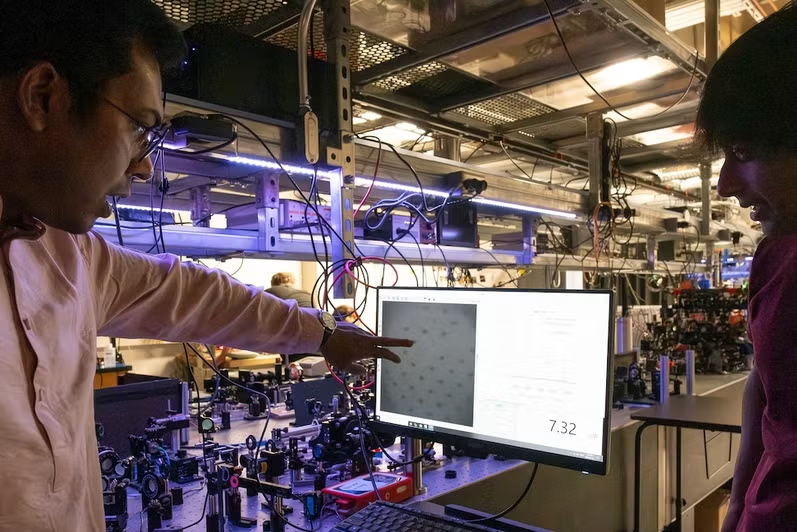
New Federal Investment Accelerates Canadian Quantum Technology & Innovation
Canada’s quantum sector has reached a pivotal moment. With the announcement of new federal funding directed at quantum research and commercialization, the country is positioning itself as a global leader in this transformative field. The investment, channeled through programs like the Strategic Innovation Fund and the Natural Sciences and Engineering Research Council (NSERC), is designed to bridge the gap between foundational quantum science and tangible, market-ready technologies.
This article dives into what this funding means for Canada’s quantum ecosystem, the specific areas receiving support, and why this matters for the broader economy and global competitiveness.
A Strategic Injection of Capital for Quantum R&D
The latest round of federal funding is not a small, incremental bump. It represents a deliberate, multi-year commitment to reinforce Canada’s strengths in quantum computing, sensing, and communication. The University of Waterloo’s Institute for Quantum Computing (IQC) is a central beneficiary, but the ripple effects will be felt across the entire Canadian innovation landscape.
The funding targets several critical gaps that have historically slowed the transition from laboratory experiments to commercial products:
- Infrastructure modernization: Upgrading cleanrooms, cryogenic systems, and fabrication facilities to support next-generation quantum processors.
- Scalable qubit platforms: Prioritizing silicon-based qubits, photonic systems, and superconducting architectures that can realistically scale beyond a few dozen qubits.
- Error correction and control electronics: Developing the classical hardware and software needed to make fragile quantum states useful for real calculations.
- Talent retention and recruitment: Creating industry-relevant training positions to keep top PhDs and engineers in Canada rather than losing them to Silicon Valley or Europe.
Quantum Computing Hardware: From Lab Bench to Chip Fab
One area receiving a significant share of the fund is the development of fault-tolerant quantum computers. While “quantum advantage” demonstrations have been made using noisy intermediate-scale quantum (NISQ) devices, the true value lies in building systems that can run long, error-corrected algorithms.
Researchers at IQC, in collaboration with industrial partners such as Quantum Valley Investments and Xanadu Quantum Technologies, are pushing the boundary of photonic and silicon quantum dot technologies. The federal funding will allow these teams to:
- Construct new prototype chips using advanced CMOS-compatible processes, reducing the cost and complexity of manufacturing.
- Invest in high-fidelity gate operations that push error rates below the threshold for surface code error correction.
- Develop modular interconnects that allow small quantum processors to be linked together, a key requirement for scaling.
The expertise built at Waterloo for the past two decades is now being translated into semiconductor fabrication recipes that could eventually be adopted by Canada’s domestic foundries, creating a homegrown supply chain for quantum components.
Quantum Sensors: Harnessing Fragile States for Real-World Impact
While quantum computing grabs headlines, quantum sensing is arguably closer to near-term commercial deployment and just as crucial. Federal funding is also flowing into detection technologies that exploit entangled states and superposition for unprecedented measurement precision.
Canadian teams are developing:
- NV-center diamond magnetometers for medical imaging and mineral exploration.
- Atomic interferometers that can detect minute gravitational variations, useful for geophysical surveys and navigation in GPS-denied environments.
- Quantum-enhanced LIDAR that operates at single-photon levels, enabling autonomous vehicles and environmental monitoring with significantly lower power requirements.
These sensor systems do not require the same massive infrastructure as a general-purpose quantum computer. They can be engineered into portable, ruggedized units, and the federal investment is helping to accelerate the transfer of these prototypes from university labs to spin-off companies.
Strengthening the Canadian Quantum Ecosystem
Funding hardware and sensors is only half the battle. The true strength of a national quantum strategy lies in the ecosystem that supports it – the collaborations, the talent pipeline, and the regulatory framework that allows innovation to flourish.
This new funding explicitly addresses the people and partnerships side of the equation. The federal government has earmarked a portion of the funds for:
Talent Pipeline and Educational Infrastructure
Canada already produces some of the world’s best quantum scientists, but many have traditionally left for positions at Google AI Quantum, IBM, or Amazon Web Services. To counteract this brain drain, the funding provides:
- Expanded graduate scholarships and postdoctoral fellowships specifically tied to quantum industry projects, ensuring students gain hands-on experience with real systems.
- New specialized lab courses at the undergraduate level, equipping the next generation with skills in cryogenics, microwave engineering, and quantum control.
- Internships and co-op placements at partner companies like D-Wave Systems, Rigetti Canada, and Photonic Inc., so that academic research directly feeds into commercial pipelines.
Industry Partnerships and Commercialization Pathways
Federal dollars are also creating dedicated technology transfer offices and “quantum hubs” that connect researchers with investors and end-users. The goal is to compress the typical 10-to-15-year cycle from discovery to product.
Key initiatives include:
- Joint venture funds where government matches private investment for early-stage quantum startups, de-risking the venture for venture capital firms.
- Standards and certification bodies that develop testing protocols for quantum hardware, making it easier for industries like aerospace and finance to adopt the technology with confidence.
- Open-access testbeds at IQC and partner institutions where small and medium enterprises (SMEs) can test algorithms and sensors without building their own laboratories.
This ecosystem approach ensures that breakthroughs don’t remain locked behind university paywalls or academic publications. Instead, they are actively channelled into companies that create high-value jobs and export revenue.
Global Implications and Canadian Leadership
The global race for quantum supremacy is not just about computing speed. It is about national security, economic competitiveness, and technological sovereignty. Countries like the United States, the United Kingdom, Germany, and China are all pouring billions into their quantum initiatives. Canada, with a comparatively smaller population and GDP, cannot match those total numbers dollar-for-dollar.
However, Canada’s strategic advantage lies in focus and excellence. The federal funding announced now is designed to double down on the areas where Canada already leads: photonic quantum computing, silicon-based qubits, and quantum cryptography.
Moreover, this investment reinforces the collaboration between academia and industry that has been the hallmark of Canada’s tech success stories, from BlackBerry to Shopify to the quantum sector today. With the new funding, researchers at IQC and across the country can push the technology readiness level (TRL) of their innovations from 3–4 (proof of concept) to 6–7 (demonstrated in relevant environment) – precisely the range where private investors become comfortable.
The Road Ahead: What This Means for 2025 and Beyond
The federal government’s commitment signals that quantum technology is no longer a speculative, futuristic endeavour. It is a strategic priority with immediate practical consequences. This funding will support:
- The deployment of the first Canadian quantum network for secure communications, linking research nodes in Waterloo, Vancouver, and Montréal.
- Demonstration of a 100+ logical qubit processor with error correction by the end of 2027.
- A ten-fold increase in the number of quantum-trained engineers entering the Canadian workforce each year.
Of course, challenges remain. Quantum systems are extraordinarily sensitive, requiring ultra-low temperatures and extreme isolation from noise. The engineering required to turn a delicate quantum state into a reliable product is Herculean. But with sustained federal support – both in capital and in policy – Canada has the talent, the infrastructure, and the determination to meet those challenges head-on.
The Institute for Quantum Computing at the University of Waterloo has been the seed crystal of this entire ecosystem. This new funding ensures that that crystal can grow into a robust, self-sustaining industry that benefits the entire country. For investors, researchers, and policymakers alike, the message is clear: Canadian quantum tech is not just coming – it is already here, and it is accelerating.
—
*This analysis draws on public announcements from Innovation, Science and Economic Development Canada and the University of Waterloo’s Institute for Quantum Computing. For further details on specific projects and grant recipients, visit the official IQC news portal.*