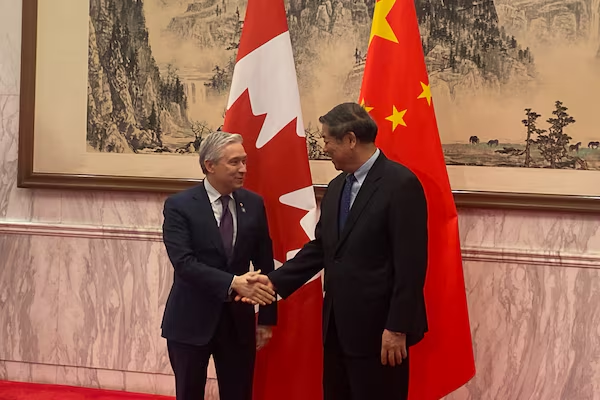
Canada’s Trade Strategy: Deepening Financial Ties with China
In a world of shifting geopolitical alliances and economic uncertainty, nations are constantly reassessing their trade playbooks. For Canada, a country historically tethered to its southern neighbor, the path forward increasingly involves looking across the Pacific. A recent and significant signal of this shift came from Innovation, Science and Industry Minister François-Philippe Champagne, who articulated a clear vision: enhancing financial trade with China is not an isolated goal, but a cornerstone of a broader, more resilient economic diversification strategy.
This move represents a nuanced and pragmatic approach to one of the world’s largest economies. It’s about more than just exporting commodities; it’s about building a sophisticated financial bridge that can support a wider range of Canadian businesses and sectors for decades to come.
Why Financial Services Are the New Frontier in Canada-China Relations
For years, the Canada-China trade relationship has been characterized by a straightforward flow: Canadian natural resources heading to China, and manufactured goods coming back. While this has been economically beneficial, it is also inherently limited and volatile, subject to the swings of global commodity prices.
Minister Champagne’s focus on the financial sector aims to transcend these limitations. But why financial services?
- Stability and High Value: Financial trade—encompassing banking, insurance, fintech, asset management, and green finance—deals in services, not physical goods. This sector offers higher-margin, recurring revenue streams and is less susceptible to supply chain disruptions.
- Enabling Broader Commerce: Robust financial linkages make all other trade easier and safer. Improved cross-border banking, currency swaps, and investment protections lower the risk for Canadian companies, from agri-tech startups to clean energy firms, looking to enter the Chinese market.
- Canadian Competitive Advantage: Canada boasts a globally respected, stable, and well-regulated financial sector. Our expertise in areas like pension fund management and sustainable finance is a significant export product in itself.
The Core Rationale: Diversification as Economic Security
The subtext of this strategy is one word: diversification. The COVID-19 pandemic and recent periods of trade tension have painfully highlighted the risks of over-reliance on any single trading partner. While the United States will remain Canada’s closest ally and largest trading partner, economic resilience demands a wider network.
Deepening financial ties with China, alongside efforts in the Indo-Pacific and with European partners, is about building a balanced portfolio. It’s economic risk management on a national scale. By creating multiple, deep channels for investment and commerce, Canada insulates itself from shocks in any one region and secures more optionality for its businesses.
Key Pillars of the Enhanced Financial Partnership
Turning this strategic vision into reality will require focused effort on several fronts. The framework likely involves a multi-pronged approach designed to build mutual trust and open practical pathways for capital and services.
1. Facilitating Investment and Market Access
A primary goal is to make it smoother for Canadian financial institutions to operate in China and vice versa, within a clear regulatory framework. This could involve:
- Negotiating improved market access for Canadian banks, insurance companies, and fintech firms.
- Working towards mutual recognition of certain financial regulations and standards.
- Encouraging Chinese investment in Canadian infrastructure and technology projects, providing capital for growth while offering stable returns.
2. Championing Fintech and Green Finance Innovation
This is where Canada’s innovation agenda directly meets trade policy. Canada can position itself as a partner of choice in two cutting-edge areas:
- Fintech Collaboration: Partnering on digital payments, blockchain applications, and regulatory technology (Regtech).
- Green Finance Leadership: With China as the world’s largest renewable energy market, there is immense potential for Canadian expertise in green bonds, ESG (Environmental, Social, and Governance) investing, and financing the transition to a low-carbon economy.
3. Strengthening the Institutional Framework
Sustainable partnerships are built on strong foundations. Key to this will be:
- Potentially expanding the Canada-China Foreign Investment Promotion and Protection Agreement (FIPA) to cover financial services more comprehensively.
- Enhancing dialogue between regulators like the Office of the Superintendent of Financial Institutions (OSFI) and their Chinese counterparts to ensure stability and transparency.
- Promoting the use of local currency (RMB) settlement for trade to reduce exchange rate risks and costs for businesses.
Navigating the Challenges: A “Prosperity and Protection” Stance
Minister Champagne’s announcement is not made in a vacuum. It acknowledges the complex landscape of engaging with China. The strategy implicitly follows a “prosperity and protection” model, where economic opportunities are pursued without compromising on core national interests.
This means the pursuit of deeper financial trade will be carefully calibrated alongside:
- Protecting National Security: Scrutinizing investments in critical sectors and ensuring the integrity of Canada’s financial system.
- Upholding Democratic Values: Continuing to advocate for human rights and rule of law within the context of the bilateral relationship.
- Managing Geopolitical Tensions: Navigating the delicate balance between China and other key partners, particularly the United States.
The path forward is not about choosing sides, but about making smart, principled, and independent economic decisions for Canada’s long-term benefit.
The Road to 2026 and Beyond
The reference to 2026 is not arbitrary. It sets a tangible horizon for this strategy to take shape and begin yielding results. By focusing on the financial sector—a high-value, enabling industry—Canada is laying the groundwork for a more mature and multifaceted economic relationship with China.
For Canadian businesses, the message is clear: the toolkit for engaging with the Asia-Pacific is being expanded. The government is working to build the financial rails that will make it safer and more profitable to explore opportunities in the world’s second-largest economy.
Ultimately, Canada’s move to deepen financial ties with China is a forward-looking bet on complexity and connection. It recognizes that in the 21st century, economic strength is derived not from dependence, but from a diversified network of strong, interconnected relationships. By investing in the financial architecture of trade today, Canada is seeking to secure its prosperity and resilience for the decades to come.