Canada and China Strengthen Supply Chain Resilience in Key Talks
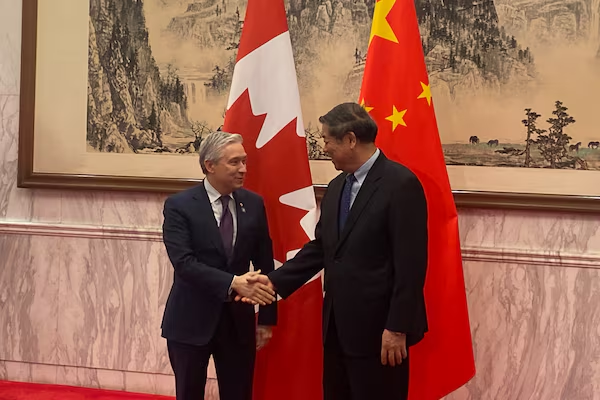
In an era defined by global economic uncertainty and geopolitical shifts, the resilience of international supply chains has become a paramount concern for nations worldwide. Recognizing this critical need, high-level diplomatic discussions are increasingly focused on fostering stability and cooperation. A recent high-stakes meeting between Canadian Finance Minister Chrystia Freeland and Chinese Vice Premier He Lifeng in Beijing has underscored a shared commitment to this very goal. The talks, centered on enhancing the integrity and reliability of bilateral trade networks, mark a significant step in navigating the complex economic relationship between the two Pacific nations.
A Strategic Dialogue for Economic Stability
The meeting between Minister Freeland and Vice Premier He Lifeng was more than a routine diplomatic exchange; it was a strategic dialogue aimed at addressing one of the most pressing challenges in the post-pandemic global economy: supply chain vulnerability. As major trading partners, both Canada and China have felt the ripple effects of disruptions, from port congestion to material shortages. These issues have highlighted an urgent need to build systems that are not only efficient but also durable and transparent.
For Canada, a nation rich in natural resources and agricultural products, secure and predictable access to the vast Chinese market is crucial. Conversely, China relies on stable imports of Canadian commodities like canola, potash, and lumber. The discussion, therefore, served as a platform to align priorities and explore concrete measures to fortify these commercial arteries against future shocks. This move towards collaborative resilience is a pragmatic approach, acknowledging deep economic interdependence while seeking to mitigate shared risks.
Key Pillars of Supply Chain Integrity Discussed
While the full details of the private discussions remain confidential, the emphasis on “supply chain integrity” points to several foundational areas of mutual interest. The dialogue likely encompassed strategies to enhance predictability, security, and sustainability in cross-border trade.
1. Enhancing Predictability and Reducing Bureaucratic Friction
A primary focus was undoubtedly on smoothing the logistical and administrative pathways for goods. This involves:
- Improving customs coordination and standardization of procedures to accelerate the clearance of goods.
- Promoting greater use of digital documentation and data-sharing to increase visibility and traceability for shipments.
- Addressing non-tariff barriers that can unpredictably delay trade, ensuring a more rules-based and consistent trading environment.
2. Building Security and Diversification
The concept of integrity also implies security and reducing over-concentration in critical sectors. The ministers likely explored:
- Collaborative efforts to identify and protect critical minerals and other strategic resources vital for technology and green energy sectors.
- Encouraging investments that diversify supply routes and production capabilities, making the overall network less susceptible to single points of failure.
- Discussing frameworks for secure trade in sensitive technologies, balancing economic opportunity with national security considerations.
3. Advancing Sustainable and Ethical Trade
Modern supply chain integrity increasingly includes environmental and social governance. The talks may have touched on:
- Aligning standards for sustainable sourcing, particularly for forestry and agricultural products, which are key Canadian exports.
- Promoting trade in green technologies and services that support both countries’ climate goals.
- Upholding internationally recognized labor standards within supply chains.
The Broader Context: Navigating a Complex Relationship
This meeting did not occur in a vacuum. The Canada-China relationship has faced significant strains in recent years, from diplomatic disputes to concerns over foreign interference. Minister Freeland’s trip, which also included a meeting with U.S. Treasury Secretary Janet Yellen, reflects Canada’s careful balancing act: deepening necessary economic cooperation with China while firmly aligning with its Western allies on security and values.
The discussion on supply chains represents a channel of pragmatic engagement. It is an area where mutual interest is clear and tangible progress can benefit both economies, potentially creating a stabilizing effect on the broader relationship. By focusing on the technical and operational aspects of trade, both sides can build a foundation of cooperation that may foster better communication on more challenging issues.
Implications for Businesses and the Global Economy
For businesses operating between Canada and China, these high-level talks are a positive signal. A commitment to supply chain integrity translates to:
- Reduced Operational Risk: Fewer unexpected delays and disruptions mean more reliable planning and lower costs.
- Increased Investment Clarity: A more predictable trade environment can encourage long-term cross-border investments in logistics, manufacturing, and infrastructure.
- New Market Opportunities: Collaboration on green and digital trade can open doors for companies specializing in sustainable technologies and advanced logistics solutions.
On a global scale, this bilateral effort contributes to the wider movement of “de-risking” rather than decoupling. It demonstrates that major economies can work constructively to reinforce the multilateral trading system by making specific linkages more robust, transparent, and rules-based.
The Path Forward: From Dialogue to Action
The true measure of success for the Beijing talks will be in the follow-up. The commitment to supply chain integrity must now be translated into actionable policies and joint initiatives. This could involve:
- Establishing a dedicated bilateral working group on supply chain issues.
- Launching pilot projects for digital trade documentation on key routes.
- Developing early-warning systems to jointly monitor and respond to potential disruptions.
A Necessary Step in Uncertain Times
The meeting between Finance Minister Freeland and Vice Premier He Lifeng signifies a mature and pragmatic approach to international economic relations. In choosing to prioritize the complex but essential issue of supply chain resilience, Canada and China have identified a common ground that serves their national interests and contributes to global economic stability. While challenges in the relationship persist, this focus on building tangible, system-level cooperation is a constructive path forward. As both nations work to implement the spirit of these discussions, businesses and consumers can hope for a future of trade that is not only prosperous but also more secure and resilient against the unforeseen storms of the global economy.