
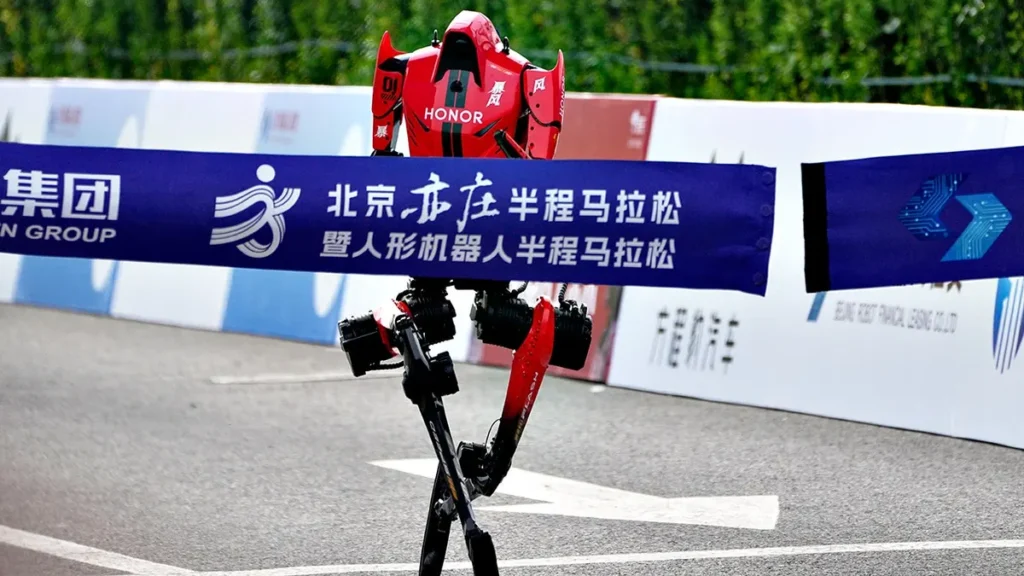
Human vs. Machine: The Groundbreaking Robot Marathon That Redefined Racing in China
The image of a marathon is timeless: the pounding of feet on pavement, the rhythm of breath, the sheer human will pushing against physical limits. But at a recent marathon in China, that classic scene was joined by a new, whirring competitor. In a world-first event that felt ripped from the pages of science fiction, autonomous humanoid robots lined up alongside elite athletes, not as tools or gimmicks, but as genuine participants in a groundbreaking race.
This wasn’t just a publicity stunt. It was a bold, public experiment at the intersection of advanced robotics, artificial intelligence, and human athleticism, signaling a future where machines step out of factories and into the complex, unpredictable world alongside us.
Beyond the Factory Floor: Robots Enter the Human Arena
For years, humanoid robots have been confined to controlled laboratory environments or performing repetitive industrial tasks. Their movement has often been rigid, slow, and unstable. The challenge of navigating a real-world environment—with its uneven surfaces, unexpected obstacles, and dynamic conditions—has been a monumental hurdle.
This marathon changed that narrative. The event, held in China, served as a high-stakes proving ground for bipedal robot technology. Organizers and engineers aimed to test core capabilities in an extreme setting:
- Dynamic Stability and Locomotion: Could the robots maintain balance and a steady gait over 26.2 miles of varied terrain?
- Advanced Sensor Fusion: How would they process real-time data from cameras, LiDAR, and inertial sensors to “see” the course and other runners?
- Energy Efficiency and Endurance: Marathon running is as much about energy management as speed. Could robotic systems optimize power consumption to last the distance?
- Autonomous Decision-Making: In a crowded field, the robots had to make split-second navigation choices without human intervention.
The Race Itself: A Tale of Two Competitors
As the starting gun fired, the contrast was stark. Human runners, a blend of muscle, instinct, and years of training, surged forward with fluid grace. The robots, with their distinctive mechanical gaits and whirring joints, moved with determined precision. They weren’t trying to mimic human running perfectly; they were executing their own optimized form of bipedal movement.
The humans, of course, possessed significant advantages in speed and agility. The elite runners quickly pulled ahead. However, the robots’ achievement wasn’t about winning in a traditional sense. Their victory was in successfully completing a task of unprecedented duration and complexity. While human runners listen to their bodies, the robots were engaged in a constant, invisible calculation: adjusting servo torque, redistributing weight, and plotting the most efficient path forward.
Why a Marathon? The Deeper Significance of the Challenge
You might wonder why organizers chose a marathon, of all events, to showcase robotics. The answer lies in the unique demands of the race. A sprint is about pure power and acceleration. A marathon is a holistic test of resilience, strategy, and systems integration.
- The Endurance Factor: It pushed the limits of battery technology and mechanical wear-and-tear in a way a short demo never could.
- Unpredictable Environment: Unlike a track, a city marathon course has curves, hills, bridges, and potentially changing weather, requiring continuous adaptation.
- Crowd Navigation: Moving safely among thousands of human runners is a profound challenge in social robotics and obstacle avoidance.
- A Symbolic Benchmark: The marathon distance is iconic. For a robot to cover it autonomously is a powerful milestone, akin to the first time a self-driving car navigated city streets.
This event was less about sports and more about stress-testing the core technologies that will enable the next generation of helper robots—those that may one day assist in disaster response, elderly care, or complex logistics in human spaces.
The Human Element: Collaboration, Not Just Competition
While framed as a race, the deeper story was one of collaboration. The human runners were, in effect, live data points and dynamic obstacles for the robots’ AI systems. The event provided invaluable real-world data that engineers could never replicate in a lab. Every avoided collision, every adjusted stride on a slope, and every mile completed added to a crucial dataset for improving robotic mobility.
Furthermore, it sparked a global conversation. It forced us to re-examine the very nature of physical achievement and competition. If a machine can complete a marathon, what does that mean for the human spirit we celebrate in athletics? The consensus leans not toward replacement, but inspiration. Just as pacemakers and advanced shoes enhance human performance, these robots represent a parallel track of technological achievement that highlights the incredible capabilities of both human and artificial design.
The Road Ahead: What This Means for the Future of Robotics
The success of China’s robot marathon is a watershed moment. It proves that humanoid robots are transitioning from research prototypes to platforms capable of operating in our world. The implications are vast and stretch far beyond the finish line.
- Accelerated Innovation: The public, high-profile nature of the challenge will drive investment and focus in robotics labs worldwide, accelerating progress in actuators, batteries, and AI navigation.
- New Applications: The technologies refined here will directly benefit robots designed for dangerous environments like nuclear decommissioning, firefighting, and deep-space exploration.
- Everyday Assistance: The ability to walk stably for long periods is fundamental for a robot that might work in a warehouse, hospital, or home.
- The Next Race: It sets a clear benchmark. The question is no longer “Can they do it?” but “How fast can they become?” Future events may see dedicated robot divisions with increasingly competitive times.
The marathon, a test of human limits since ancient Greece, has found a new purpose in the 21st century. It has become a measuring stick for silicon and steel. As the robots crossed the finish line in China, they did more than complete a race; they crossed a threshold into a new era of embodied AI. The race between human and machine is not a zero-sum game. It is a shared journey, pushing both biology and engineering to remarkable new places. The next lap in this ongoing race promises to be even more extraordinary.

