
Why China’s EV Giants Conquer the Globe But Stall at America’s Shores
If you have traveled anywhere outside North America in the last two years, you have witnessed a transformation that feels almost sudden. The taxis in Bangkok hum silently. The delivery vans in Berlin carry unfamiliar badges. The family sedans in São Paulo look like nothing sold in your local dealership.
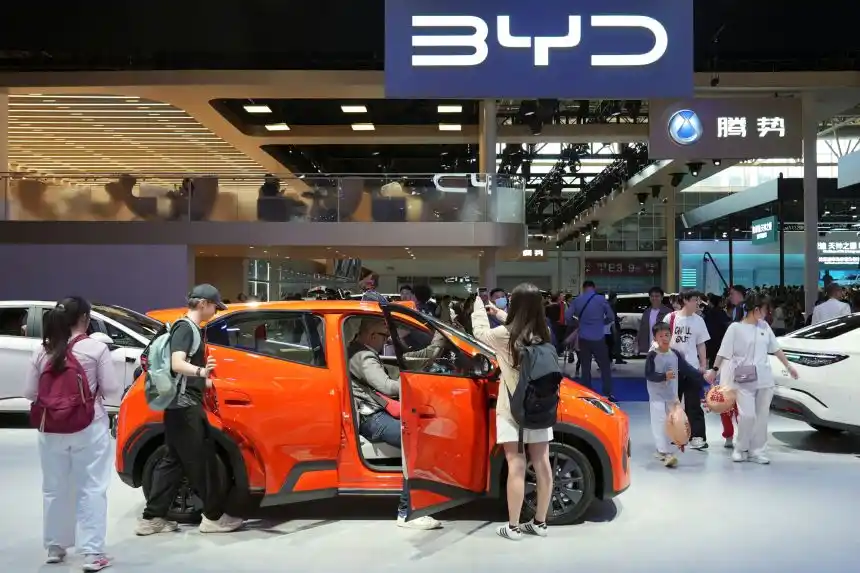
What you are seeing is the Chinese electric vehicle industry in full flight. Brands like BYD, NIO, SAIC Motor, and Geely have executed the most rapid automotive expansion in modern history. They did not just enter the global market. They took over entire segments of it.
Yet, for all their ambition and technological muscle, these same companies remain almost invisible in the United States. A Chinese EV on an American highway is still a rarity—a curiosity spotted perhaps at a trade show or in the hands of an importer. The contrast between their global conquest and their American absence is one of the most fascinating economic stories of this decade.
Let’s examine how Chinese automakers achieved worldwide dominance and why the U.S. market remains the one prize they cannot seem to claim.
The Engine of Global Domination
To understand the scale of this shift, look at the numbers. China exported over 1.2 million vehicles in 2023 alone, with the majority being electric or plug-in hybrid models. That figure surpassed Japan’s exports for the first time in history. China is now the world’s largest car exporter.
This was not accidental. It was the result of a deliberate, state-supported strategy that combined manufacturing scale, battery technology supremacy, and aggressive pricing.
Vertical Integration That Western Rivals Cannot Match
The critical advantage Chinese EV makers hold is not design or software alone. It is battery control. BYD, for example, manufactures its own batteries in-house. This allows them to control the single most expensive component of an EV—typically 30 to 40 percent of the vehicle cost—while their Western competitors purchase batteries from suppliers like CATL, LG, or Panasonic.
This vertical integration creates a cost structure that legacy automakers simply cannot replicate without years of investment. A BYD Seagull, a small electric hatchback, sells for roughly $11,000 in China. No profitable Western manufacturer can match that price point today.
Speed to Market and Product Diversity
Chinese automakers refresh their models every 18 to 24 months. The traditional three-to-four-year cycle common in Detroit and Stuttgart is considered glacial by Shenzhen standards. This rapid iteration allows Chinese brands to introduce new features, battery chemistries, and manufacturing efficiencies at a pace that leaves competitors scrambling.
- Affordable commuters: Models like the Wuling Mini EV (a joint venture with GM) sold for under $5,000 in China.
- Luxury performance: NIO delivers battery-swapping technology and premium interiors that rival Mercedes and BMW.
- Commercial vehicles: SAIC and BYD now dominate electric bus and truck fleets across South America and Africa.
No segment has been left untouched.
The Fortress America: Why the U.S. Remains a Wall
Given this momentum, one might expect Chinese EVs to flood American dealerships. They do not. The reasons are layered, rooted in policy, geopolitics, and consumer psychology.
The 100 Percent Tariff Barrier
The most immediate and effective obstacle is the Section 301 tariff imposed under the Trump administration and largely retained by the Biden administration. Chinese-built passenger vehicles entering the United States face a 27.5 percent tariff. This effectively eliminates any price advantage a Chinese EV might have.
Compare this to Europe, where tariffs on Chinese EVs are around 10 percent. There, Chinese automakers can still compete on price while absorbing the tariff. In the United States, the tariff is punishing enough to destroy the cost proposition entirely.
The Inflation Reduction Act’s Surgical Exclusion
Beyond tariffs, the Inflation Reduction Act (IRA) contains provisions that specifically exclude vehicles with Chinese battery components from the $7,500 federal tax credit. This is a deliberate industrial policy move. It channels consumer dollars toward domestic or allied supply chains while starving Chinese imports of subsidy support.
Even if a Chinese automaker built a factory in Mexico (and BYD has explored this possibility), vehicles assembled there would still fall under scrutiny if their battery supply chain runs through China. The IRA creates a regulatory moat that is difficult to cross.
National Security and Data Privacy Concerns
The third barrier is less tangible but equally formidable. American lawmakers from both parties have expressed concerns about data security in connected Chinese vehicles. Modern EVs are effectively data centers on wheels. They collect location data, driving patterns, biometric information, and video footage.
The fear is that this data could be transmitted to the Chinese government under the country’s intelligence laws. In 2023, the Biden administration opened an investigation into whether Chinese connected vehicles pose a national security risk. The mere threat of a ban or restriction makes automakers hesitant to invest heavily in the U.S. market.
Consumer Recognition and Trust
Finally, there is the soft barrier of brand perception. Chinese automakers have a reputation problem in the United States that does not exist in Southeast Asia or Latin America. American consumers are skeptical of quality, reliability, and safety standards from brands they do not recognize. Building a dealership network, service infrastructure, and brand trust from zero is a multi-billion-dollar undertaking that takes a decade or more.
What The American Market Is Missing
The irony is that American consumers are the ones losing out. The intense competition among Chinese EV makers has driven innovation and price reduction that the U.S. market has not experienced.
- Battery swapping: NIO’s stations replace a depleted battery in under five minutes—faster than filling a gas tank.
- Solid-state battery prototypes: Chinese companies are racing to commercialize solid-state technology years ahead of Western timelines.
- Ultra-fast charging: BYD’s latest platform can add 200 miles of range in 15 minutes at compatible chargers.
None of this technology is currently available to American buyers through official channels.
The Geopolitical Standoff
This is not simply a business story. It is a reflection of the broader U.S.-China rivalry. The American approach to Chinese EVs mirrors the approach to Huawei in telecommunications and TikTok in social media: a combination of tariffs, national security arguments, and supply chain decoupling.
The Chinese response has been to double down on markets where they are welcome. Southeast Asia, the Middle East, Africa, South America, and even parts of Europe have become priority export destinations.
BYD is building factories in Thailand, Brazil, Hungary, and Indonesia. They are building the infrastructure for global dominance while the U.S. market remains isolated.
What Comes Next
The trajectory is clear. Chinese EVs will continue to expand their global footprint. They will dominate markets where price sensitivity is high and tariff barriers are low. The United States will face a choice in the coming years.
One path is to continue the current protective posture, accepting that American consumers will pay higher prices for domestically aligned vehicles while Chinese brands grow stronger elsewhere. The other path is to force a competitive response—either by attracting Chinese automakers to build factories on American soil under strict compliance regimes, or by allowing controlled imports through negotiated trade agreements.
Neither option is easy. But the status quo is not static. Every month that passes, Chinese automakers gain more scale, more data, and more manufacturing expertise. The gap in EV production costs between China and the United States is not shrinking. It is widening.
The global auto industry has already changed. The United States can decide whether to participate in that change or watch it happen from behind a tariff wall.

