Ebola Returns to the DRC: Why the WHO Just Declared a Global Health Emergency
The World Health Organization has pulled a trigger that global health experts hoped would remain untouched for years. The current Ebola outbreak in the Democratic Republic of the Congo has escalated to the highest possible alert status: a Public Health Emergency of International Concern (PHEIC).
This is not bureaucratic theater. This is the fourth time in modern history that the WHO has invoked this designation for an Ebola virus. The decision signals that something fundamental has changed on the ground—and that the window for containment is narrowing.
What a PHEIC Actually Means for Global Health Security
There is widespread confusion about what a global health emergency declaration accomplishes. Travel bans dominate public conversation, but those are precisely what the WHO advises against. A PHEIC is a coordination mechanism, not a lockdown order.
When the Director-General declares a PHEIC, three things happen immediately:
- International funding streams unlock. Donor governments and multilateral institutions can release emergency funds without waiting for separate legislative approvals.
- Supply chains accelerate. Vaccine manufacturers, pharmaceutical companies, and logistics providers prioritize the affected region for resources that would otherwise take weeks to arrive.
- Bureaucratic barriers drop. Health workers, laboratory equipment, and investigational treatments cross borders faster because customs and regulatory agencies receive a directive to expedite.
The real purpose is speed. In an Ebola outbreak, every hour of delay costs lives—and increases the probability that the virus establishes a foothold beyond the current epicenter.
The Perfect Storm: Why This Outbreak Is Different
Eastern DRC is not a typical outbreak setting. The region has been a conflict zone for decades, and that reality now dictates the trajectory of the epidemic.
The Zaire Strain Returns
Laboratory confirmation has identified the Zaire ebolavirus as the causative agent. This is the same strain that devastated West Africa between 2014 and 2016, killing over 11,000 people. However, there is a critical distinction: we now have a licensed vaccine and experimental therapeutics that did not exist during that catastrophe.
The question is whether we can deliver them in time.
Urban Transmission Changes Everything
The virus has reached a densely populated urban center. When Ebola operates in remote, isolated villages, containment follows a predictable pattern. Urban transmission rewrites the playbook entirely.
High population density, informal housing with shared sanitation, and public transportation networks create conditions where contact tracing becomes exponentially more difficult. One unidentified case in a market or a bus station can generate dozens of secondary infections before symptoms appear.
Armed Conflict Disrupts Response
This is the factor that most alarms field epidemiologists. Health workers cannot safely enter communities controlled by armed groups. Contact tracing teams face ambush risks. Rumors and misinformation spread faster than public health messaging when trust in government institutions is already fractured.
The DRC has dealt with Ebola before. It has never dealt with Ebola while simultaneously managing active military operations in the same territory.
Vaccination: Our Best Tool Faces Brutal Logistics
The rVSV-ZEBOV vaccine is remarkably effective. Clinical trials conducted during previous outbreaks demonstrated near-complete protection after a single dose. But vaccines do not work if they remain frozen in a warehouse.
The cold chain requirement for this vaccine is strict: storage temperatures must remain between -60°C and -80°C. In a region where electricity grids fail daily, maintaining that temperature across hundreds of kilometers of unpaved roads is a logistical nightmare.
Mobile cold storage units exist, but they are expensive and limited in quantity. The WHO is now scrambling to deploy enough units to cover the geographic spread of suspected cases.
Cross-Border Contamination Is the Real Nightmare Scenario
The DRC shares borders with Rwanda, Uganda, and South Sudan. These are porous borders with heavy civilian traffic. People cross for markets, family visits, and medical care every single day.
The WHO is not yet recommending travel restrictions. In fact, the agency has explicitly stated that border closures would likely backfire by driving travelers underground, where they would avoid screening altogether.
Instead, the strategy focuses on:
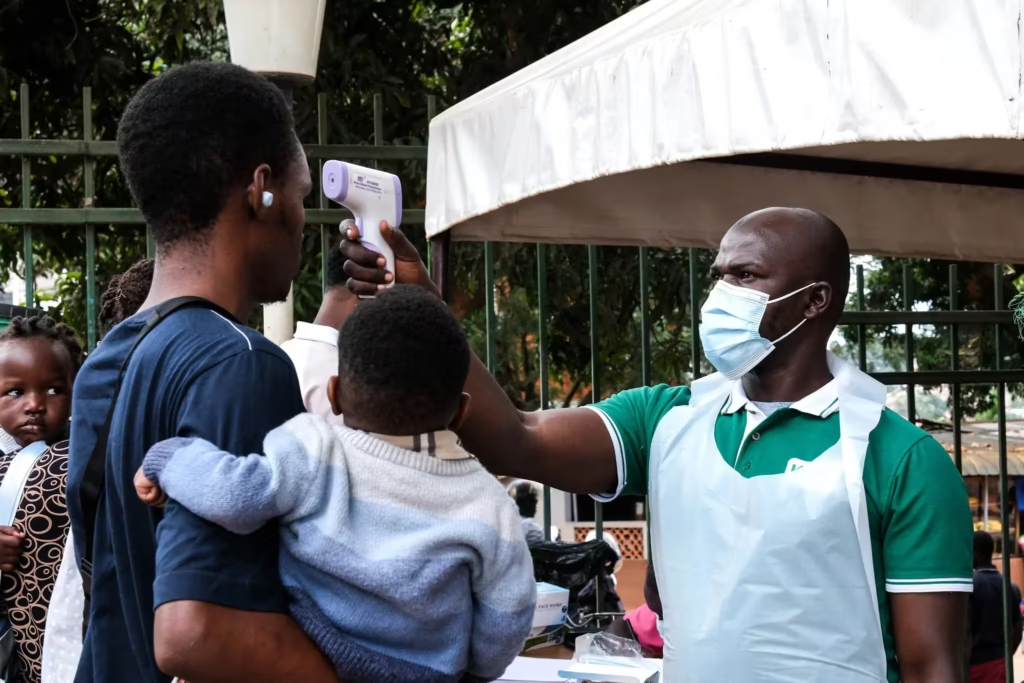
- Enhanced surveillance at official border crossings with thermal screening and symptom questionnaires
- Community surveillance programs in border towns that rely on local health workers who already know their populations
- Pre-positioning of vaccine doses in neighboring countries so that ring vaccination can begin immediately if a case crosses
The goal is containment within the DRC. That goal is achievable, but it requires resources that have not yet fully arrived.
What This Means for the Rest of the World
For individuals outside central Africa, the immediate risk remains extremely low. Ebola does not transmit through the air. It requires direct contact with bodily fluids from a symptomatic patient.
However, the declaration serves as a reminder that infectious diseases do not respect borders. The 2014 West Africa outbreak demonstrated that a single undetected case on an international flight can spark a multi-country response.
International airports are now on heightened alert. Passengers arriving from affected regions will face screening protocols. This is routine, not alarming.
The Science Is Ready. The Question Is Politics.
We have the tools to stop this outbreak cold. The vaccine works. The treatments work. The diagnostic tests can identify cases within hours.
What remains uncertain is whether the international community will commit the resources necessary to deploy those tools in a conflict zone. History offers mixed evidence. Previous PHEIC declarations have generated surges of funding, but they have also triggered stigma and discrimination against travelers from affected countries.
The bottom line is straightforward: containment depends on reaching every contact, vaccinating every ring, and earning the trust of communities that have every reason to be suspicious of outsiders. That takes money, personnel, and time.
The WHO has sounded the alarm. Now the world must answer.