
Israeli Soldier’s Vandalism of Sacred Jesus Statue Sparks Outrage and Condemnation
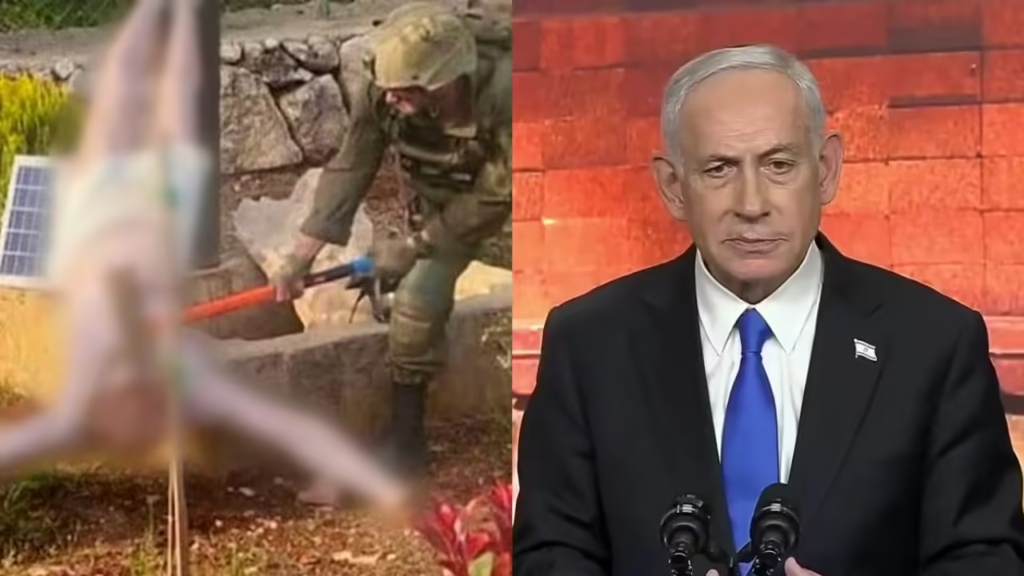
A shocking act of vandalism by an Israeli soldier against a revered religious statue in Lebanon has ignited a firestorm of criticism, drawing condemnation from the highest levels of the Israeli government and deepening concerns over military discipline. The incident, captured on video, shows a soldier using a rock to smash the head of a statue of Jesus Christ outside a church in the border village of Deir Mimas. This violation of a sacred space has transcended geopolitical tensions, touching a raw nerve and prompting a swift official response.
The Incident: A Moment of Sacrilege Captured on Camera
The event occurred during an Israeli military operation in southern Lebanon. A group of soldiers was filmed near the Saint Charbel Church, a Maronite Catholic site. In the widely circulated footage, one soldier is seen picking up a large rock, walking toward a white statue of Jesus with outstretched arms, and deliberately striking the statue’s head, which then falls to the ground. The soldier then makes a hand gesture to the camera.
This act was not part of any military objective. It was a standalone act of disrespect that immediately reverberated beyond the remote village. The statue, a symbol of faith and solace for the local Christian community, was desecrated in a moment that laid bare a severe breach of protocol and human decency.
Immediate Repercussions and Official Responses
The backlash was swift and severe. Israeli Prime Minister Benjamin Netanyahu publicly condemned the soldier’s actions, stating the behavior was “contrary to the values of the Israel Defense Forces (IDF).” He emphasized that the soldier would face disciplinary measures, signaling the gravity with which the government viewed the incident.
The IDF’s response followed a similar tone:
- The military issued a formal apology, calling the soldier’s actions “shameful and disgraceful.”
- They confirmed the incident was under investigation by the Military Police.
- The soldier was immediately suspended from operational duty pending the outcome of the inquiry.
- The IDF reiterated its commitment to “upholding international law and respecting the sites and beliefs of all religions.”
Broader Implications: More Than Just Vandalism
While the physical damage to the statue is reprehensible, the implications of this event stretch far further. It strikes at several critical issues currently surrounding the IDF and Israel’s standing on the world stage.
1. Military Discipline and “Norms-Breaking” Behavior
This incident did not happen in a vacuum. It comes amid ongoing, fierce criticism of the IDF’s conduct in Gaza, with allegations of widespread civilian casualties and destruction. Analysts and military ethicists point to this act of vandalism as a potential symptom of a deeper issue—a erosion of discipline and a culture where “norms-breaking” behavior can occur. When soldiers operate for extended periods in high-stress, hostile environments without clear red lines being enforced, acts that would be unthinkable in other contexts can surface. This event raises urgent questions about the training and oversight of troops, especially in sensitive areas involving religious and cultural sites.
2. Fueling Regional and Religious Tensions
Lebanon, and particularly its southern border region, is a fragile mosaic of religious communities. Deir Mimas is a historically Christian village. An attack on a Christian symbol by an Israeli soldier risks inflaming sectarian sentiments and could be exploited by hostile actors to paint Israel’s actions as a war against religions, not just militant groups. It undermines Israel’s efforts to maintain a distinction between Hezbollah—the Iranian-backed militant group it is fighting—and the broader Lebanese civilian population. The Lebanese government and Christian leaders denounced the act as a “flagrant violation” of sanctity, further complicating an already volatile border situation.
3. A Public Relations Disaster
In the arena of global public opinion, the visual of a soldier destroying a Jesus statue is devastating. It provides a simple, emotionally charged narrative that opponents can use to discredit the IDF and, by extension, Israel’s broader military campaigns. It overshadows complex security justifications and reduces the discourse to an image of sacrilege. For Israel’s allies, particularly in the West where Christian communities are influential, it creates an uncomfortable diplomatic rift and demands forceful condemnation.
Historical Context and the Sanctity of Religious Sites
The IDF has a documented doctrine for protecting holy sites during conflict, rooted in both military ethics and practical desire to avoid unnecessary conflict. Past operations have often included coordination with religious authorities to secure churches, mosques, and synagogues. This incident represents a stark violation of that core principle. Historically, attacks on religious symbols are seen as particularly egregious war crimes, as they target the cultural and spiritual heart of a community. The soldier’s actions, therefore, touch on a fundamental tenet of international law and the laws of armed conflict.
Path Forward: Accountability and Healing
The immediate path forward hinges on transparent accountability. The IDF’s investigation must be thorough and its consequences meaningful. This will be closely watched by the international community and the people of Lebanon. Beyond punishment, there are calls for:
- Formal reparations: The Israeli government or IDF funding the restoration of the damaged statue.
- Enhanced training: Implementing mandatory, reinforced training for all soldiers on the protection of cultural property and religious sites, with clear and severe penalties for violations.
- Dialogue: Opening a channel with local religious leaders in Lebanon to express regret directly and work to rebuild a shred of trust.
Conclusion: A Stain That Demands Cleansing
The vandalism of the Jesus statue in Deir Mimas is a profound tragedy. It is a story of one soldier’s reckless act that wounded a community, embarrassed a nation, and provided ammunition to its foes. While Prime Minister Netanyahu’s condemnation was necessary, words are not enough. This moment serves as a critical juncture for the IDF to examine the culture within its ranks and reassert the sacred principles of discipline and respect that must guide any moral army. For the people of Deir Mimas, the shattered statue is a physical wound in their landscape of faith. How Israel chooses to atone will determine whether this incident becomes a forgotten footnote or a lasting stain on its record. The restoration of stone is possible; the restoration of trust will be a far greater challenge.

