
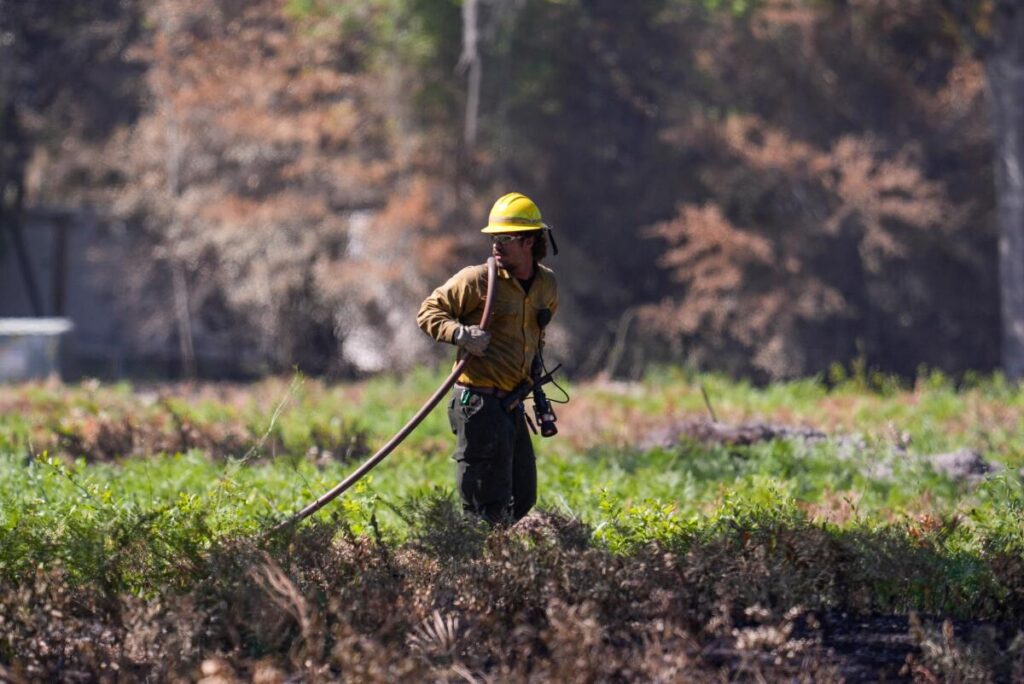
Tragedy on the Front Lines: Florida Firefighter Killed, 120 Georgia Homes Lost in Massive Wildfires
The relentless wildfire season has claimed its first major casualties, leaving a Florida firefighter dead and more than 120 homes reduced to ash in southern Georgia. What began as a dry spell has escalated into a humanitarian and environmental crisis, forcing emergency crews into desperate, round-the-clock battles against flames that show no sign of slowing.
A Hero Lost: Remembering the Fallen Firefighter
In the midst of the chaos, a Florida firefighter—deployed to assist neighboring Georgia—tragically lost his life while combating the blaze. Officials have not yet released his name pending family notification, but tributes are already pouring in from fire departments across both states. His death is a stark reminder of the immense risks these men and women take every time they suit up.
Firefighters work in blistering heat, choking smoke, and unpredictable wind shifts. One moment they are containing a line, the next they are surrounded by towering walls of fire. This tragedy underscores that no amount of training fully prepares a crew for the raw fury of a wind-driven wildfire.
The Human Cost of Wildfire Response
- Deployed firefighters often travel far from home to assist other states
- Shift lengths can exceed 48 hours in extreme conditions
- Mental and physical exhaustion compounds the danger
- Support networks for families remain critical during deployment
The Georgia Destruction: 120 Homes Gone
While the firefighter’s death cuts deepest, the scale of property loss is staggering. Over 120 homes in rural Georgia have been completely destroyed, displacing hundreds of families. Entire neighborhoods are unrecognizable—foundations blackened, trees stripped of their bark, and vehicles melted into puddles of twisted metal.
Emergency shelters have been set up in nearby towns, but many residents are struggling to process the sudden loss of everything they owned. Local churches and community centers are collecting donations of clothing, food, and toiletries for those who escaped with little more than the clothes on their backs.
What Survivors Need Most Right Now
- Temporary housing and hotel vouchers
- Clothing, shoes, and toiletries
- Pet food and supplies for evacuated animals
- Financial assistance for immediate expenses
- Mental health counseling for trauma
Why These Wildfires Are Growing So Fast
Climate conditions are fueling this disaster. Drought has gripped the region for weeks, turning forests and grasslands into tinder. Combined with low humidity and gusty winds, even a small spark—whether from a downed power line or human carelessness—can explode into a major blaze within minutes.
Unlike Western wildfires that often burn in remote mountains, these Southeastern fires are burning in the wildland-urban interface, where homes are scattered among pine forests and scrublands. That makes containment vastly more difficult and dangerous.
Key Factors Driving the Blazes
- Prolonged drought across southern Georgia and northern Florida
- Wind gusts exceeding 30 miles per hour
- Dense underbrush acting as natural fuel
- Low relative humidity drying out vegetation
- Limited water sources in rural fire zones
What Is Being Done Now
More than 500 firefighters from Florida, Georgia, and federal agencies are now deployed. Air tankers are dropping retardant, helicopters are making water drops, and ground crews are carving firebreaks with bulldozers. Still, officials warn that containment may take weeks, especially if dry weather persists.
Evacuation orders remain in effect for several communities, and smoke advisories have been issued for cities as far away as Jacksonville and Tallahassee. Residents are urged to keep go-bags packed and stay tuned to local alerts.
Current Response Resources on the Ground
- Type 1 Incident Management Team coordinating strategy
- National Guard helicopters for aerial water drops
- Mobile command centers for real-time mapping
- Medical triage units for injured firefighters and civilians
- Animal rescue teams for livestock and pets
How You Can Help
Even if you are miles away from these flames, your support matters. Consider donating to the Georgia Red Cross or local firefighter charities. Many funds have been set up specifically to support the families of the fallen firefighter and the displaced homeowners.
Every dollar helps a grieving family, a burned-out community, or the exhausted crews still on the front lines.
Ways to Contribute
- Donate to the Georgia Firefighters Fund
- Volunteer at local evacuation shelters
- Drop off supplies at designated collection points
- Share verified fundraising links on social media
- Write letters of support to deployed fire crews
Final Thoughts
Wildfires don’t respect state lines. A Florida firefighter gave his life in Georgia, and 120 American families have been left homeless. This is a shared tragedy that reminds us how fragile our safety can be when nature turns violent.
Stay safe, stay informed, and if you can—help those who are now fighting to rebuild from ashes. The road to recovery will be long, but with community support and continued firefighting efforts, these devastated areas can rise again.
Have you been affected by these wildfires? Share your story in the comments below, or email us to let us know how your community is coping.

