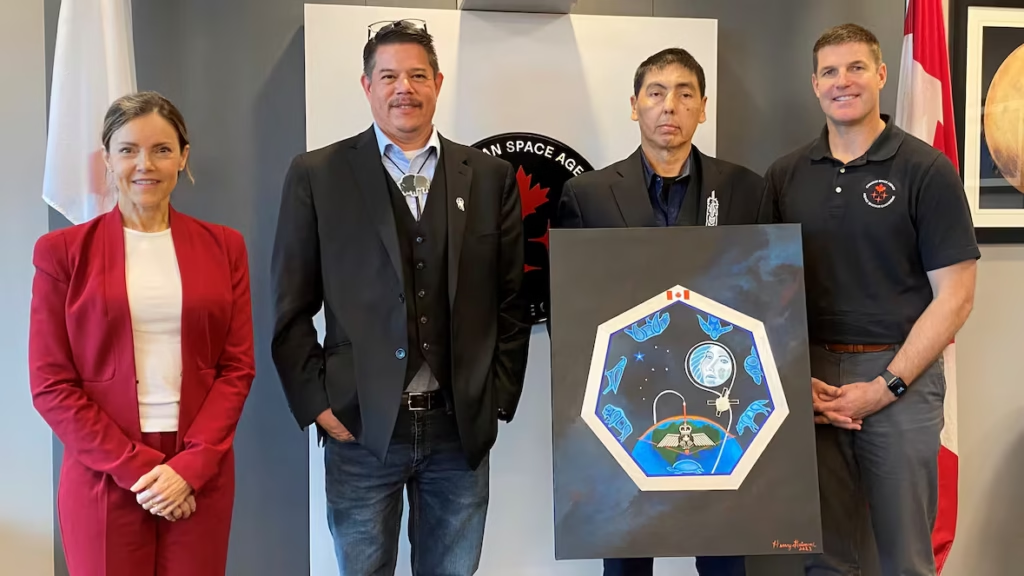
Indigenous Artist Designs Space Patch for Canada’s Artemis II Astronaut
In a powerful fusion of ancestral knowledge and cosmic ambition, a First Nations artist from Manitoba has created a symbol that will journey around the Moon. Anishinaabe painter Henry Guimond has been chosen to design the official mission patch for Canadian astronaut Jeremy Hansen, who will fly on NASA’s historic Artemis II mission. This marks the first time an Indigenous artist has been commissioned for such a task, weaving the rich tapestry of Canada’s First Peoples into the fabric of deep space exploration.
A Canvas of Culture and Cosmos
Guimond, a member of the Sagkeeng First Nation, was approached by the Canadian Space Agency (CSA) to translate profound themes of connection, Earth stewardship, and shared human destiny into a single, iconic emblem. The resulting patch is far more than a simple logo; it is a visual story, deeply rooted in Indigenous worldview.
At its heart, the design features a central circle representing Mother Earth, viewed from the unique perspective of space. Flowing from it are seven strands of hair, merging into the roots of a tree. This powerful imagery is drawn from the tragic legacy of residential schools, specifically honoring the children who never returned home. Guimond transforms this symbol of loss into one of enduring connection and remembrance, suggesting that from the roots of our shared history, growth and strength can emerge—even reaching for the stars.
Symbolism Stitched into Space
Every element of Guimond’s patch is meticulously chosen, creating layers of meaning that resonate across cultures:
- The Eagle Feather: Cradling the Earth is a white eagle feather, a sacred item in many Indigenous cultures representing truth, honesty, and a clear perspective. It signifies the clarity of vision from space, looking back at our fragile planet.
- The Seven Grandfather Teachings: The seven hair strands also embody these essential Anishinaabe principles: Love, Respect, Courage, Honesty, Wisdom, Humility, and Truth. They are the guiding values for the mission and for humanity.
- Celestial Guardians: The Northern Lights (Aurora Borealis) and the Moon itself are depicted, acknowledging their significance in Indigenous storytelling and navigation. They serve as celestial guides for the journey.
- Unified Orbit: Encircling the main imagery is a ring of 13 stars, symbolizing the 13 moons in an annual lunar cycle and the continuous, unifying orbit of the Artemis II spacecraft.
More Than Art: A Step Toward Reconciliation
The commissioning of an Indigenous artist for a flagship national project is a significant act. It moves beyond tokenism, representing a tangible step in Canada’s journey toward reconciliation. It acknowledges that Indigenous knowledge systems—which have long observed and understood celestial patterns—have a vital place in modern science and exploration.
For Guimond, the project carried immense personal and cultural weight. “It’s about bringing our stories, our perspectives, into a realm where we haven’t been represented before,” he shared. The patch ensures that as the Orion spacecraft ventures farther than any human-rated craft has ever gone, it carries with it the spirit, history, and resilience of the First Peoples of the land now called Canada.
Jeremy Hansen’s Personal Connection
Astronaut Jeremy Hansen, who will wear the patch on his spacesuit, has spoken passionately about its meaning. He sees it as a direct link between his mission and the country he represents. For Hansen, the design is a constant reminder of the responsibility to look after one another and our planet, a lesson powerfully evident when viewing Earth from the void of space.
“This patch tells a story,” Hansen said, “a Canadian story that includes our past, acknowledges truth, and points us toward a future where we explore space together, guided by timeless teachings.”
The Artemis II Mission: A Historic Flight
Artemis II is the first crewed mission of NASA’s Artemis program, which aims to return humans to the Moon and establish a sustainable presence there. Slated to launch no earlier than September 2025, the mission will see Hansen and three NASA astronauts—Reid Wiseman, Victor Glover, and Christina Koch—orbit the Moon, testing systems for future lunar landings. Hansen’s role makes him the first Canadian ever to travel to lunar space.
The inclusion of this uniquely Canadian and Indigenous-designed patch underscores a broader shift in space exploration: the recognition that venturing into the cosmos is not just a technological endeavor, but a deeply human one. It asks us to consider who we are and what values we carry with us as we become an interplanetary species.
A Legacy Woven in Thread and Thought
Henry Guimond’s Artemis II patch is more than an embroidered insignia. It is a bridge between Earth and sky, between ancient wisdom and futuristic vision. It challenges the narrative of space exploration as a purely Western achievement, instead positioning it as a collective human journey enriched by diverse perspectives.
When the Artemis II crew lifts off from Kennedy Space Center, they will carry a piece of Manitoba, a piece of Anishinaabe culture, and a powerful message of remembrance and responsibility. In the silent expanse between worlds, the patch will serve as a silent ambassador, telling a story of connection that began long before the rocket’s ignition and will endure long after its engines fall silent. It reminds us that as we reach for the Moon, we must never lose sight of our roots, our shared home, and the teachings that can guide us toward a better future, both on Earth and among the stars.