Canada’s 2026 Economic Start Defies Expectations With Steady Growth
The opening months of 2026 have delivered a welcome and somewhat unexpected narrative for the Canadian economy. Against a backdrop of persistent global uncertainty and lingering domestic challenges, early data suggests the nation’s economic engine is humming with a resilience that has caught many forecasters off guard. Rather than stalling, the economy appears to be navigating a path of steady, measured growth, defying the gloomier predictions that had dominated headlines just months prior.
This positive surprise offers a crucial moment of stability and a potential inflection point. It suggests that the combined effects of monetary policy, consumer adaptation, and strategic sectoral performance are creating a more durable foundation than previously assumed. Let’s delve into the key drivers behind this encouraging start to the year.
The Pillars of Surprising Resilience
The economy’s performance isn’t being powered by a single, overheated sector. Instead, it’s a story of broad-based stability across several key areas, each contributing to a stronger-than-anticipated whole.
Consumer Spending Refuses to Crumble
A primary driver of the surprise has been the enduring strength of the Canadian consumer. Despite higher costs of living and elevated interest rates, household spending has remained remarkably robust in select areas.
- Services Lead the Charge: Spending on travel, dining, and entertainment has continued to recover and solidify, indicating a strong consumer desire for experiences and a normalization of post-pandemic behavior.
- Strategic Discretionary Spending: While big-ticket item purchases may be subdued, consistent spending on smaller comforts and non-essential goods has provided a steady flow of economic activity.
- Labor Market Cushion: A still-tight labor market, with wage growth finally outpacing inflation in many sectors, has provided households with the confidence and means to continue spending, acting as a critical buffer.
Housing Market Finds a Tentative Floor
The housing sector, a perennial focus and source of volatility, has shown signs of stabilizing rather than collapsing. This has been a significant factor in shifting economic sentiment.
- Sales Activity Thaws: After a prolonged slowdown, sales activity in key markets has begun to pick up, suggesting pent-up demand is starting to engage with adjusted price expectations.
- Construction Adaptation: While not booming, residential construction has adjusted to the new rate environment, with a focus on multi-unit projects helping to sustain industry activity and related employment.
- Stability Breeds Confidence: The mere avoidance of a sharp correction has alleviated fears of a wealth-effect-driven consumer pullback, contributing to a more positive overall economic mood.
Export Sectors Benefit from Diversification and Demand
Canada’s export portfolio is showing its strengths, particularly as global supply chains continue to evolve and demand for certain commodities remains firm.
- Energy Sector Steadiness: While not at the record highs of previous years, stable global energy prices have provided consistent revenue and investment flow into the sector.
- Critical Minerals Momentum: Strategic focus and international demand for Canadian critical minerals (like lithium, cobalt, and nickel) are translating into increased project development and export potential, fueling regional growth.
- U.S. Economic Resilience: The surprising durability of the U.S. economy, Canada’s largest trading partner, has provided a reliable source of demand for a wide range of Canadian goods and services.
Navigating the Persistent Headwinds
While the start of 2026 is encouraging, it is not a declaration that all challenges have vanished. The economy’s “steady growth” is occurring within a context of ongoing constraints that require careful navigation.
The high cost of borrowing remains a reality for both businesses and homeowners, dampening investment ambitions and limiting large-scale consumer purchases. Furthermore, productivity growth continues to be a long-standing concern, with questions about whether current growth is sustainable without significant gains in output per worker. Geopolitical tensions and global economic fragmentation also pose persistent risks to the export-dependent components of Canada’s growth.
Implications for Policy and the Road Ahead
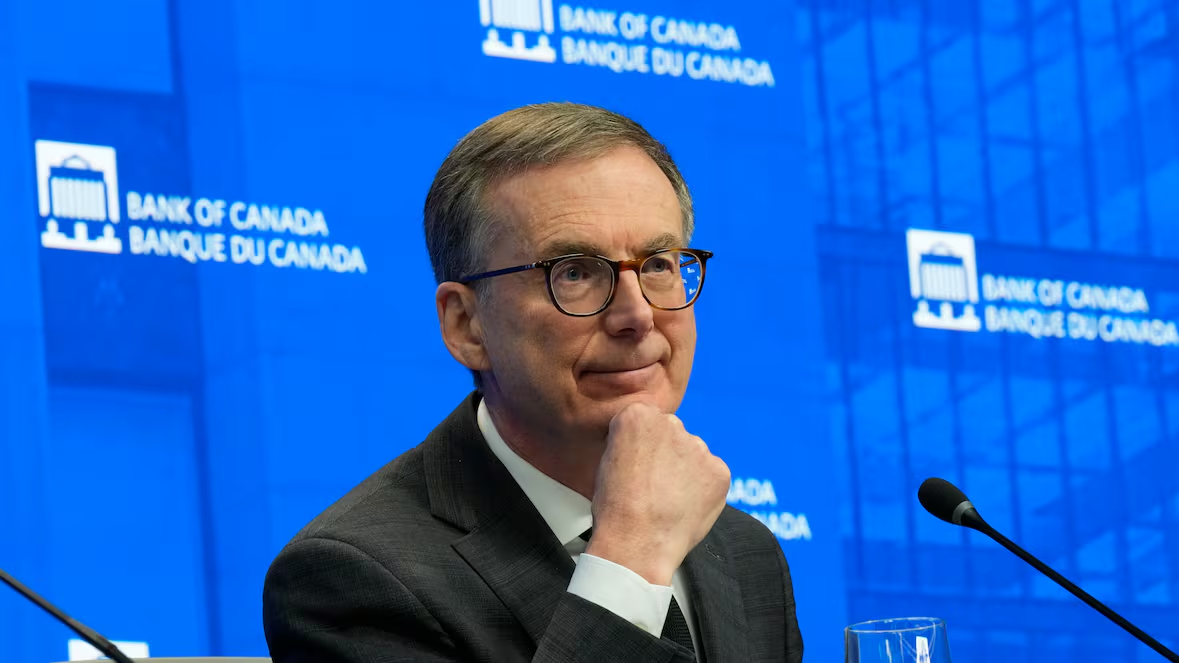
This unexpected resilience presents a complex picture for policymakers. The Bank of Canada, which had been poised to continue a cautious easing cycle, may now have more room to assess incoming data. The economy’s ability to absorb higher rates without buckling suggests the soft landing scenario is increasingly plausible.
For businesses, the environment signals a period of stability rather than boom or bust. This could encourage more strategic, long-term planning and investment, particularly in areas aligned with the green transition and technological adoption. For households, it offers a sigh of relief and a more stable platform for financial planning, though budget consciousness remains essential.
Sustainable Growth or a Temporary Reprieve?
The critical question now is whether this positive start is the beginning of a sustainable growth phase or a temporary plateau before challenges reassert themselves. The answer likely lies in the evolution of several factors:
- Inflation’s Last Mile: Can progress on inflation continue, allowing for real income growth to strengthen further?
- Business Investment: Will stable conditions finally translate into a meaningful uptick in business investment and productivity-enhancing capital spending?
- Global Economic Health: Can key international economies, particularly the U.S., maintain their stability?
A Cautiously Optimistic Outlook
The first act of 2026 has rewritten the expected script for the Canadian economy. Defying predictions of stagnation, the data points to an economy demonstrating notable resilience and capacity for steady growth. This is not a return to the breakneck expansion of past decades, but rather the emergence of a more mature, stable, and diversified economic rhythm.
While significant headwinds persist and vigilance is required, the surprising strength at the start of the year provides a valuable foundation of confidence. It suggests the Canadian economy has built up more internal shock absorbers than many believed, setting the stage for a year defined not by downturn, but by managed, sustainable growth and the cautious optimism that comes with it. The coming months will be crucial in determining if this promising start can be converted into a lasting trend.