
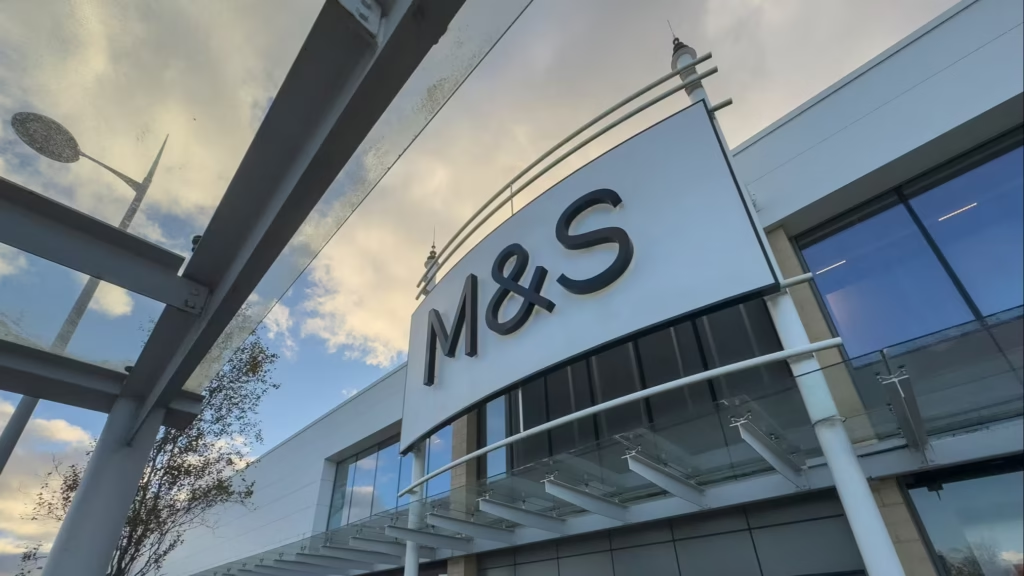
M&S Calls for Increased Police Funding as Protests Impact High Street Retail
The smooth operation of Britain’s bustling high streets and retail hubs is a delicate ecosystem, one that recent waves of activist demonstrations have thrown into sharp relief. In a significant move highlighting the growing concern within the retail sector, Marks & Spencer (M&S) has publicly demanded that police forces across the UK be given the necessary resources to effectively manage protests that disrupt business and public safety. This call to action follows specific incidents where retail operations, including those of M&S, were severely impacted by activist groups, raising urgent questions about the balance between the right to protest and the right to trade.
The High Street on the Front Line: When Protests Disrupt Commerce
For decades, the British high street has been more than just a place to shop; it’s a community hub, an employment centre, and a barometer of economic health. However, this environment is increasingly becoming an arena for direct action. Groups targeting various issues, from climate change to international conflicts, have chosen retail districts for high-visibility demonstrations.
While the right to peaceful protest is a cornerstone of democracy, the execution of these protests has sometimes crossed a line. Blockades of store entrances, vandalism, and large-scale gatherings that obstruct thoroughfares have led to significant operational challenges:
- Forced store closures and reduced opening hours for staff and customer safety.
- Disruption to vital supply chain deliveries, affecting stock levels.
- Intimidation of both employees and customers, creating a hostile environment.
- Significant financial losses from lost trading and increased security costs.
For a retailer like M&S, which prides itself on customer service and accessibility, these disruptions strike at the heart of its business model. The company’s statement underscores a sentiment felt by many in retail: that the current framework for policing such events is stretched too thin.
M&S’s Stance: A Plea for Resources and Clarity
M&S’s intervention is notable for its directness. The retail giant is not merely criticising protestors but is pointing its advocacy squarely at the need for systemic support for law enforcement. Their argument is built on a clear premise: police officers need the manpower, legal backing, and strategic resources to pre-empt and manage large-scale disruptions effectively.
This involves several key aspects:
- Proactive Policing: The ability to plan and deploy sufficient officers ahead of known planned actions, rather than a reactive scramble.
- Clear Legal Frameworks: Support for officers in enforcing laws around obstruction, vandalism, and aggravated trespass without ambiguity.
- Protection of Critical Infrastructure: Treating key retail and logistics hubs as vital to community well-being and economic stability.
By framing the issue as one of resource allocation, M&S elevates the conversation beyond a simple business-versus-activist debate. It positions public safety and economic resilience as shared societal priorities that require adequate investment.
The Ripple Effect: Consequences Beyond the Shop Floor
The impact of these disruptions extends far beyond a single day’s sales figures. The repercussions ripple outwards, affecting a wide range of stakeholders.
Employees and Local Communities
Store staff, often on front-line contracts, face uncertainty and stress. Shifts may be cancelled last minute due to closures, affecting livelihoods. Furthermore, local residents and businesses that rely on the footfall generated by major retailers also suffer from the knock-on effect of a deserted high street.
Investor Confidence and the UK Retail Brand
Persistent instability in major shopping areas can erode investor confidence in the UK retail sector. If the world’s premier shopping destinations are seen as regularly inaccessible or chaotic, it damages the country’s brand as a stable and welcoming place to do business.
The Wider Policing Dilemma
Police forces are already under immense pressure, facing complex challenges from cybercrime to community policing. Diverting significant resources to police prolonged protests in city centres inevitably means those resources are not available elsewhere. M&S’s call is, therefore, also a call for a strategic review of how public safety resources are prioritised in an era of frequent public demonstrations.
Finding the Balance: Peaceful Protest vs. Public Nuisance
This situation presents a classic democratic tension. Retailers and police are not seeking to ban protest. Instead, the appeal from M&S highlights the need for a workable balance. Peaceful assembly and free speech must be protected, but not at the unlimited expense of other citizens’ rights to go about their business safely and freely.
Effective policing is the linchpin in maintaining this balance. With proper resources and strategies, police can facilitate lawful protest while preventing the escalation into unlawful disruption. This might involve designated protest areas that don’t choke critical economic arteries, or clearer communication between organisers, authorities, and businesses to minimise unintended consequences.
A Catalyst for Broader Conversation
M&S’s public demand is likely a catalyst for a broader coalition. Other retail chains, hospitality groups, and business improvement districts (BIDs) have undoubtedly faced similar issues but may have lacked a prominent voice to articulate the collective challenge. The move could galvanise wider business community advocacy for a more coherent national strategy.
Ultimately, the health of the high street is a concern for everyone. It provides jobs, services, and social cohesion. Ensuring it remains a safe and accessible space is not just a commercial imperative, but a civic one. By calling for police to be properly resourced, M&S is advocating for a foundational element of that security. The coming months will show whether this call is heeded, and how the UK navigates the complex intersection of activism, commerce, and community life in its public spaces. The stability of our town centres may well depend on it.

