Alberta’s New Bill to Shield Children from Explicit Library Content
In a move sparking intense debate across the province, the Alberta government has introduced new legislation that would grant parents significant control over the library materials their children can access. The proposed Bill 20, the Provincial Priorities Act, includes amendments to the Libraries Act that would fundamentally alter how public libraries operate, framing the changes as a necessary step to protect young minds. Proponents hail it as a victory for parental rights, while critics warn it could lead to censorship, increased bureaucracy, and a chilling effect on the very purpose of public libraries.
Understanding the Core of the Proposed Library Changes
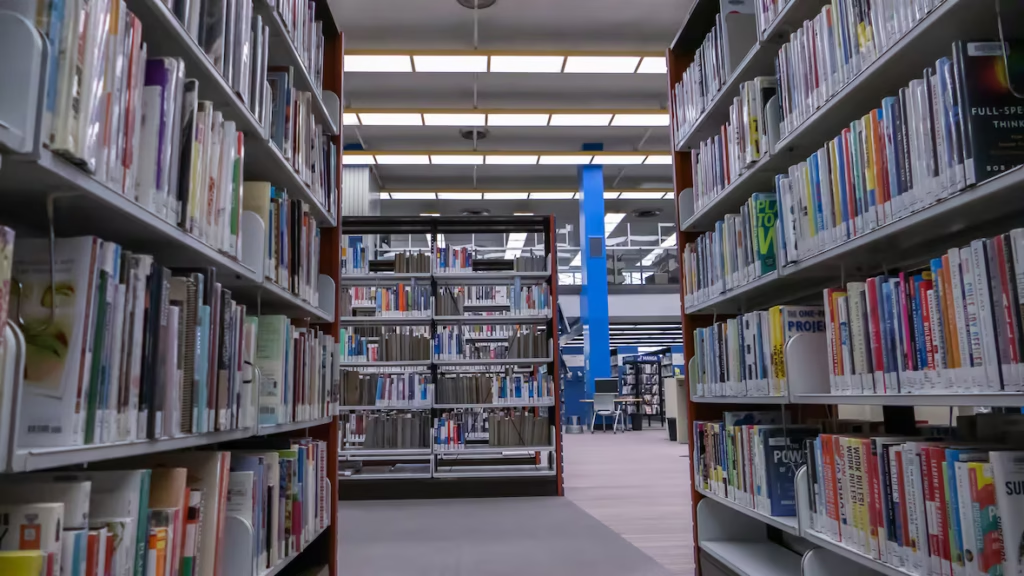
At its heart, the proposed legislation seeks to formalize a system where parental consent is required for a child under 16 to obtain a library card. More controversially, it mandates that all public and municipal libraries in Alberta establish two distinct collections:
- A “Children’s Section”: Curated specifically for those under 18, containing materials deemed age-appropriate.
- An “Adult Section”: Housing all other materials, which would be inaccessible to minors without explicit parental or guardian consent.
This structural division is the government’s primary mechanism to, in their words, “shield children from sexually explicit and graphic content.” The bill would also require libraries to create easily accessible policies on how they select materials and handle complaints, aiming for greater transparency.
The Government’s Rationale: Parental Rights and Protection
The United Conservative Party government, led by Premier Danielle Smith, has positioned this bill as a cornerstone of its commitment to empowering parents. The narrative focuses on giving families the tools to guide their children’s development without government or institutional overreach.
“Parents have the right to decide what their children are exposed to,” has been a consistent refrain from government officials. They argue that the current system is too permissive, potentially allowing children to stumble upon material that is not suitable for their age. The legislation is framed as a common-sense measure to restore primary decision-making authority to the family unit, ensuring that values taught at home are not undermined by unrestricted access at the public library.
A Storm of Criticism: Censorship, Cost, and Core Mandates
The response from library associations, free speech advocates, educators, and opposition parties has been swift and severe. The criticisms are multi-faceted and strike at the core of what public libraries represent.
The Slippery Slope to Censorship
The most potent fear is that this bill opens the door to systemic censorship. Critics ask: Who decides what is “age-appropriate” or “sexually explicit”? Would books dealing with LGBTQ+ themes, puberty, or historical violence be relegated to the adult section? There is a deep concern that the law could be used to marginalize content related to marginalized communities under the vague guise of “protection.”
- Libraries have professional, trained staff who use established review criteria to build collections that serve their entire community.
- Creating a binary “child” and “adult” system ignores the vast spectrum of maturity and need among teenagers, potentially cutting off 15-year-olds from resources for advanced school projects or personal understanding.
Logistical and Financial Nightmares
Beyond ideology, the practical implications are staggering. Public libraries operate on tight budgets. The mandate to physically separate millions of items into two collections would be a colossal and expensive undertaking.
- Smaller, rural libraries would be hit hardest, facing massive costs for new shelving, signage, and potentially even renovations.
- The re-cataloging and re-shelving process would take thousands of staff hours, diverting resources from programs, community outreach, and new acquisitions.
- Enforcement would fall on frontline library workers, putting them in the difficult position of policing access and potentially confronting patrons.
Undermining the Library’s Mission
At its deepest level, opponents argue the bill misunderstands the mission of a public library. Libraries are not merely repositories of books; they are gateways to knowledge, inclusion, and exploration for all citizens.
“Libraries are about equitable access to information,” one critic noted. “This creates a barrier. For some children, the library is their only safe space to explore ideas, understand themselves, or find stories that reflect their own experiences.” There is also significant worry for vulnerable youth who may not have engaged parents to grant consent, effectively locking them out of a vital public resource.
The National Context and Looking Ahead
Alberta’s move does not exist in a vacuum. It echoes similar debates and legislative efforts in other jurisdictions, notably several U.S. states, where “parental rights” bills have led to widespread book challenges and removals. The Alberta bill is being closely watched as a potential precedent for Canada.
As the legislation moves through the committee and debate stages, key questions remain unanswered:
- How will “explicit content” be legally defined to prevent arbitrary application?
- What specific protections will be in place to ensure LGBTQ+ and diverse voices remain accessible to youth?
- Is the government prepared to provide significant funding to libraries to implement these sweeping changes?
The battle lines are drawn. On one side, a government asserting parental authority over children’s intellectual development. On the other, a coalition defending public libraries as open, inclusive, and professionally-managed pillars of a free society. The outcome of this debate will shape not just the shelves of Alberta’s libraries, but the very concept of intellectual freedom and access to information for the next generation of Albertans. The conversation, much like the purpose of a library itself, is now open to the public.