
US Navy Aviator Rescue Ignites Trump’s Fiery Iran Threat
The dramatic rescue of a U.S. Navy aviator from the Gulf of Oman has become the flashpoint for a renewed and intense war of words between Washington and Tehran. The incident, which saw the pilot recovered after ejecting from an F/A-18 Super Hornet, has prompted former President Donald Trump to issue a stark and fiery new threat against Iran, underscoring the ever-present volatility in one of the world’s most critical maritime corridors.
The Incident: A High-Stakes Rescue at Sea
Details emerging from the rescue operation paint a picture of precision and urgency. The aviator was forced to eject from their aircraft over international waters in the Gulf of Oman, a body of water bordering Iran and crucial for global oil shipments. The U.S. Navy’s 5th Fleet, based in Bahrain, swiftly coordinated the recovery effort.
Key elements of the successful mission included:
- The immediate launch of search and rescue assets, including helicopters.
- The pilot was located and safely recovered from the water in a matter of hours.
- Official statements confirmed the aviator was in “good condition” and returned to the USS Dwight D. Eisenhower aircraft carrier.
While the mechanical failure that led to the ejection is under investigation, the geopolitical location of the incident instantly amplified its significance. The Gulf of Oman has been a stage for repeated confrontations, including seizures of vessels and attacks on shipping, often linked to the wider tensions between Iran and the West.
Trump’s Response: A Blunt Warning to Tehran
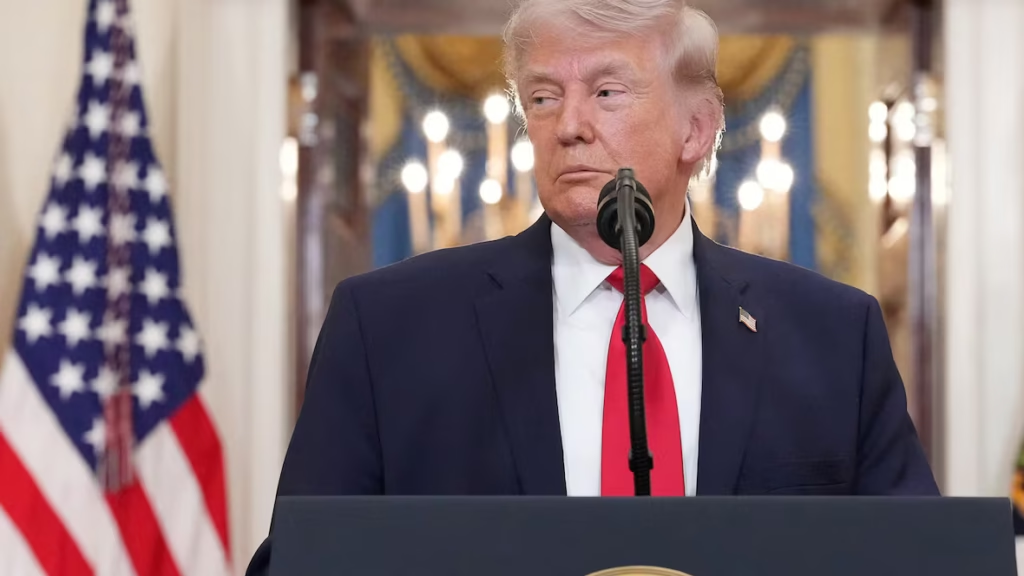
The rescue operation quickly moved from a military news item to a political catalyst when former President Donald Trump seized upon the event. Interpreting the incident through the lens of his “maximum pressure” campaign against Iran, Trump issued a severe public threat.
In his statement, Trump framed the aviator’s presence in the region as a direct result of Iranian aggression, suggesting the pilot was there “to monitor Iran’s hostile activities.” He then delivered a characteristically unambiguous warning: “If Iran dares to strike any of our people or assets, we will respond with a force that is 1,000 times greater.”
This rhetoric marks a significant escalation in Trump’s post-presidency commentary on foreign policy and echoes the tense period following the 2020 U.S. drone strike that killed top Iranian General Qasem Soleimani, which brought the two nations to the brink of direct conflict.
Context: A Long-Simmering Conflict
To understand the weight of this threat, one must look at the persistent undercurrent of hostility. The core tensions stem from:
- Iran’s Nuclear Program: Stalled negotiations and continued uranium enrichment.
- Regional Proxy Warfare: Iran’s support for groups in Yemen, Syria, and Lebanon, which the U.S. and its allies see as destabilizing.
- Maritime Security: Repeated incidents involving commercial shipping and naval vessels in the Persian Gulf and Strait of Hormuz.
The rescue of the Navy pilot, while a routine operation in itself, touched directly on this third and most immediate point of friction, providing a tangible hook for renewed threats.
Analysis: Political Posturing or Prelude to Action?
Security analysts are divided on the immediate implications of Trump’s statement. Some view it primarily as political messaging—a way to reaffirm a tough-on-Iran stance to his domestic base ahead of the election cycle. It draws a clear contrast with the current administration’s more diplomatic, albeit still strained, efforts to manage the relationship.
However, others warn that such public and severe threats, regardless of the speaker’s current office, carry real-world risk. They can:
- Box in political actors, creating public expectations for a forceful response to any future incident.
- Empower hardliners in Tehran who argue that the U.S. only understands the language of force.
- Increase the chance of miscalculation, where a minor altercation could spiral due to heightened alert levels and charged rhetoric.
The Biden administration has maintained a cautious public stance on this specific incident, focusing on the success of the rescue rather than engaging with the provocative rhetoric from the former president.
The Human Element: Training and Preparedness Pay Off
Amid the geopolitical storm, the successful rescue stands as a testament to the skill and readiness of U.S. naval forces. Ejecting from a high-performance aircraft is a traumatic, dangerous event. The rapid location and recovery of the pilot highlight the unparalleled search and rescue (SAR) capabilities maintained by the Navy in these contested waters.
This aspect serves as a silent but powerful message of its own: despite regional tensions and political noise, the U.S. military maintains a constant, vigilant, and highly capable presence. The safety of personnel is a non-negotiable priority, and the protocols in place function effectively even under the shadow of potential adversarial activity.
Looking Ahead: Navigating Choppy Waters
The aftermath of the aviator’s rescue leaves the strategic picture in the Gulf of Oman unchanged yet more electrically charged. The fundamental points of conflict between the U.S. and Iran remain unresolved. The incident and the reaction it provoked serve as a potent reminder that the region is a tinderbox, where routine operations can instantly become geopolitical flashpoints.
The key questions moving forward are:
- Will this event lead to a tangible increase in naval incidents or confrontations?
- How will the current U.S. administration navigate the dual challenges of Iranian policy and domestic political pressure exemplified by Trump’s threats?
- Can diplomatic channels remain open to de-escalate a potential crisis, or is the region locked in a cycle of action and reaction?
For now, the Navy aviator is safe, a mission was accomplished with precision, and the world is reminded that in the strategic waters of the Middle East, the personal and the political, the operational and the geopolitical, are inextricably and dangerously linked. The rescue was a success, but it illuminated the thin line between safety and conflict that defines this volatile region.

