
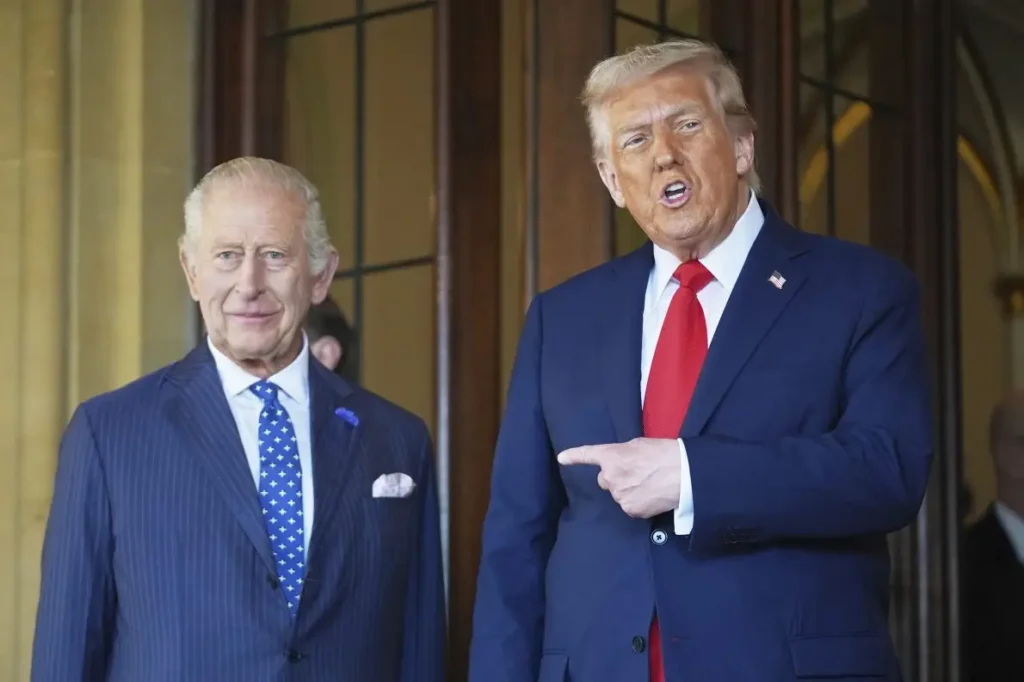
# Trump’s Secret Plan to Annex Canada: Why King Charles Halted It
The world of international diplomacy is no stranger to bold ideas and secret discussions, but few could have anticipated the bombshell claim emerging from a forthcoming political biography. According to new revelations, during Donald Trump’s tumultuous presidency, a senior advisor seriously proposed a plan so radical it seems ripped from an alternate-history thriller: the annexation of Canada. Even more astonishing is the reported reason it was shelved—not due to legal impossibilities or fears of war, but because of the former president’s personal fondness for King Charles III.
This surreal anecdote, detailed in author David Drucker’s upcoming book *“The Final Trump Card: Inside the Greatest Political Comeback in American History,”* offers a stunning glimpse into the unorthodox and often personality-driven foreign policy machinery of the Trump White House. It underscores a reality where centuries-old alliances could be weighed against personal relationships, and where even the most foundational partnerships were viewed through a uniquely transactional lens.
## The Annexation Proposal: From Fringe Idea to Presidential Briefing
The notion of the United States absorbing its northern neighbor is not a new fantasy in certain fringe circles, often rooted in a misinterpretation of 19th-century history. However, Drucker’s reporting suggests this idea moved from the political fringes directly into the Oval Office. As reported by Global News, a Trump advisor formally presented the concept of annexing Canada as a serious policy proposition.
The rationale was allegedly anchored in a contentious reading of the War of 1812, a conflict often vaguely remembered by Americans but deeply significant to Canadian national identity. The advisor’s argument posited that the U.S. could have, or perhaps should have, claimed Canadian territory as its own following that war. For a president who championed an “America First” doctrine and frequently questioned the value of long-standing international agreements, this grandiose vision of territorial expansion reportedly piqued his interest, if only momentarily.
### What Would Annexation Have Entailed?
The practical implications of such a move are, of course, astronomical:
Yet, according to this account, these monumental logistical and diplomatic barriers were not the primary factor in the plan’s dismissal.
## The Royal Veto: How Personal Respect Overruled Expansion
In a twist that seems almost Shakespearean, the force that reportedly halted this geostrategic gambit was not the Pentagon, the State Department, or the Canadian military. It was the regard of one man for a king.
David Drucker states that Trump ultimately rejected the annexation plan because he “likes the king” and holds a “soft spot” for the British Royal Family. This personal affinity for King Charles III acted as an unlikely circuit-breaker on a proposal that would have reshaped North America. This detail aligns with publicly observed interactions, such as the warm reception Trump gave the then-Prince Charles and Camilla during their 2019 state visit to the UK. The decision, according to the biography, left the annexation-proposing advisor bewildered, highlighting a critical and often unpredictable aspect of Trump’s leadership: the preeminence of personal chemistry over traditional policy analysis.
### The Monarch as a Symbolic Shield
This episode inadvertently casts King Charles, and the monarchy as an institution, in a novel role: as a symbolic guardian of Canadian sovereignty. While the King’s role in Canada is constitutionally ceremonial, this account suggests his personal relationship with a sitting U.S. president had a tangible, if surreal, impact on high-level White House deliberations. It reinforces the unique, anachronistic power of soft diplomacy and personal rapport in an era often dominated by hard power and economic threats.
## Context: A Pattern of Transactional Alliance Politics
While the annexation story may seem like an isolated piece of political fiction, it fits coherently into the documented pattern of Trump’s first term. His administration was defined by a skeptical, deal-driven approach to international relations that often unsettled traditional allies.
Canada itself was directly in the crosshairs of this approach. Despite being America’s closest neighbor and largest trading partner, it faced aggressive tariffs on steel and aluminum, with Trump famously labeling the country a national security threat for trade purposes. He openly criticized Prime Minister Justin Trudeau and reportedly mused about withdrawing from the North American Free Trade Agreement (NAFTA), only to later renegotiate it.
### Other Key Examples of Unorthodox Foreign Policy
In this context, the annexation idea—however fleeting—emerges not as a complete anomaly, but as an extreme manifestation of a worldview where all relationships, even the most symbiotic, are subject to renegotiation and where historical alliances offer no guaranteed protection.
## Reaction from the North: Disbelief, Dismissal, and Dark Humor
Unsurprisingly, the reaction from Canadian officials and observers has ranged from amused disbelief to outright dismissal. The idea is so far outside the realm of mainstream political discourse in Canada that it has been largely met with a characteristic mix of eye-rolls and punchlines.
Former Canadian lieutenant-general and diplomat Andrew Leslie captured the prevailing sentiment, bluntly calling the reported plan “lunacy.” Other political analysts and former officials have treated the revelation as a curious artifact—a testament to the strange ideas that can circulate in any administration rather than a genuine threat that was ever close to execution. For many Canadians, the story serves as a darkly humorous confirmation of their occasional suspicions about the volatility of their southern neighbor’s political process.
### The Underlying Seriousness Beneath the Absurdity
However, beneath the understandable ridicule lies a more serious reflection. For Canada, a nation whose security and economic well-being are inextricably linked to the United States, the anecdote is a stark reminder of its vulnerability. Its national security has long been predicated on the goodwill and shared values of American leadership. This story highlights a scenario where that foundational goodwill could not be assumed, and where the relationship’s stability hinged on the personal whims of a single U.S. president.
## Conclusion: A Surreal Chapter in the Annals of Diplomacy
The claim of a secret annexation plan, halted only by presidential regard for a monarch, will likely be filed as one of the most bizarre footnotes in modern political history. It reads like a satirical plot, yet it emerges from a serious journalistic account of a deeply unconventional presidency.
Whether taken literally or as a metaphor for the extreme transactional thinking present in the administration, the story illuminates several enduring truths. It shows how personal relationships can unexpectedly shape global politics. It underscores the fragility of even the most established international norms when confronted with disruptive leadership. And for Canada, it reinforces the perpetual challenge of navigating its indispensable yet occasionally unpredictable partnership with the United States.
Ultimately, the tale of Trump, Canada, and King Charles is less about a realistic threat of annexation and more about the profound surprises that can emerge when personality-driven politics collide with the solemn theatre of international relations. It is a reminder that in the 21st century, the course of history can sometimes be swayed not by grand ideologies or military strategies, but by something as simple and human as one leader liking another.

