How VAR Saved Barcelona From Repeating Atlético’s Champions League Heartbreak
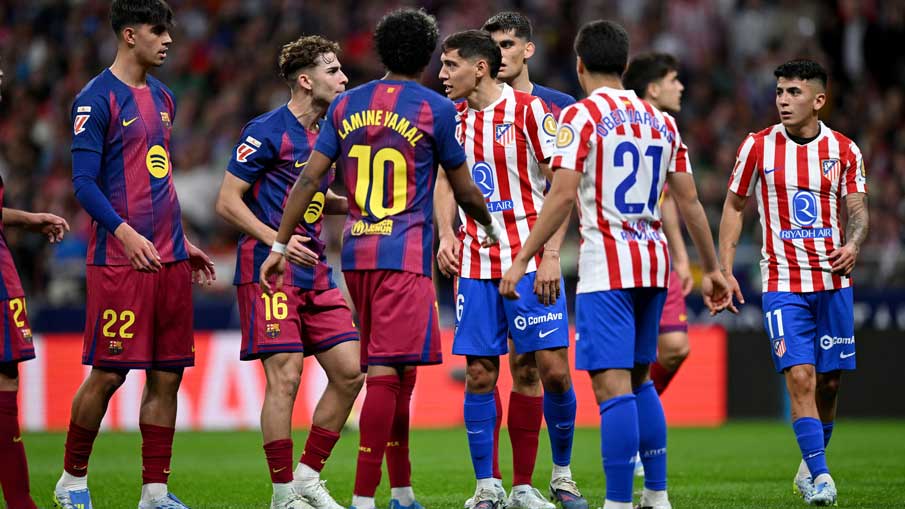
The line between eternal glory and crushing despair in the UEFA Champions League is often vanishingly thin. A single moment, a solitary decision, can rewrite a club’s history and define a generation of fans’ memories. In a dramatic twist of fate, Video Assistant Referee (VAR) technology recently played the starring role in a tale of two Spanish giants, sparing FC Barcelona a nightmare while inadvertently casting a shadow over the past anguish of Atlético Madrid.
The Night Barcelona Dodged a Historic Collapse
The scene was the Estadi Olímpic Lluís Companys, with Barcelona holding a narrow 1-0 lead from the first leg of their Champions League quarter-final against Paris Saint-Germain. The tie was on a knife-edge. Early in the second half, with the aggregate score delicately poised, Barcelona’s young defender Ronald Araújo was shown a straight red card for a last-man challenge on the breaking Bradley Barcola.
The stadium fell into stunned silence. Down to ten men for over half an hour, facing the firepower of Kylian Mbappé and company, Barcelona fans were instantly transported to a familiar, dark place of European capitulation. History, it seemed, was repeating itself in the cruelest fashion. The prospect of another “remontada” against them, another monumental collapse from a winning position, felt all too real.
VAR’s Crucial, Game-Changing Intervention
But then, the pause. The referee, István Kovács, was instructed to review the incident on the pitchside monitor. The world waited. Replays showed that while Araújo’s contact was clear, there was a significant tug on his arm by Barcelona’s İlkay Gündoğan in the build-up, moments before the challenge. This initiating foul, missed in real time, was now undeniable.
The outcome was seismic. The red card for Araújo was rescinded and instead, a free-kick was awarded to Barcelona for the initial foul by Gündoğan. The Catalan club remained with eleven men. The entire complexion of the match, and likely the tie, shifted in an instant. While PSG would eventually win the game and advance, the decision prevented Barcelona from facing an almost impossible task with ten men for 40 minutes. VAR had, unequivocally, saved them from a potential historic and traumatic implosion.
The Ghost of Madrid 2016: Atlético’s Unhealed Wound
For fans of Atlético Madrid, watching this sequence of events unfold would have been a particularly bitter pill to swallow. It served as a stark, painful reminder of their own heartbreak in the 2016 Champions League final against Real Madrid in Milan.
In that fateful match, with the score 1-1 in the first half, Atlético’s striker Antoine Griezmann slammed a penalty against the crossbar. The momentum was palpable. Then, in the second half, a pivotal moment: Real Madrid’s Sergio Ramos scored the opening goal from an offside position. The flag stayed down. In the pre-VAR era, the decision stood. Atlético fought back valiantly to force extra time and eventually penalties, but they had been forced to climb a mountain that, with correct officiating, might not have existed.
A Tale of Two Eras: Technology as the Deciding Factor
The parallel is haunting. Both incidents were critical, game-defining decisions in the knockout stages of the Champions League involving Spanish clubs. The fundamental difference lies not in the clubs, but in the technology available at the time.
- 2016 (Atlético): No VAR. A potentially incorrect offside call stands, altering the tactical and psychological landscape of a Champions League final. Atlético’s quest for their first European Cup was derailed by a human error that could not be reviewed.
- 2024 (Barcelona): VAR in full effect. A potentially game-ending red card is reviewed, contextualized, and correctly overturned due to a preceding foul. Barcelona is spared a disproportionate punishment and given a fighting chance to continue with a full squad.
For Atlético, the “what if” is eternal. What if VAR existed in 2016? Would Ramos’s goal have been disallowed? Would the momentum have carried Diego Simeone’s men to victory? The technology that saved Barcelona from a potential collapse is the same technology that, in its absence, cemented Atlético’s most painful modern memory.
The VAR Debate: Justice vs. Narrative
This juxtaposition fuels the endless debate surrounding VAR. Purists argue that the raw, immediate emotion of the game—for better or worse—is being sanitized. They point to the agony of Atlético as part of football’s rich, if brutal, tapestry.
- The Argument for VAR: Its primary mission is to achieve minimum factual accuracy for clear and obvious errors in game-changing situations. In Barcelona’s case, it corrected a significant mistake (missing the initial foul) that would have unfairly decided the tie.
- The Argument Against VAR: It can disrupt the flow of the game and create a sterile atmosphere of forensic analysis. More poignantly, it creates an uneven historical ledger where past injustices, like Atlético’s, are forever locked in, while future ones are prevented.
Barcelona benefited from the precision that Atlético was denied. This isn’t about one club being favored over another; it’s about the evolution of the sport’s rules. The heartbreak of 2016 remains valid for Atlético fans, but it now serves as the most powerful case study for why the sport embraced technological aid.
Conclusion: A New Chapter in Football Justice
Football’s history is written by its moments, and now those moments are subject to video review. The incident at the Estadi Olímpic was more than just a corrected call in a quarter-final; it was a live demonstration of how the sport’s justice system has transformed.
VAR saved Barcelona from a scenario that felt ominously familiar—a numerical disadvantage leading to a European exit from a winning position. In doing so, it inadvertently held up a mirror to Atlético Madrid’s enduring pain, highlighting the immutable truth that the clubs of the past played by a different, less accurate set of rules.
The technology is not perfect, and its implementation can be frustrating. Yet, as Barcelona’s reprieve and Atlético’ lingering “what if” prove, its core purpose is undeniable: to ensure that the stories of heartbreak and glory are, as much as possible, decided by the players’ actions on the pitch, and not by an official’s unavoidable human error in a single, irreversible moment. The era of definitive, unchecked injustice is over, for better or worse, and the Champions League narrative will forever be divided into pre-VAR and post-VAR chapters.