
How One MP’s Stunning Move is Redrawing Canada’s Political Map
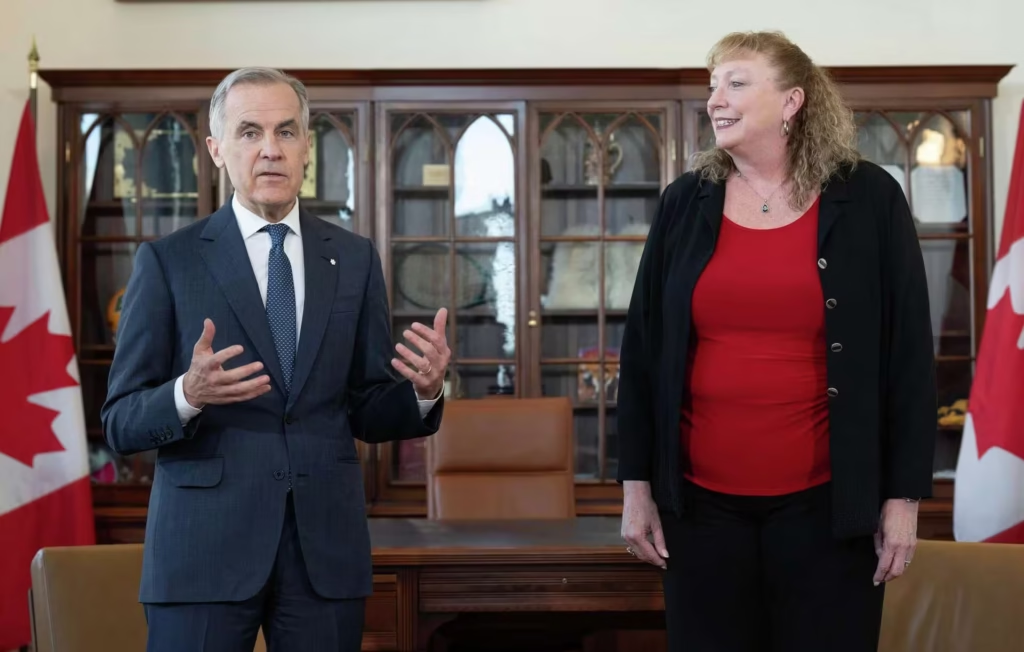
The steady rhythm of Canadian politics was shattered this week by a seismic event that has left strategists scrambling and pundits breathless. In a decision that reverberated from the halls of Parliament to the coffee shops of Main Street, Conservative MP Marilyn Gladu has left her party to join Peter Carney and the Liberal Party. This isn’t just another minor political shuffle; it is a profound defection that cracks open the door to a new era of realignment, challenging long-held assumptions about party loyalty, regional strongholds, and the very coalitions that win elections.
For observers and citizens alike, this move forces a fundamental question: is the traditional left-right political spectrum in Canada becoming obsolete? The crossing of a seasoned parliamentarian like Gladu—known for her deep roots in Sarnia-Lambton and her staunch advocacy for the energy sector—into the Liberal fold suggests the answer may be yes. This article delves into the layers of this political earthquake, exploring why it happened, what it means for the future, and why Peter Carney’s leadership is proving to be a powerful magnet for change.
The Gladu Gambit: More Than Just Crossing the Floor
Floor-crossings, while dramatic, are not unheard of in Canadian history. However, Marilyn Gladu’s decision stands apart in its potential symbolic and strategic weight. It is a move that feels less like an isolated incident and more like a catalyst. To understand its significance, we must look at the unique elements Gladu brings to the Liberal bench.
First and foremost is her regional identity. Sarnia-Lambton is classic Conservative territory—a riding built on industry, manufacturing, and resource development. Gladu wasn’t just a placeholder here; she was a vocal champion for these interests. Her defection doesn’t just give the Liberals one more seat; it provides them with a credible, trusted voice in a community that has often viewed the party with skepticism. It is a direct challenge to the Conservative Party’s claim as the sole defender of Canada’s industrial heartland.
Secondly, her departure highlights a growing ideological fissure within the Conservative movement. Gladu has been publicly critical of her former party’s approach on several key files, including pragmatic climate policy, support for technological innovation in the energy sector, and the tone of political discourse. Her alignment with Carney suggests she sees a more receptive home for her practical, solutions-oriented brand of politics within the modern Liberal tent.
Decoding the Motivations: Policy, Persona, and Political Calculus
What would drive a high-profile MP to make such a monumental switch? The reasons are likely a complex blend of the personal, the political, and the pragmatic.
Policy Divergence: At its core, this is a story about policy alignment. Peter Carney’s Liberals have deliberately staked out ground that appeals to economic centrists and pragmatic progressives. Their platform, emphasizing a transition to a green economy that doesn’t abandon workers, fiscal responsibility paired with strategic investment, and evidence-based governance, appears to have resonated with Gladu more than the direction of her former party.
The Carney Appeal: The Liberal leader himself is a central character in this drama. Carney’s unique profile—a former central banker with global economic stature who champions progressive causes—transcends traditional partisan boundaries. He represents competence, stability, and a forward-looking vision that can appeal to voters tired of partisan combat. For a MP like Gladu, joining Carney may be seen as joining a project defined by seriousness rather than sloganeering.
Strategic Foresight: For the Liberals, this is a masterstroke. It instantly validates their outreach to moderate conservatives and working-class voters. It disrupts the opponent’s unity and generates positive media momentum. For Gladu, it offers a platform with potentially greater influence on the issues she cares about, free from the constraints of a party caucus where her views may have been sidelined.
The Ripple Effect: What Gladu’s Move Means for Canada’s Parties
The immediate aftermath of this defection is clear: a morale boost for the Liberals and a tangible increase in their parliamentary count. But the long-term implications are where the true political revolution may unfold.
For the Liberal Party: A Broadened Coalition
The Liberals under Carney are explicitly attempting to build a “big tent” coalition for the 21st century. Gladu’s arrival is the strongest evidence yet that this strategy is working. It signals that the party is a viable home for:
- Centrists focused on economic growth and fiscal sustainability.
- Professionals and business leaders attracted to Carney’s credibility.
- Voters in resource-rich regions who feel taken for granted by the Conservatives and ignored by the NDP.
This expansion could redefine the Liberal base, making it less of an urban coastal party and more of a truly national, pan-regional force.
For the Conservative Party: A Crisis of Identity
Conversely, the Conservatives are faced with an immediate and painful challenge. Gladu’s exit puts a spotlight on internal divisions and raises urgent questions:
- Is the party’s messaging on climate and energy driving away its own pragmatists?
- Can it hold its diverse coalition of social conservatives, populists, and business-minded moderates together?
- Does it risk losing further ground in its traditional strongholds if it cannot address the concerns of MPs like Gladu?
This defection will force a period of intense introspection and could trigger a battle for the party’s soul ahead of the next election.
For the Political Landscape: Volatility and Opportunity
The stable, predictable dynamics of Canadian politics are becoming unstable. Gladu’s move is a symptom of a larger trend: voter dealignment. More and more, citizens are voting based on leaders, specific issues, and perceived competence rather than blind tribal loyalty. This creates a volatile environment where sudden shifts are possible. It also creates opportunity for parties bold enough to redefine themselves and for leaders who can project a vision of pragmatic, post-partisan governance.
The Road to the Next Election: A New Battlefield
As the dust begins to settle, the strategic map for the next federal campaign has been irrevocably altered. Key battleground ridings, particularly in Ontario’s industrial belt and similar regions across the country, are now in play in a new way. The Liberals can deploy Marilyn Gladu as a powerful surrogate to argue that supporting Carney is not a betrayal of local economic interests, but their best guarantee.
The Conservatives, meanwhile, must now fight a war on two fronts: defending their right flank while desperately trying to recapture the center. The NDP and other parties will also need to recalibrate, as the absorption of a center-right figure into the Liberal fold could squeeze their own attempts to appeal to working-class voters.
A Harbinger of Change
Marilyn Gladu’s decision to join Peter Carney is far more than a juicy political scandal. It is a harbinger of a realigning political season. It tells us that old loyalties are fraying, that policy is trumping partisanship for some, and that leaders with a compelling, credible vision can redraw the lines of political combat. In one bold move, the political calculus for the next election has been transformed. The ground beneath Ottawa has shifted, and every party must now learn to navigate the new landscape it has created. The race for Canada’s future just became infinitely more interesting.

