
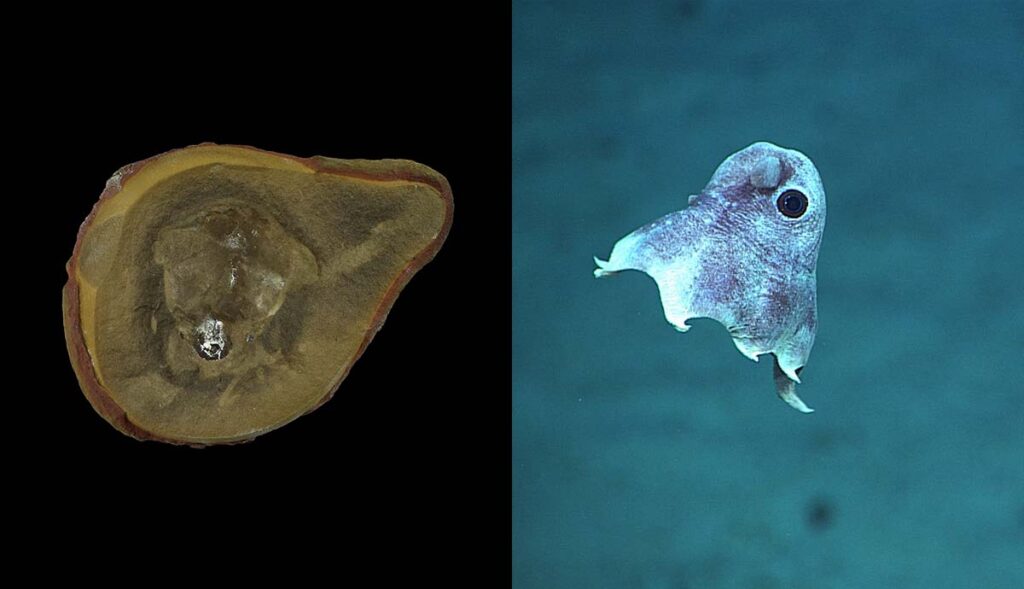
Myth Busted: World’s Oldest Octopus Fossil Actually a Nautilus
For decades, a small, enigmatic fossil held a prestigious title in the annals of paleontology: the world’s oldest known octopus. Discovered in Montana’s Bear Gulch Limestone and dating back a staggering 330 million years, the specimen known as *Pohlsepia mazonensis* was a scientific celebrity. Its delicate, ten-armed silhouette seemed to perfectly capture the moment these intelligent, soft-bodied cephalopods first graced the Earth’s oceans. However, a groundbreaking new study has turned this long-held belief on its head, revealing that this iconic fossil is not an octopus at all, but a distant, shelled relative—a nautilus.
The Fossil That Fooled Scientists
The story of *Pohlsepia* is a classic tale of how the incomplete nature of the fossil record can lead even experts down the wrong path. Unearthed from a fossil bed renowned for its exceptional preservation, the specimen appeared to show a clear, squid-like body with ten tentacles and what was interpreted as an ink sac. Its age, from the Carboniferous period, predated the next oldest accepted octopus fossils by a massive 50-70 million years, making it a revolutionary find.
For over 20 years, *Pohlsepia* was textbook material, cited as evidence that octopuses and their coleoid relatives (squid and cuttlefish) had evolved much earlier than previously thought. Its existence suggested a “ghost lineage”—a long period of evolution for which no other fossils had been found. But the very features that made it unique also planted seeds of doubt.
Red Flags in the Stone
A team of researchers led by Dr. Christopher Whalen from the American Museum of Natural History decided to take a fresh, high-tech look at the famous fossil. Using advanced imaging techniques and comparing it to a vast array of other ancient and modern cephalopods, they began to notice inconsistencies that didn’t fit the octopus narrative.
- The “Arms”: Octopuses have eight arms. *Pohlsepia* seemed to have ten. While some argued two might be longer feeding tentacles, like a squid, the arrangement was odd.
- The “Body”: The shape and proportions of the fossil’s mantle (the main body) didn’t align well with known octopus or squid morphology.
- The Critical Missing Piece: Perhaps most damning was the complete absence of any internal hard parts. Coleoids like octopuses possess a gladius or pen—a stiff, internal remnant of a shell. *Pohlsepia* showed no trace of one.
A Case of Mistaken Identity: The Nautilus Connection
As the evidence against an octopus identity mounted, the researchers searched for a better fit. They found it in a much more ancient and conservative group: the nautiloids. Specifically, *Pohlsepia* bore a striking resemblance to an extinct group called ellycerids, which are early relatives of today’s chambered nautilus.
The key to the reclassification lies in a structure called the phragmocone. This is the chambered shell that nautiloids use for buoyancy. In many fossils, only the body chamber (where the animal lived) is preserved, with the delicate, coiled phragmocone often lost. The researchers propose that what was originally interpreted as the rounded head and mantle of an octopus is, in fact, the preserved body chamber of a small, compact nautiloid. The ten “arms” are not muscular tentacles but the remnants of the nautiloid’s cirri—numerous, slender, finger-like appendages.
Why This Discovery Matters
Correcting this 330-million-year-old case of mistaken identity is more than just a taxonomic footnote; it has significant implications for our understanding of evolution.
- Resetting the Evolutionary Clock: The octopus lineage loses its oldest representative. The confirmed fossil record for octopuses and their soft-bodied cousins now firmly begins much later, likely in the Jurassic period. This removes the need for a lengthy, invisible “ghost lineage” and suggests a later, possibly more rapid, diversification.
- A Victory for Scientific Rigor: This story is a powerful example of science self-correcting. It highlights the importance of revisiting old assumptions with new technology and methodologies. As Dr. Whalen noted, “It’s a very unusual fossil, and it’s not surprising that it was misinterpreted initially.” The willingness to challenge a established idea is central to scientific progress.
- Understanding the Nautiloid Family: The reclassification enriches the history of nautiloids, showing the diversity of forms they once took. *Pohlsepia* now represents a unique, short-bodied branch on their extensive family tree.
The Enduring Mystery of Soft-Bodied Fossils
The saga of *Pohlsepia* underscores the incredible challenge of studying creatures that are almost entirely soft tissue. Octopuses, squid, and their ancestors are notoriously rare in the fossil record. They require very specific conditions—like the fine-grained, low-oxygen environment of the Bear Gulch—to be preserved at all. This scarcity makes every potential specimen critically important and, as this case shows, open to interpretation.
The hunt for the true “oldest octopus” is now wide open again. Paleontologists will continue to scour fossil sites from the right time periods, knowing that the ancestor of these brilliant, shape-shifting creatures is still out there, waiting to be found—and correctly identified.
Lessons from a Fossil
The journey of *Pohlsepia mazonensis* from octopus icon to nautiloid relative is a fascinating chapter in paleontology. It teaches us humility, reminding us that our understanding of the deep past is always a work in progress, built piece by fragile piece. It also reinforces a crucial scientific principle: that evidence must always trump elegance. A 330-million-year-old octopus was a beautiful and compelling story, but the data, upon closer inspection, told a different, equally important tale about the long and winding path of cephalopod evolution.
While the title of “oldest octopus” is once again vacant, the scientific process has proven its worth, diligently separating myth from reality in the ancient stone.

