
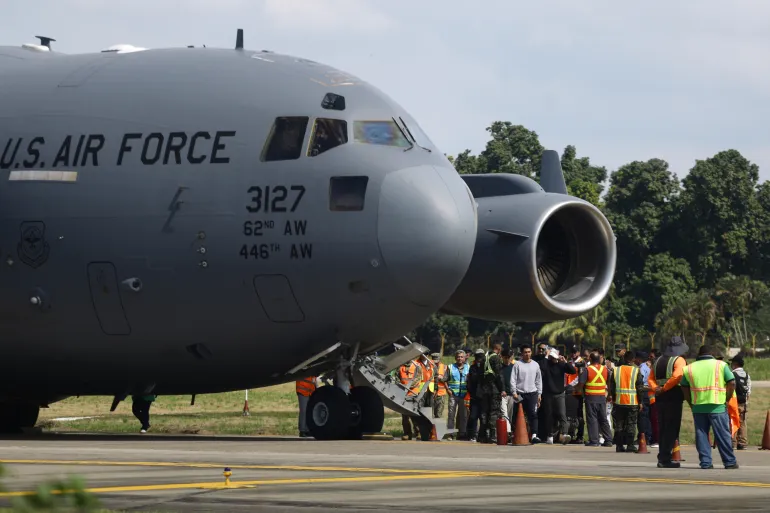
U.S. Deports Latin American Migrants to Congo in Bizarre Twist
In a move that has left immigration advocates and legal experts stunned, the United States has reportedly deported a group of Latin American migrants to the Democratic Republic of Congo. This unprecedented and bewildering action highlights the extreme and often opaque nature of U.S. immigration enforcement under policies aimed at deterring migration at all costs.
According to reports, approximately 15 individuals, originally from Latin American countries, found themselves on a flight not back to their nations of origin, but to the central African nation of Congo. A lawyer involved in the case confirmed the arrivals, describing a situation mired in confusion and potential grave danger for the deportees.
A Journey from the Americas to Central Africa
The very premise of this deportation is what makes it so extraordinary. U.S. deportation flights typically return individuals to their home countries or, in some complex cases, to third countries that have agreed to accept them. Sending Latin Americans to Congo, a country with no obvious geographic, cultural, or linguistic ties to the deportees, defies standard procedure.
The mechanics of how this happened remain unclear, but immigration lawyers point to a few potential, troubling explanations:
- Third-Country Deportation Agreements: The U.S. may have struck a little-known agreement with the DRC to accept certain deportees. Such agreements are often negotiated under the radar and can bypass individual asylum claims.
- Passport Confiscation and “Re-documentation”: In some cases, when origin countries are slow or refuse to issue travel documents, U.S. authorities might work with a third country to provide temporary papers, effectively creating a new, forced destination.
- Catastrophic Error or Misidentification: While less likely on this scale, the possibility of a systemic error cannot be entirely ruled out in an overwhelmed system.
The Legal and Humanitarian Quagmire
For the individuals involved, this deportation represents a nightmare scenario. Uprooted from the Western Hemisphere, they are now in a country where they likely do not speak any of the national languages (French, Lingala, etc.), have no support network, and face immense challenges to safety and survival.
Congo itself is a nation grappling with prolonged conflict, humanitarian crises, and political instability. Dropping individuals with no resources into such an environment is viewed by human rights organizations as a potential violation of non-refoulement—the international law principle that forbids returning asylum seekers to a country where they would face persecution or threat to their life.
“This is not just unusual; it’s reckless and inhumane,” stated one immigration attorney familiar with similar deportation tactics. “These people sought safety or opportunity, and instead of having their cases heard fairly, they’ve been shipped to a completely unfamiliar and potentially dangerous context. It’s a deportation strategy that seems designed to maximize suffering as a deterrent.”
The Broader U.S. Policy Context: Deterrence at Any Cost
This incident did not occur in a vacuum. It fits into a pattern of increasingly aggressive and geographically expansive U.S. deportation practices over the past decade.
Key policies that enable such actions include:
- Expedited Removal: Allows for fast-track deportation without a hearing before an immigration judge for certain individuals.
- Third-Country Asylum Agreements: Similar to the “Remain in Mexico” policy or agreements with Central American nations, these deals aim to offload asylum processing and responsibility onto other countries.
- Pressure on Origin Countries: The U.S. has leveraged visa sanctions and other diplomatic tools to pressure countries into accepting deportation flights more quickly, sometimes leading to rushed and flawed processes.
The deportation to Congo appears to be a drastic extension of this logic: if a home country won’t cooperate quickly, find another country—any country—that will, regardless of the human consequences.
Voices from the Ground and the Path Forward
Advocates on the ground are scrambling to assist the deportees who have arrived in Congo. The immediate needs are dire: shelter, food, medical care, and legal assistance to understand their new, precarious status. Some may try to continue their journey, while others may be trapped in a legal limbo, unable to return to their home countries or the U.S., and unable to legally settle in Congo.
This case raises urgent questions that demand answers from U.S. authorities:
- What is the legal basis for deporting Latin American nationals to the DRC?
- What specific agreements, if any, are in place between the U.S. and Congolese governments regarding deportations?
- What safeguards, if any, were in place to assess the safety and suitability of Congo for these specific individuals?
- How many more such deportations have occurred or are planned?
A New Low in Immigration Enforcement?
The deportation of Latin Americans to Congo represents a bizarre and alarming twist in global migration management. It underscores a willingness to treat vulnerable people as geopolitical pawns, subjecting them to unimaginable disruption and risk for the sake of political messaging on border control.
This policy, if it is indeed a policy and not a one-off anomaly, moves beyond deterrence and into the realm of deliberate dislocation. It severs individuals not only from their sought-after refuge but from their entire hemisphere, casting them adrift in a world where they have no bearings.
As the international community and the public seek clarity, the fate of these 15 individuals serves as a stark warning. In the pursuit of hardened borders, the line between enforcement and human rights abuse becomes dangerously blurred. The story is no longer just about keeping people out; it’s about how far a nation will go to send them away, no matter where—or how perilous—that “away” may be. The world is watching, and the precedent being set is a deeply troubling one.

