
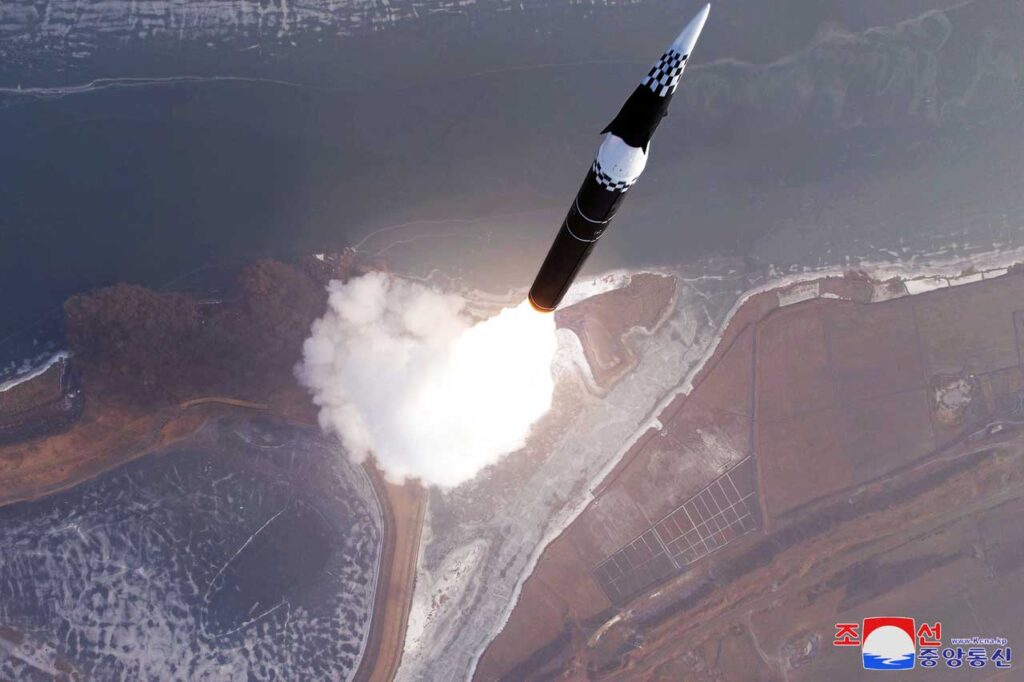
North Korea Launches Ballistic Missiles Amid Rising Regional Tensions
The Korean Peninsula is once again at the center of global security concerns. South Korea’s military has confirmed that North Korea fired multiple short-range ballistic missiles toward the sea off its east coast, marking another provocative act in a year already saturated with weapons tests. This latest launch underscores the persistent and growing threat posed by Pyongyang’s advancing military programs, directly challenging international sanctions and destabilizing regional stability.
The missiles were launched from a site in North Korea’s inland north, traveling approximately 300 kilometers before splashing down in the waters between the Korean Peninsula and Japan. While the specific model was not immediately identified, the short-range nature suggests it could be a system like the KN-23 or KN-24, which are designed to be highly maneuverable and evade missile defense systems.
A Pattern of Provocation: Understanding the Strategic Timing
This launch is not an isolated event but part of a calculated pattern of military demonstrations by Kim Jong Un’s regime. Analysts point to several potential motivations behind the timing of this specific test.
Signaling Discontent and Defiance: The launch comes on the heels of a recent trilateral military exercise involving South Korea, the United States, and Japan. North Korea consistently condemns such drills as rehearsals for invasion, using its own weapons tests as a form of protest and a demonstration of its capability to retaliate against what it perceives as hostility.
Advancing Military Capabilities: Every launch serves a dual purpose: political messaging and technical validation. With each test, North Korean engineers gather critical data on performance, reliability, and accuracy, incrementally improving their arsenal. The focus on short-range, solid-fuel systems is particularly concerning, as these missiles are easier to hide, launch quickly, and are key to any potential conventional conflict on the peninsula.
Domestic Consolidation: Internally, these displays of military might serve to bolster the regime’s image, reinforce Kim Jong Un’s power, and rally nationalistic sentiment in the face of chronic economic hardship and isolation.
The International Response: Condemnation and Calls for Restraint
The reaction from the international community was swift and uniform in its condemnation. South Korea’s Joint Chiefs of Staff stated the launch was a “clear provocation” that undermines peace. Japan also confirmed the launch, with Prime Minister’s office monitoring the situation closely.
The United States reiterated its “ironclad” commitment to the defense of its allies, South Korea and Japan. A spokesperson for the U.S. Indo-Pacific Command emphasized that while this event did not pose an immediate threat to U.S. personnel or territory, it highlights the destabilizing impact of North Korea’s illicit weapons programs.
These tests present a significant challenge for the United Nations Security Council, which has passed multiple resolutions prohibiting North Korea from developing ballistic missiles. However, enforcing these sanctions has proven difficult, and diplomatic efforts have been stalled since the collapse of talks in 2019.
The Escalating Threat: From Short-Range to Nuclear-Capable Systems
While this event involved short-range missiles, it occurs within the broader context of North Korea’s alarming progress on its full-spectrum weapons portfolio. The regime is no longer just testing basic Scud derivatives; it is fielding a sophisticated array of delivery systems.
Key Developments in North Korea’s Arsenal:
- Solid-Fuel ICBMs: The successful testing of the Hwasong-18 intercontinental ballistic missile represents a quantum leap. Solid-fuel missiles require less launch preparation time than liquid-fuel ones, making them more survivable and providing less warning to adversaries.
- Tactical Nuclear Weapons: Kim Jong Un has declared a policy of exponentially increasing the production of nuclear warheads, with a focus on tactical battlefield systems. He has also stated that his missiles are now designed to deliver these warheads.
- Hypersonic Glide Vehicles: North Korea claims to have tested these advanced weapons, which fly at high speeds and unpredictable trajectories, posing a severe challenge to existing missile defense architectures.
- Satellite-Launch Vehicles: Using ballistic missile technology, Pyongyang has placed a military reconnaissance satellite in orbit, enhancing its ability to target assets across the region.
This multi-layered advancement means that the threat is no longer just to Seoul or Tokyo, but potentially to the entire United States homeland, changing the fundamental strategic calculus for all nations involved.
Regional Security Implications: A More Volatile Northeast Asia
The continuous cycle of provocation and response risks creating a new, dangerous normal in Northeast Asia. The security dynamics are becoming increasingly tense and complex.
Strengthening Trilateral Cooperation: In direct response to North Korean threats, the security partnership between South Korea, Japan, and the United States has deepened significantly. This includes real-time missile warning data sharing, more frequent and complex joint exercises, and a unified diplomatic front. While this enhances deterrence, Pyongyang views it as further encirclement, creating a classic action-reaction spiral.
Pressure on China and Russia: As permanent members of the UN Security Council, China and Russia hold unique leverage over North Korea. However, their willingness to enforce sanctions has waned. Both countries have recently blocked efforts to increase pressure on Pyongyang, arguing for a focus on dialogue and the easing of sanctions. This geopolitical divide hampers the international community’s ability to present a united front.
The Risk of Miscalculation: With advanced weapons deployed on both sides and military postures on high alert, the risk of an accidental clash escalating into a broader conflict is real. A misinterpreted radar signal, an errant missile test, or an overly aggressive military maneuver could trigger a response that spirals out of control.
Navigating an Uncertain Future: Diplomacy or Deterrence?
The path forward remains fraught with difficulty. The fundamental gap between the involved parties is vast: the U.S. and its allies demand complete denuclearization as a precondition for sanctions relief, while North Korea insists on being recognized as a nuclear state and seeks security guarantees and the lifting of sanctions upfront.
Potential Paths Ahead:
- Enhanced Deterrence: The current trajectory suggests a continued focus on strengthening military alliances, expanding joint exercises, and further integrating missile defense systems among the U.S., South Korea, and Japan.
- Conditional Engagement: Some experts advocate for a more flexible approach, such as pursuing a step-for-step or “action-for-action” plan that could freeze North Korea’s testing and production in exchange for limited sanctions relief, without requiring full denuclearization at the outset.
- Managing the Threat: In the absence of a diplomatic breakthrough, the strategy may shift to one of containment and risk management—focusing on capably deterring North Korea while preventing proliferation of its technology and preparing for potential crises.
The latest ballistic missile launch is a stark reminder that the North Korean challenge is persistent and evolving. It is a problem that defies easy solutions. As Pyongyang continues to refine its ability to deliver a nuclear weapon anywhere on the peninsula and beyond, the stakes for regional and global security could not be higher. The international community is left grappling with the complex task of deterring aggression, preventing war, and finding a diplomatic off-ramp from a crisis that shows no signs of abating. The waters off the Korean Peninsula’s east coast, where these latest missiles landed, are a silent testament to the simmering tensions that threaten to boil over.

