Israel Blocked Rescue of Journalist After Lebanon Bombing, Officials Allege
A new and grave accusation has emerged from the Israel-Lebanon border, further straining an already volatile situation. Lebanese authorities have publicly alleged that Israeli forces actively obstructed emergency rescue teams from reaching a critically injured journalist following an airstrike in southern Lebanon. This claim adds a disturbing layer to the ongoing conflict, raising urgent questions about the protection of civilians and media personnel in war zones.
The Incident: A Strike and a Stalled Rescue
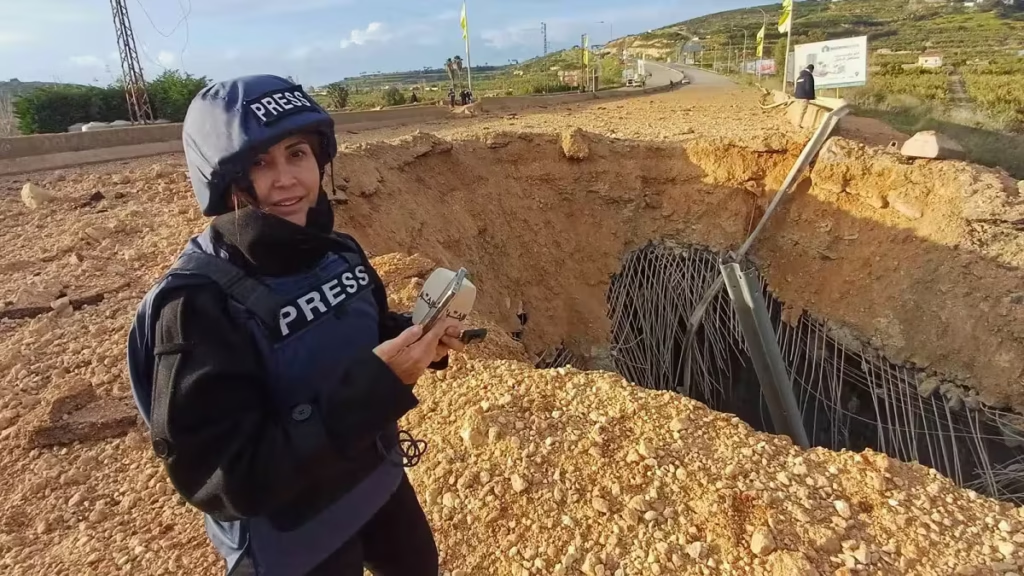
According to reports from Lebanese military and civil defense sources, the event unfolded on a tense Tuesday. An Israeli bomb struck a vehicle in the town of Tayr Harfa, a region that has seen frequent exchanges of fire between Israeli forces and Hezbollah militants.
Inside the vehicle was a journalist, whose identity and affiliation have been a point of contention. Initial Lebanese reports identified the individual as a Lebanese journalist. The strike left the occupant severely wounded and trapped in the wreckage.
Here is the sequence of events as presented by Lebanese officials:
- An Israeli aerial bombardment hit the journalist’s vehicle.
- Local Lebanese civil defense teams, including paramedics from the Lebanese Red Cross, were dispatched to the scene to extract and treat the victim.
- As these emergency crews approached the bomb site, Israeli forces allegedly fired warning shots in their vicinity.
- This gunfire, described as deliberate suppression, forced the rescue teams to halt their advance and take cover, unable to reach the burning vehicle for a critical period.
Lebanese Foreign Minister Abdallah Bou Habib condemned the act, stating it represented a “double crime” – the initial strike and the subsequent prevention of medical aid. “Preventing rescue is a violation of every international law and norm,” he asserted.
The Israeli Response and Competing Narratives
The Israeli military has provided a starkly different account of the event. An Israel Defense Forces (IDF) spokesperson confirmed carrying out a strike in the area but stated the target was a “vehicle identified as a means of transport for terrorists in the area.”
Crucially, the IDF denied targeting journalists or obstructing rescue operations. They presented aerial footage purporting to show that the vehicle was struck in an open area, not near any structures, and claimed that “no civilians, including journalists, were identified in the area prior to the strike.”
The Central Dispute: Civilian or Combatant?
The heart of the conflicting narratives lies in the identity of the target. Israel maintains it struck a legitimate military target associated with Hezbollah. Lebanese officials and local media unions insist a journalist was the victim.
This discrepancy is not uncommon in the fog of the ongoing border conflict. It underscores the immense challenges of reporting and establishing facts in real-time during active hostilities. International press freedom organizations have called for an independent investigation to clarify the circumstances, a request that has so far gone unanswered.
Broader Context: A Border on the Brink
This incident did not occur in isolation. For months, the Israel-Lebanon border has been a constant flashpoint, marked by daily exchanges of rocket fire, airstrikes, and artillery shelling. The clashes have resulted in significant casualties on both sides, including fighters and civilians, and have displaced tens of thousands of people from their homes in northern Israel and southern Lebanon.
The escalating tension has several key drivers:
- Hezbollah’s Stated Motive: The Lebanese militant group says its attacks are in solidarity with Hamas and Palestinians in Gaza, opening a “support front” to pressure Israel.
- Israel’s Objective: The IDF states it is acting to push Hezbollah forces back from the border, as mandated by UN Security Council Resolution 1701, to allow displaced Israeli civilians to return home safely.
- International Diplomacy: Efforts by the United States and European powers to broker a diplomatic solution have repeatedly stalled, with both Israel and Hezbollah setting conditions the other side rejects.
The alleged obstruction of a rescue mission threatens to further poison the atmosphere and complicate these already fragile diplomatic efforts.
Legal and Ethical Implications
The Lebanese accusation, if proven, touches on serious violations of international humanitarian law (IHL), also known as the laws of war.
Key principles under potential scrutiny include:
- Distinction: Parties must distinguish between combatants and civilians. Attacks must not be directed at civilians, including journalists engaged in professional duties.
- Precaution: All feasible precautions must be taken to avoid and minimize incidental loss of civilian life.
- Protection of Medical Personnel: IHL explicitly grants protection to medical and humanitarian personnel. Deliberately impeding their work is a grave breach.
The principle of allowing and facilitating access for humanitarian and medical aid is a cornerstone of these laws. Blocking such access, especially to a person *hors de combat* (out of action due to injury), is widely condemned.
Reactions from the Media and Human Rights Community
The allegation has sent shockwaves through international journalism and human rights circles. The Committee to Protect Journalists (CPJ) and Reporters Without Borders (RSF) issued strong statements of concern.
“Journalists are civilians and must be protected under international law. Impeding their rescue after an injury is unconscionable,” said a CPJ representative. These groups have reiterated calls for all parties to respect the safety of journalists, who play a vital role in documenting conflict and informing the world.
Within Lebanon, the incident has fueled public anger and reinforced a narrative of Israeli aggression. Media syndicates have organized protests, demanding accountability and greater international pressure to protect journalists working in the field.
A Call for Clarity and Accountability
As the dust settles—both literally and figuratively—from this specific strike, the competing claims remain unresolved. The incident highlights the perilous environment for journalists working in conflict zones like southern Lebanon, where they face risks not only from stray fire but also from being directly targeted or caught in political crosshairs.
The urgent need is for a transparent, credible investigation. Given the deep mistrust between the parties, this would likely require a neutral third party, such as the United Nations. Without such an inquiry, the facts will remain contested, accountability will be absent, and the dangerous cycle of accusation and retaliation will continue.
For now, the story of the stalled rescue in Tayr Harfa stands as a grim testament to the human cost of the border war and the erosion of the protective frameworks designed to limit suffering in wartime. It is a stark reminder that in the chaos of conflict, the lines between military necessity and humanitarian imperative can become tragically blurred, with life-or-death consequences.