
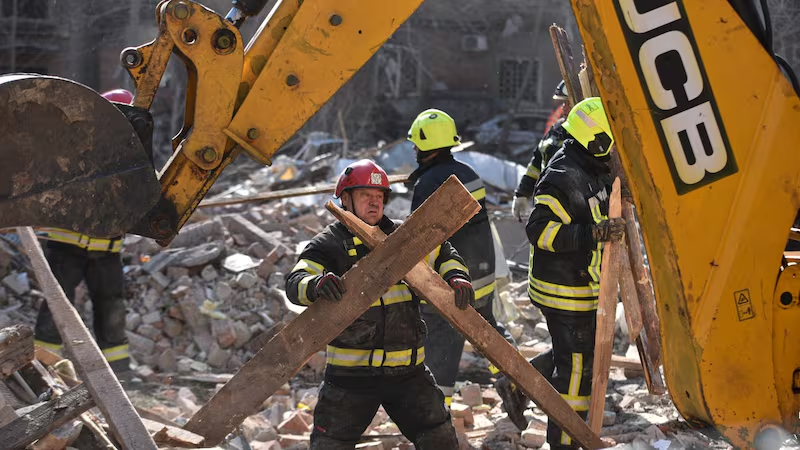
Relentless 20-Hour Barrage: Russia’s Sustained Assault on Dnipro Claims Eight Lives
The war in Ukraine has seen many horrific moments, but this week’s attack on Dnipro stands out for its sheer brutality and duration. For 20 consecutive hours, Russian forces unleashed a non-stop bombardment on the central-eastern city, leaving a trail of destruction, grief, and renewed questions about the protection of civilian lives in modern warfare.
The prolonged assault, stretching from early morning on Thursday until the late hours of the night, killed at least eight civilians and wounded more than two dozen others. It was one of the deadliest and most sustained attacks Dnipro has faced in recent months, and it has sent shockwaves through a nation already weary from over two years of full-scale war.
The 20-Hour Siege: What Happened in Dnipro
Local officials described the assault as relentless. The barrage began just after sunrise on Thursday and did not let up until the early hours of Friday. Unlike many attacks that come in waves with breaks in between, this one was a near-continuous pounding that kept the entire city in a state of terror.
Key details of the attack include:
- The bombardment lasted for 20 consecutive hours without significant pauses
- Residential buildings, a medical clinic, and critical infrastructure were directly targeted
- Emergency crews were forced to stop rescue operations multiple times because of ongoing strikes
- The attack involved a mix of missiles, drones, and artillery fire
Residents described a day spent entirely in basements and bomb shelters, unsure if their homes would still be standing when they emerged. The psychological impact of such a prolonged assault cannot be overstated, as families huddled together for hours on end with no sense of when the danger would end.
Targets of the Attack
Russian forces did not limit themselves to military objectives. Civilian infrastructure was hit hard, suggesting a deliberate strategy to terrorize the population and disrupt daily life.
Among the confirmed targets were:
- Residential apartment buildings – Multiple homes were hit, with several collapsing partially or entirely
- A medical clinic – Healthcare facilities were damaged, further straining the city’s ability to treat the wounded
- Energy infrastructure – Power lines and substations were struck, causing outages across parts of the city
- Transportation hubs – Roads and rail links were damaged, complicating evacuation and supply efforts
The Human Toll: Stories from the Ground
Among the eight confirmed dead was a young child and an elderly woman. Regional Governor Serhiy Lysak confirmed the devastating news, noting that the ages of the victims ranged from just a few years old to well into their 80s.
Hospitals across Dnipro were placed on high alert as the attacks continued. Medical staff worked double shifts, treating patients suffering from:
- Severe shrapnel wounds
- Blast injuries including internal hemorrhaging
- Crush injuries from collapsed buildings
- Burns from fires caused by the strikes
One survivor, speaking to local media from a temporary shelter, described the terror of the day:
“We sat in the basement for almost the entire day. Every time we thought it was over, the ground shook again. We didn’t know if our building would be next. The walls vibrated. The children were crying. It was like being trapped in a nightmare with no end.”
Another resident, a 62-year-old retired teacher, said she lost everything.
“My apartment is gone. Everything I owned, every memory, every photograph. But I am alive. My neighbor was not so lucky. She was getting water from the well when the second wave hit.”
Strategic Implications: Why Dnipro Was Targeted
Dnipro is not just another Ukrainian city. It holds significant strategic value on the battlefield, and this attack fits into a larger Russian military pattern.
Why Dnipro matters in the war:
- It sits on the Dnieper River, a critical natural barrier and transportation corridor
- It serves as a major logistical hub for Ukrainian forces operating on the eastern front
- It connects supply lines between the north and south of the country
- It is home to key industrial and manufacturing facilities that support the war effort
A Pattern of Escalation
Military analysts believe this 20-hour assault is part of a broader Russian strategy to degrade Ukraine’s ability to launch a spring counteroffensive. By targeting Dnipro’s infrastructure and terrorizing its civilian population, Russia aims to:
- Disrupt supply chains by damaging rail and road links
- Overwhelm air defense systems by launching sustained, multi-wave attacks
- Demoralize the population and create pressure on the government to negotiate
- Deplete Ukrainian ammunition reserves by forcing continuous defensive responses
The attack also exposed vulnerabilities in Ukraine’s air defense coverage. While the country has made significant gains in intercepting drones and missiles, the sheer volume and duration of this strike revealed gaps, particularly during prolonged engagements where defensive systems can become overwhelmed or run low on ammunition.
What This Means for Civilians in Dnipro and Beyond
For the residents of Dnipro, this attack is a chilling reminder that no city in Ukraine is truly safe from long-range bombardment. The city had experienced relative quiet in recent weeks, leading some to believe the danger had passed. This assault shattered that illusion.
The psychological toll is mounting across the region:
- School closures have become routine as parents refuse to send children to class during heightened alert
- Work stoppages are increasingly common, with businesses unable to operate during extended attacks
- Displacement is on the rise, as families flee the city for safer areas in central and western Ukraine
- Mental health crises are spiking, with hospitals reporting increased cases of anxiety, depression, and PTSD
Local authorities have urged residents to remain vigilant and to take shelter at the first sound of air raid sirens. Emergency preparedness kits, including water, food, and medical supplies, are being distributed to vulnerable populations.
The Challenge of Sustained Attacks
What makes the Dnipro attack particularly concerning for military strategists and humanitarian workers alike is its duration. Most attacks come in short bursts of 30 minutes to a few hours. A 20-hour assault presents unique challenges:
- Exhaustion of first responders – Rescue workers cannot operate effectively when they must shelter every few minutes
- Depletion of medical supplies – Hospitals treating a continuous stream of casualties face shortages of blood, bandages, and surgical materials
- Inability to conduct damage assessments – Officials cannot safely survey destruction until the attack ends, delaying response efforts
- Psychological breaking point – Civilians can endure short bursts of terror, but 20 hours of sustained fear pushes human endurance to its limits
International Response: A Renewed Plea for Air Defense
This attack comes at a critical moment in Ukraine’s relationship with its Western allies. The country has been pushing for more advanced air defense systems to counter exactly this type of threat.
Ukrainian President Volodymyr Zelenskyy addressed the attack in his nightly message, stating:
“Every hour of terror in Dnipro is proof that Russia does not want peace. They want to destroy our cities, our people, our future. We need the means to defend ourselves. We need air defense systems. We need them now.”
What Ukraine is asking for:
- Additional Patriot and NASAMS systems to cover more cities
- Long-range missiles that can strike Russian launch sites
- Electronic warfare equipment to disrupt drone guidance systems
- Increased ammunition supplies for existing air defense platforms
Looking Ahead: The Battle for Dnipro Continues
As the smoke clears over Dnipro, the city faces the difficult task of recovery while bracing for more attacks. Recovery teams are still searching through rubble for any remaining survivors or victims. The death toll may yet rise.
For now, the people of Dnipro are doing what they have done throughout this war: they are adapting, surviving, and refusing to be broken. Volunteers are organizing clean-up crews. Neighbors are opening their homes to those who lost everything. The city’s spirit, though battered, remains intact.
But the question that hangs over everything is simple: How many more prolonged assaults can Ukraine endure? And at what point will the world’s response match the scale of the destruction unfolding on the ground?

