
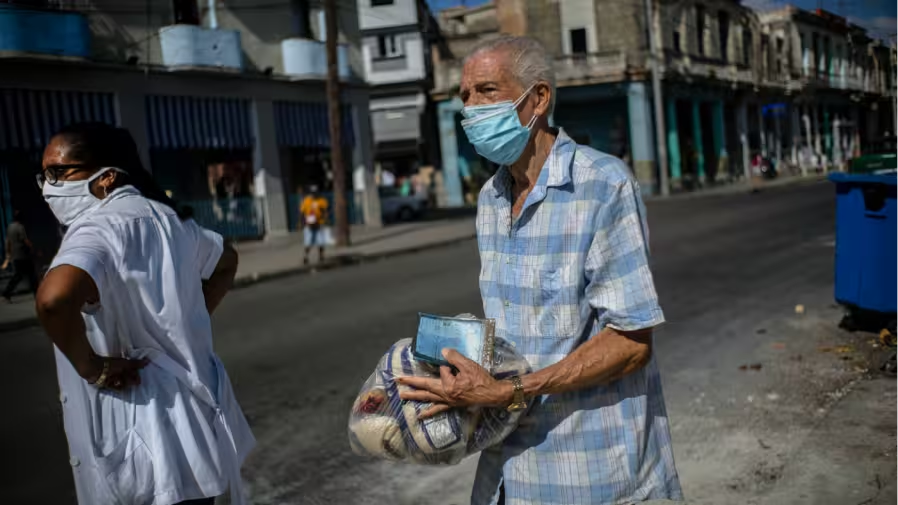
Cuba’s Ration Crisis: How Empty Libretas Force Families to the Brink
For more than sixty years, the small blue libreta de abastecimiento has been the most intimate document in a Cuban household—a pocket-sized promise from the state that every citizen would receive a fair share of food. Today, that promise is crumbling. As Cuba’s economy spirals deeper into its worst crisis in three decades, the ration books that once guaranteed survival now offer little more than a bitter reminder of what used to be.
Across Havana, Santiago, and the remote countryside, bodega shelves sit empty for weeks. When shipments do arrive, the quantities are so small that families must line up before dawn, often walking away with only a fraction of what their libreta entitles them to. The system that Fidel Castro called “the most just distribution of basic goods” has become a grinding exercise in scarcity management.
The Historical Weight of the Libreta
Created in 1962, the ration book was a response to the U.S. trade embargo and the collapse of Cuba’s agricultural infrastructure after the revolution. It was designed to guarantee equality: every Cuban, from laborer to party official, received the same allotment of rice, beans, sugar, and cooking oil. For decades, it worked—albeit with periodic shortages during the “Special Period” of the 1990s.
But the current crisis is different. It is structural, not temporary. Cuba’s economic model, heavily dependent on tourism and subsidized imports from allies like Venezuela and Russia, has fractured. The pandemic wiped out tourism revenue. U.S. sanctions tightened. Remittances shrank. And production at home—sugar, coffee, tobacco, even plantains—has fallen to multi-decade lows.
As a result, the state simply does not have the foreign currency to buy the food it promises. The libreta has become a ghost document.
What the Ration Book Actually Delivers in 2025
If you rely solely on your libreta today, your monthly sustenance looks like this:
- Rice: 3 kilograms per person—down from 5 in the early 2000s
- Beans: 300 grams—often black or red, when available
- Sugar: 1.5 kilograms—refined white, but sometimes replaced by raw
- Cooking oil: 250 milliliters—a single cup for 30 days of frying
- Eggs: 8 eggs per person—but only if the bodega receives a shipment, which happens sporadically
- Chicken: Rarely seen. When it appears, it is distributed in tiny frozen portions
- Soap and detergent: Unpredictable—sometimes a single bar for the whole family
Compare that to what a family needs. A bag of rice runs out in a week. The oil barely lasts 10 days. For many, the libreta covers less than one-third of monthly caloric requirements. Everything else must be found outside the official system—at prices that eat up an entire state salary in a single purchase.
Why the System Is Breaking Down
Collapse of Import Capacity
Cuba imports roughly 60–70% of its food. The country used to trade sugar and nickel for rice and wheat from Vietnam, Russia, and the United States. Those channels have narrowed dramatically. Meanwhile, the controlled exchange rate for the Cuban peso means that even when goods arrive, the state subsidizes prices so heavily that it loses money on every kilo sold. The more people use the libreta, the more the government bleeds.
Agricultural Decline at Home
Domestic production has never recovered from the post-Soviet shock. The 1990s forced Cuba into organic farming and urban gardens, but those innovations were never scaled up to replace industrial agriculture. Today, state farms are underfunded, fuel is scarce for tractors, and fertilizer imports have plunged. Yields for staples like rice and beans are a fraction of what they were in the 1980s.
Dollarization and the Dual Economy
The government allowed limited dollarization in 2019, then reversed course. Now, two currencies coexist with wildly different buying power. The state ration is priced in the weak Cuban peso. But anything above the ration—eggs, meat, dairy—sells in the “Mercado Libre” where prices are often in convertible pesos or hard currency. A dozen eggs on the black market cost about 200 pesos—more than a day’s wage for a state employee.
How Cubans Are Adapting
When the libreta fails, creativity fills the gap. Entire neighborhoods now function as informal supply networks. A neighbor with rural contacts trades coffee for eggs. A retiree resells leftover bakery dough as ration bread that no longer officially exists.
Common survival strategies include:
- “Bodega tourism” — visiting multiple bodegas in a single day, hoping one has received a delivery
- Group buying cooperatives — pooling money among families to purchase bulk rice on the black market
- Barter networks — trading goods, medicine, or labor for food
- Remittance reliance — using money sent from abroad to buy food outside the ration system
One Havana resident summarizes the sentiment bluntly: the libreta no longer sustains life—it highlights its absence.
The Political and Social Toll
Empty shelves have become more than an economic indicator—they are a political pressure point. Sporadic food protests have emerged, with chants demanding bread, peace, and work. Authorities have increased security around distribution points and warned against reselling ration goods, but enforcement cannot resolve scarcity.
Emigration has accelerated. Many Cubans now leave citing food insecurity as the primary driver. Those remaining face a constant trade-off between time spent queuing for unreliable rations and engaging in informal work to afford market prices.
Is There a Way Forward?
Most economists agree the ration system is no longer sustainable in its current form. It reflects a different era—one with external subsidies, stable demographics, and predictable imports. Today’s reality is defined by inflation, supply collapse, and constrained foreign exchange.
Proposals include replacing the libreta with targeted cash transfers, liberalizing agricultural markets, or creating a modern food assistance program for vulnerable groups. All remain politically sensitive, as the ration book is tied deeply to the revolutionary identity of the state.
What This Means for Visitors and Investors
For visitors, Cuba’s food system now operates on scarcity economics. Restaurant menus depend on inconsistent supply chains, and even basic meals require hard currency. The era of inexpensive, abundant dining has effectively ended.
For investors and humanitarian planners, the core issue is structural: logistics. Food availability is less about production alone and more about transport, fuel, storage, and pricing systems that no longer function efficiently.
The bottom line: Cuba’s ration book has shifted from a guarantee of survival to a symbol of systemic breakdown. As the libreta empties, it reflects a broader collapse—one where access to food increasingly depends on cash, networks, and chance rather than policy.

