Trudeau’s Organizational Architect Departs: The End of an Era for the Liberal Party of Canada
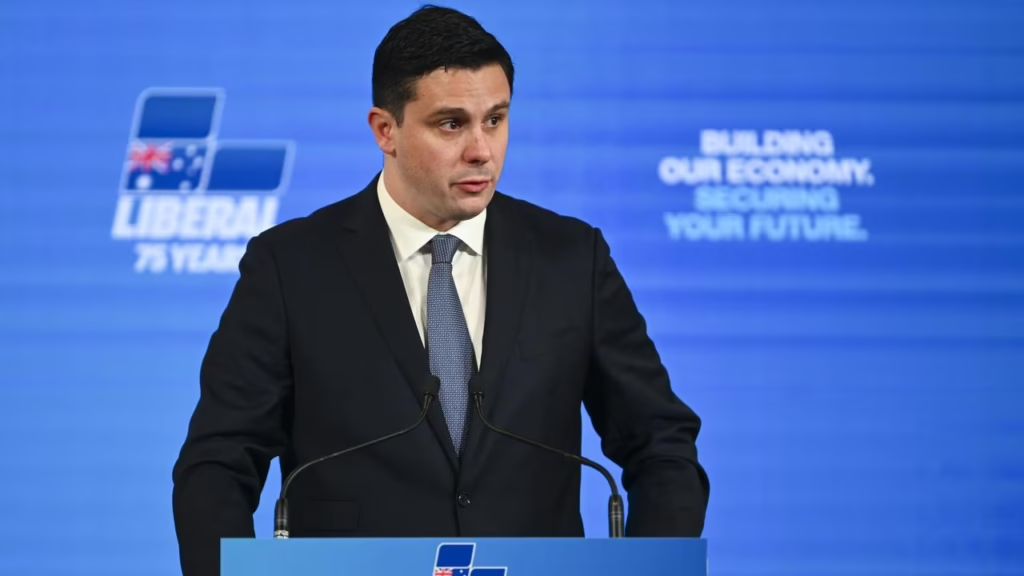
The political machinery behind Justin Trudeau’s three consecutive election victories is undergoing its most significant transformation in almost a decade. The architect of the Liberal Party’s formidable data-driven electoral engine, National Director Azam Ishmael, is stepping down after nearly ten years at the helm.
His departure marks not merely a staffing change but a potential inflection point for a party that is facing mounting voter fatigue, a reinvigorated Conservative opposition, and the existential challenge of remaining relevant in a fractured political landscape. For close observers of Canadian politics, Ishmael’s exit raises a pressing question: can the Liberal Party maintain its organizational dominance without the strategist who modernized every corner of its backroom operations?
The Man Behind the Machine
To understand the magnitude of this change, one must first appreciate the opaque but critical role of a national director. The position is often described as the party’s CEO, distinct from the elected leader’s political staff. While the leader and his inner circle define messaging and legislative priorities, the national director controls the permanent infrastructure: membership databases, fundraising technology, volunteer mobilization, riding association support, and crucially, the war chest that fuels election campaigns.
When Ishmael took over in 2013, the Liberal Party was a shell of its former self, reduced to third-party status in the House of Commons with a depleted donor base and outdated field tactics. His tenure would ultimately redefine what it means to run a modern political operation in Canada.
Ishmael arrived with a background in technology and business, bringing a Silicon Valley ethos to the staid world of political organizing. He immediately prioritized the migration of the party’s voter contact systems to the cloud, invested heavily in predictive modeling, and fostered a culture of constant A/B testing in fundraising appeals.
Unlike the traditional route of seasoned political operatives, his outsider perspective allowed him to treat the party like a startup that needed to pivot urgently. This approach was not without internal friction; long-time volunteers often grumbled about the impersonal, metric-obsessed direction.
Yet the results were undeniable. By 2015, the Liberals had built a grassroots donor base that outmatched the Conservatives in small-dollar contributions for the first time in a generation, and their get-out-the-vote digital infrastructure was widely credited with turning out young and new Canadians in record numbers.
A Decade of Strategic Dominance
Ishmael’s legacy is written in a series of electoral wins that reshaped Canada’s political map. His systems underpinned:
- The 2015 “Sunny Ways” majority
- The 2019 minority
- The 2021 mid-pandemic snap election that returned the Liberals to power
Each campaign revealed layers of his organizational philosophy. He championed a permanent campaign model, where the party never stopped fundraising, identifying supporters, or testing narrative frames—even in the off-years of a majority government.
This created a self-reinforcing cycle: continuous data inflow made the party’s predictive models smarter, leading to more efficient ad targeting, which in turn drove higher donations to fund further data refinement.
Data as the New Ground Game
Perhaps Ishmael’s most enduring contribution was the complete digitization of the Liberal ground game. Under his leadership, the party rolled out Votewell, a proprietary canvassing application that synthesized decades of Elections Canada data with consumer analytics and real-time doorstep feedback.
Field organizers no longer relied on static paper lists. They walked into neighbourhoods armed with dynamic models that identified swing voters by name, predicted their likelihood to support the party, and even suggested conversational scripts based on micro-targeted issue clusters.
This technological edge became particularly crucial in the dense suburban ridings of the 905 region, where the Liberals managed to hold off Conservative advances in 2019 and 2021 by surgically mobilizing just enough of their base.
Revolutionizing the Donor Pipeline
On the financial front, Ishmael transformed sporadic supporters into a reliable monthly revenue stream. He scrapped reliance on high-dollar cocktail circuit fundraisers in favour of a dispersed, digital-first small-donor model.
The Conservatives had long boasted a superior direct-mail apparatus, but Ishmael’s team leapfrogged them with aggressive email and social media acquisition funnels. Provocative issue-based petitions, leader-centric video content, and countdown-timer-driven donation pages became hallmarks of the Liberal online experience.
This approach not only insulated the party from accusations of cash-for-access but also built a massive list of engaged, low-dollar donors whose cumulative power consistently matched the Conservatives’ big-money machine.
Why Now? Reading the Political Tea Leaves
Ishmael’s exit comes at a moment of pronounced vulnerability for the Liberal brand. After eight years in government, Justin Trudeau’s personal approval ratings have sagged under the weight of affordability crises, housing shortages, and general exhaustion with the government’s communication style.
The Conservative Party, under Pierre Poilievre, has successfully adopted many of the same digital fundraising and mobilization tactics that once gave the Liberals a monopoly on grassroots energy. Poilievre’s team is now vacuuming up small donations with incendiary, algorithm-friendly content that bypasses traditional media filters.
The departure timing suggests a calculated internal assessment. A new national director will need at least two years to fully audit the party’s systems, build relationships with riding associations, and imprint their own strategic vision before the next fixed election date.
An orderly transition now, rather than a frantic scramble after a leadership change or election call, is a hallmark of institutional maturity. Yet it also signals that the party’s power brokers recognize the need for fresh thinking.
The Fundraising Arms Race
The Liberals’ small-donor advantage has visibly eroded. The Conservative Party has consistently outpaced them in total donations raised in recent quarters, and Poilievre’s donor count has surged.
Ishmael’s model was built on a positive, aspirational appeal tied to the Trudeau persona. That brand of optimism is harder to sell in a period shaped by inflation and affordability pressures.
The next national director inherits a fundraising system that still functions—but may require a fundamental message refit to compete with anger-driven micro-donations without losing centrist identity.
The Successor’s To-Do List
The incoming director faces structural challenges that Ishmael identified but could not fully resolve:
Volunteer Burnout and Ground-Level Morale
The permanent campaign model has exhausted many volunteers. Rebuilding engagement without losing efficiency will be critical.
Nominations and Candidate Readiness
The party must ensure 338 fully prepared candidates across all ridings while avoiding internal nomination conflicts.
Digital Security and Disinformation
With vast voter data systems in place, cybersecurity and misinformation defense have become central electoral risks.
Beyond the Transition: A Political Ecosystem in Flux
Ishmael’s departure is more than an internal staffing shift—it is a stress test of the Liberal Party’s organizational identity. His systems have become the invisible backbone of its electoral success.
The key question now is whether that success was institutional—or personal.
If the party can sustain its dominance without him, it proves the Liberal machine is durable. If not, it suggests a deeper dependency on a single architect than previously acknowledged.
Either way, Canadian politics is entering a new phase where organizational design—not just leadership—will increasingly determine electoral outcomes.