Empowering the Next Generation: Inside DC’s Young Women in STEM & Trades Conference
The hum of machinery, the glow of a computer screen, the smell of sawdust in a workshop—these are the sounds and scents of possibility. For many young women, these environments have historically felt unwelcoming or simply off-limits. However, a significant shift is underway, and it was on full display at the recent Young Women in Science, Technology, and Trades Conference hosted by Durham College (DC). This event was not merely a career fair; it was a deliberate, high-impact intervention designed to reshape how female students perceive their own futures in these critical sectors.
As someone who has watched the landscape of technical education evolve over the years, I can tell you that this conference represents a strategic move away from talking about gender parity and toward actively building it. We are past the point of simply encouraging girls to “consider” STEM. The conversation has now shifted to demonstration, hands-on experience, and tangible pathway creation. This conference is a masterclass in that new approach.
Why This Conference Matters Now More Than Ever
We are facing a paradoxical shortage. While technology and skilled trades sectors are booming with high-paying, stable jobs, the talent pipeline remains stubbornly homogenous. According to recent labour market data, women represent a fraction of the workforce in fields like mechanical engineering, electrical trades, and advanced manufacturing. This isn’t a pipeline problem of interest; it is a pipeline problem of access and perception.
The DC conference attacks the root causes:
- Lack of Visibility: Young women rarely see role models who look like them in these roles. The conference provides a critical mass of female mentors and industry professionals.
- The Confidence Gap: Studies show girls self-select out of technical subjects at a younger age, often due to societal stereotypes. Hands-on wins at the conference build concrete competence, which builds confidence.
- Misinformation: The trades are often framed as a “fallback” option. This event rebrands them as the high-tech, lucrative, and innovative career paths they actually are.
A Day of Discovery: Beyond the Lecture Hall
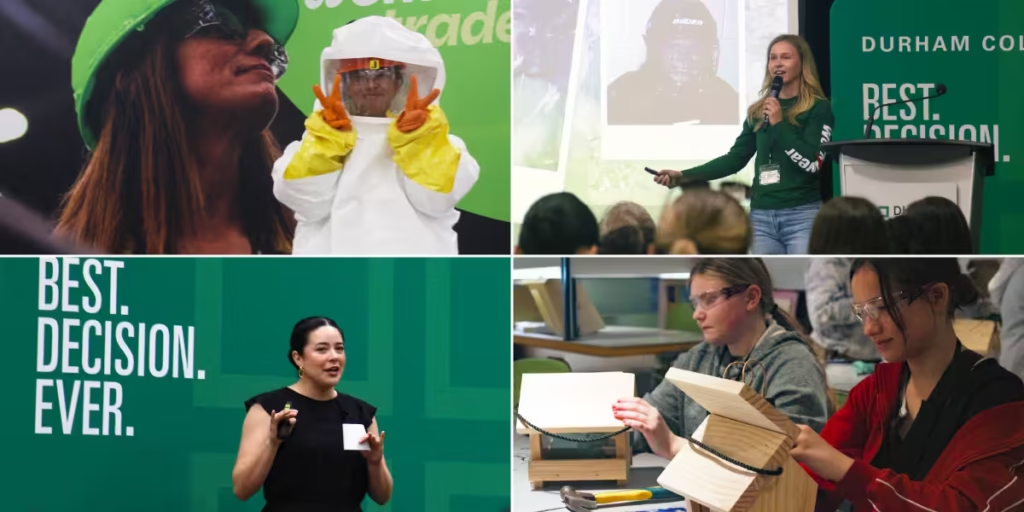
What set this year’s conference apart was its refusal to rely solely on keynote speeches. While inspiring talks are valuable, the real magic happened in the labs and workshops. DC transformed its campus into a living laboratory where students didn’t just hear about careers—they lived them.
Interactive Workshops in Science and Technology
Participants engaged in modules that ranged from coding robotics to conducting chemical analyses. The goal was not perfection, but exposure. The tactile learning experience dismantles the fear of the unknown.
Key activities included:
- Hands-on 3D printing and design challenges that teach spatial reasoning and CAD fundamentals.
- Building and programming simple circuits in an electronics lab, demystifying the “black box” of hardware.
- Data analysis simulations where students acted as environmental scientists, solving real-world problems using real datasets.
The Trades: Building Skills and Confidence
Perhaps the most energetic part of the conference was the trades zone. Here, the stigma of the “dirty job” was obliterated. Students were welding, wiring, and framing projects under the guidance of female faculty members and industry mentors.
The atmosphere shifted from hesitant observation to active, joyful participation. One could see the lightbulb moment for a student who successfully completed a weld for the first time or wired a working electrical outlet. This is the transformative power of apprenticeship-based learning. It proves that competence is not gendered.
The Power of “Seeing is Believing”
A highlight for many attendees was the panel discussion featuring women who are currently thriving in the industry. This segment was far removed from a dry corporate presentation. The speakers shared raw stories of imposter syndrome, overcoming skepticism from peers, and finding their footing in male-dominated shop floors and tech labs.
This authenticity is the conference’s secret weapon. When a young woman sees a mechanical engineer or a millwright who shares her background, her future becomes tangible. The conference leverages this social proof effectively. It’s not about convincing someone that a path is possible; it is about showing them that other people just like them are already walking it.
Creating Tangible Pathways
One of the most strategic elements of the DC conference was its laser focus on the next step. It didn’t end with inspiration. The event was structured to funnel that enthusiasm directly into action.
- Direct Enrollment Information: Admissions advisors were on site, ready to walk students through the application process for programs like Electrical Techniques, Mechanical Engineering Technology, and Biotechnology.
- Financial Aid Navigation: A dedicated station helped students understand scholarships and bursaries specifically aimed at women in trades and technology. Affordability is often a hidden barrier, and this conference addressed it head-on.
- Industry Networking: Sponsoring companies were not just handing out swag. They were collecting resumes, offering summer internships, and pre-screening for apprenticeship positions.
The Long-Term Impact on the Workforce
Events like the Young Women in Science, Technology, and Trades Conference are critical infrastructure for our economic future. When we increase the diversity of our technical workforce, we don’t just fill jobs; we improve innovation.
Research consistently shows that diverse teams build better products and solve problems more efficiently. By investing in these conferences, institutions like Durham College are not performing a social service; they are making a strategic economic investment. They are ensuring that the next generation of engineers, technicians, and tradespeople reflects the actual population they will serve.
Breaking the Cycle of Stereotypes
It is also important to recognize the ripple effect. A young woman who attends this conference goes home and talks to her parents, her younger siblings, and her friends. She changes the conversation at the dinner table. She normalizes the idea that a woman can be a power engineer or a software developer. This is how we break the cycle of stereotypes—one empowered student at a time.
Final Thoughts for Educators and Parents
If you are reading this and wondering how to get involved, the answer is simple: support access to experiential events like this one. The data is clear. Traditional career counselling has not moved the needle enough. What moves the needle is the visceral experience of success—the feeling of the drill in your hand, the code compiling without errors, the pride in a finished project.
The DC conference showed that the next generation of women is ready, willing, and more than capable. They don’t need us to lower the bar. They need us to open the door, hand them the tools, and get out of their way. The future of the skilled workforce is not just bright; it is diverse, capable, and ready to build.