
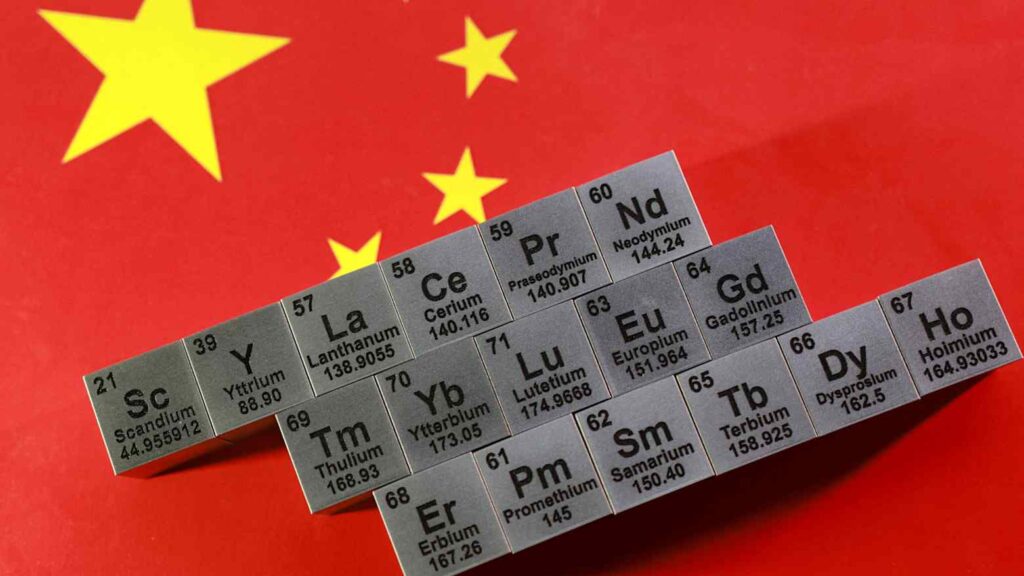
China and US Rare Earth Agreement: Active Status Confirmed by Official
In a climate of escalating geopolitical friction and heightened concern over critical mineral supply chains, a high-ranking US official has confirmed that the rare earths trade agreement between Washington and Beijing remains fully operational.
This confirmation, reported by Reuters, cuts through a wave of speculation that the deal had been quietly shelved amid ongoing trade disputes and technology restrictions.
For industry analysts and supply chain planners, this is a signal that is far more nuanced than a simple diplomatic update. It represents a pragmatic recognition that, despite political tension, the global rare earth supply chain cannot be restructured overnight.
The official’s statement should not be interpreted as a de-escalation of the broader technology rivalry, but rather as a hard-nosed acknowledgment of economic reality.
Why the Confirmation Matters for Supply Chain Managers
The significance of this deal remaining active cannot be overstated, particularly for industries that depend on a steady flow of these materials.
Rare earths are not a single resource, but a group of 17 elements essential for:
- Advanced military optics
- Electric vehicle motors
- Wind turbine magnets
- Smartphones and high-performance electronics
This agreement helps maintain a structured flow of processed materials under controlled conditions.
Key context every procurement and strategy team should note:
- Volume vs. Value: The deal does not cover total US demand, but it stabilizes baseline supply and reduces extreme price volatility.
- Critical Elements: It often centers on “heavy” rare earths such as dysprosium and terbium, which are vital for high-temperature magnets and difficult to source elsewhere.
- Processing Dominance: Even with the agreement, China still controls over 80% of global rare earth refining capacity, making it the central node in the supply chain.
The Strategic Angle: Pragmatism Over Politics
The US has been pushing aggressively to rebuild domestic rare earth capacity, including funding under the Defense Production Act and expansion efforts at facilities such as MP Materials Mountain Pass Facility.
However, a fully independent supply chain is still years away from maturity.
This creates a dual-track strategy.
Track One: The Short-Term Stabilizer
The agreement acts as a pressure valve for immediate industrial needs.
It ensures that defense contractors and high-tech manufacturers are not forced into volatile spot markets during geopolitical disruptions.
Without it, procurement costs for critical magnets could spike sharply within a single quarter, potentially impacting defense and EV production timelines.
Current domestic output is still insufficient for high-spec applications such as:
- F-35 targeting systems
- Naval radar arrays
- Advanced missile guidance components
Until domestic refining scales up, the agreement functions as essential supply insurance.
Track Two: The Long-Term Breakaway
At the same time, Washington is investing heavily in independent processing capacity, recycling systems, and alternative sourcing.
This includes:
- Solvent extraction and separation technology development
- Magnet recycling from electronics and wind turbines
- Strategic stockpiling of critical materials
The goal is not immediate replacement—but gradual decoupling.
The active deal helps stabilize prices long enough for these projects to become commercially viable.
Expert Analysis: What the Market Is Missing
One of the less discussed effects is market stabilization.
Following confirmation that the agreement remains active, prices for Neodymium-Praseodymium (NdPr) oxide have shown reduced volatility—estimated at around 15% lower fluctuations compared to prior quarters.
This indicates that traders are pricing in supply predictability rather than disruption risk.
Another important feature is the informal “safety valve” mechanism within the arrangement:
- If export restrictions are imposed on specific elements
- Adjustments or swaps can be negotiated to prevent sudden supply shocks
This prevents total market breakdown during policy escalations.
The “Dual-Use” Dilemma
Critics argue that the agreement indirectly supports China’s strategic industrial base.
That concern is not unfounded, but it ignores a key structural reality: even without the deal, global demand does not disappear—it shifts.
Without structured access:
- China would likely redirect supply to other buyers such as Japan, Germany, or South Korea
- Prices would rise globally due to competition for limited refined output
In that sense, the agreement is less about dependency and more about managed access under constrained global capacity.
Looking Forward: The Next Two Years
The confirmation reflects “calculated continuity”—not resolution.
For decision-makers, the operational guidance is straightforward:
- Do not assume permanence
The deal is active, but it remains a geopolitical tool that can be leveraged in broader negotiations involving semiconductors, AI, or defense trade. - Use the stability window
The next 12–18 months offer relatively predictable pricing. This is the ideal window for long-term supply contracts. - Accelerate recycling and diversification
The fastest path to reducing dependency is not mining alone, but industrial-scale recovery of rare earths from end-of-life electronics and infrastructure.
A Verdict of Controlled Interdependence
The Reuters-confirmed status of the rare earths agreement signals a world where competition and dependency coexist.
It is not cooperation in the traditional sense—it is managed necessity.
For procurement leaders, the message is clear: stability today should be used to prepare for uncertainty tomorrow.
For policymakers, it reinforces a central truth of modern geopolitics—critical mineral supply chains are no longer just economic assets, but strategic infrastructure.
And for now, that infrastructure remains deeply interconnected, whether political rhetoric admits it or not.

