
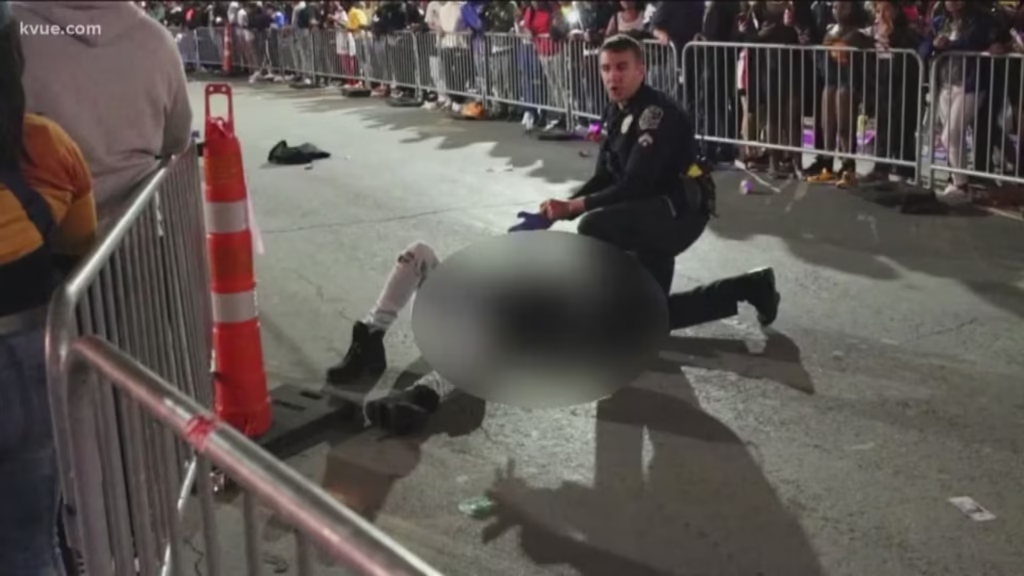
Unprovoked Violence in the Capital: 10 Weekend Shootings Leave 4 Injured in Austin, Texas
Residents of Austin, Texas, are reeling after a violent weekend marked by a series of seemingly random shootings that left four people injured. Mayor Kirk Watson confirmed that police responded to ten separate shooting incidents over the course of just a few days, and the common thread is disturbing: none of the attacks appear to have any clear motive or target.
While Austin has seen its share of crime, the brazen, indiscriminate nature of these events has sparked deep unease across the city. Local authorities are working around the clock to determine whether these incidents are connected, and the public is being urged to remain vigilant.
The Scope of the Violence
According to law enforcement officials, the shooting spree unfolded across multiple neighborhoods in Austin, with no single geographical pattern emerging.
The ten separate events occurred between Friday evening and Monday morning, leaving four individuals with non-life-threatening injuries. Emergency responders treated the victims at the scene, and all were transported to local hospitals in stable condition.
Mayor Watson addressed the public in a press conference, calling the series of incidents “deeply troubling” and emphasizing that the randomness of the attacks makes them particularly difficult to prevent.
“These were not domestic disputes, robberies, or arguments gone wrong. They appear to be unprovoked, and that raises serious questions about public safety,” Watson stated.
The victims include a mix of ages and backgrounds, further underscoring the random nature of the shootings. Police have not released their identities but confirmed that none of the injuries are considered life-threatening.
Mayor’s Response and Investigation Status
The Austin Police Department (APD) has launched a full-scale investigation into each shooting, deploying extra patrols and plainclothes officers to high-traffic areas.
Mayor Watson has assured the community that the city is “doing everything in its power” to identify and apprehend the assailants.
However, in a candid moment, the mayor acknowledged the challenge:
“When there is no clear connection between the shooter and the victim, our traditional investigative methods become much more difficult. We are relying on community tips, surveillance footage, and forensic evidence to piece together what happened.”
At this stage, authorities have not established a link between the ten incidents. There is no evidence of a single shooter or organized group.
The working theory is a possible copycat phenomenon—where one incident may have inspired others—or simply a tragic coincidence of multiple unrelated acts of gun violence occurring within a compressed time frame.
What the Data Tells Us
To put this weekend’s events in context, it is worth examining Austin’s overall crime trends.
According to the Austin Police Department’s most recent annual report, the city has experienced a slight uptick in aggravated assaults and gun-related offenses compared to the previous year. However, the rate of random shootings—where the victim and perpetrator have no prior relationship—remains statistically low, making this weekend’s cluster an outlier.
Criminologists point out that random shootings are among the hardest crimes to solve and deter. Without a motive rooted in robbery, gang activity, or personal conflict, the perpetrator leaves fewer investigative leads.
The psychological impact on the community is also magnified, as residents realize that simply being in the wrong place at the wrong time could make them a target.
Community Reaction: Between Fear and Resolve
The news has sent a shockwave through Austin’s neighborhoods. Social media posts show residents expressing concern for their safety, especially in areas where the shootings occurred.
Some have called for increased police presence, while others are demanding a deeper look at the root causes of gun violence.
Local businesses in affected areas have reported a dip in foot traffic, and some parents are keeping children indoors.
“You don’t expect this in Austin. This is a vibrant city. These random acts make you feel like nowhere is safe,” said a resident of the South Congress area, one of the locations where a shooting was reported.
Yet, there is also a resilient streak. Community leaders have organized safety forums and are encouraging residents to form neighborhood watch groups. The Austin Police Department has scheduled town hall meetings to discuss the incidents and share prevention tips.
Practical Safety Recommendations
In light of this weekend’s events, security experts recommend the following steps for Austin residents and visitors:
- Stay aware of your surroundings. Avoid distractions like headphones or staring at your phone when walking in public areas, especially at night.
- Trust your instincts. If a situation feels off, cross the street, enter a store, or call 911.
- Report suspicious activity. Do not assume someone else has already called. Provide a detailed description—clothing, vehicle, direction of travel.
- Plan your route. Stick to well-lit, populated streets. Let someone know where you are going and when you expect to arrive.
- Secure your home and vehicle. Lock doors and windows, and do not leave valuables visible in your car. Random crime can include carjackings or break-ins.
- Engage with local resources. Sign up for community alerts and attend neighborhood safety meetings.
Authorities also emphasize that if you see something, say something. The Austin Police Department non-emergency line is available, and anonymous tips can be submitted through Crime Stoppers.
Expert Analysis: The Challenge of Random Violence
Dr. Elena Martinez, a criminologist at the University of Texas at Austin, notes that random shootings often stem from a combination of personal desperation, mental health crises, and easy access to firearms.
“When there is no prior relationship, you are looking at an offender who may be acting out in a moment of extreme rage or confusion. They are not thinking about consequences. That makes them unpredictable,” she explains.
She adds that while the total number of victims in this case is relatively small—four injured—the psychological footprint is enormous.
“A single random shooting can terrorize an entire city because it breaks the social contract: we assume that if we follow the rules and stay out of trouble, we are safe. Random violence shatters that assumption.”
What Happens Next?
The immediate priority for APD is to gather evidence and identify suspects. Forensic teams are analyzing shell casings, collecting surveillance footage from nearby businesses and residences, and interviewing witnesses.
Mayor Watson has indicated that the city will evaluate whether any additional resources, such as state or federal assistance, are needed.
In the longer term, city officials are likely to revisit gun violence prevention strategies. These may include enhanced community policing, mental health outreach programs, and legislative advocacy at the state level.
However, these discussions often become politically charged, especially in a state like Texas where gun ownership is deeply rooted.
For now, the focus remains on investigation and public safety. Austinites are urged to remain calm but cautious.
“We will get through this,” Mayor Watson said. “Austin is a strong community. We look out for one another.”
Final Thoughts
The ten random weekend shootings that left four people injured in Austin, Texas, serve as a grim reminder that gun violence can strike anywhere, anytime.
The lack of a clear motive or target makes these incidents especially frightening, but it also galvanizes the community to demand answers and action.
As the investigation unfolds, residents are doing what they do best: staying connected, looking out for neighbors, and refusing to let fear define their city.
Austin will undoubtedly recover, but the scars of this weekend—both physical and psychological—will take time to heal.
If you have any information related to these shootings, contact the Austin Police Department Tips Line at 512-974-TIPS (8477).
Stay safe, stay aware, and report anything suspicious.

