Global Stock Markets Recover as Technology Shares Improve
Canadian investors following their retirement savings or stock portfolios may be surprised by how quickly developments on Wall Street can influence markets around the world. On Monday, November 9, 2026, international stock markets moved higher after artificial intelligence-related shares recovered some of their previous losses in the United States.
Asian and European indexes recorded gains following Friday’s improvement in American technology stocks. U.S. stock futures also advanced, providing further indications of improving market sentiment after a difficult week for investors.
However, the recovery did not eliminate concerns surrounding the artificial intelligence industry. Political developments, electricity expenses, data center construction, and uncertainty involving major technology companies continued to influence investment decisions.
European Stock Markets Record Gains
European financial markets started Monday’s trading session higher as investors responded to the improvement in American equities.
Germany’s DAX increased 0.6% to 25,974.42, while France’s CAC 40 advanced 0.4% to 8,168.36. Britain’s FTSE 100 also gained 0.4%, reaching 10,720.81.
U.S. stock futures indicated further positive movements. Futures tracking the S&P 500 increased 0.3%, while those connected to the Dow Jones Industrial Average climbed 0.6%.
These gains followed Friday’s recovery on Wall Street, where technology shares helped stabilize the broader market after several sessions of selling.
For international investors, the movements demonstrated how developments involving American technology companies can influence trading activity across different financial centers.
Taiwan Leads the Asian Market Recovery
Asian markets experienced different results on Monday, with Taiwan recording the strongest performance among the major indexes mentioned in the report.
Taiwan’s Taiex index jumped 4.9%, supported by a 4.7% increase in Taiwan Semiconductor Manufacturing Company (TSMC). The semiconductor manufacturer’s recovery helped lift the broader technology sector.
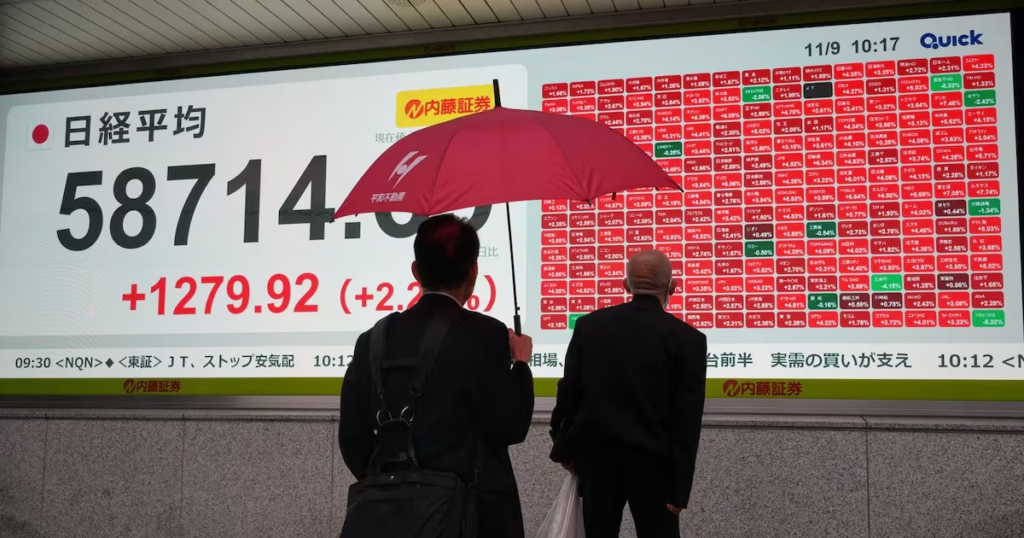
Japan also recorded substantial gains. The Nikkei 225 finished 2.3% higher at 58,775.50.
Tokyo Electron, a manufacturer of semiconductor production equipment, gained 2.8%, although it surrendered some of its earlier advances. Advantest, which produces semiconductor testing equipment, increased 1.3%.
The improved performance of these companies reflected renewed interest in semiconductor-related investments following Friday’s recovery in American technology shares.
SoftBank Shares Decline Over Robotics Transaction
Not every Japanese company benefited from the broader market improvement. SoftBank Group shares declined 4.2% as the company attempted to salvage a $5.4 billion robotics transaction involving Switzerland-based ABB.
The proposed transaction encountered difficulties after Chinese regulators rejected the deal. The development added uncertainty surrounding SoftBank’s efforts to complete the agreement.
South Korea and Other Asian Markets Deliver Mixed Results
South Korea’s Kospi index initially advanced before reversing direction and finishing 0.8% lower at 5,018.85.
Samsung Electronics gained 0.6%, while semiconductor manufacturer SK Hynix increased 0.4%. These relatively modest advances came after considerable fluctuations in technology shares over recent weeks.
Elsewhere, Hong Kong’s Hang Seng Index slipped 0.1% to 24,448.95. China’s Shanghai Composite increased 0.3% to 3,660.79, while Australia’s S&P/ASX 200 edged 0.1% higher to 9,029.70.
The different results showed that the recovery was not equally distributed across the region. Investors continued evaluating individual companies and economic conditions rather than treating every technology stock as an equally attractive investment.
Political Concerns Affect Artificial Intelligence Investments
One factor contributing to recent pressure on artificial intelligence stocks involved uncertainty surrounding the construction of additional data centers in the United States.
Democratic victories in the U.S. midterm elections raised questions about the possible effects of political developments on AI infrastructure projects, particularly in Texas.
Data centers require considerable amounts of electricity to operate the computing equipment used to develop and run artificial intelligence systems. Their expanding energy requirements have attracted attention from communities concerned about increasing household electricity bills.
Voters across political parties have expressed concerns about artificial intelligence and the higher power expenses associated with data center operations.
These developments matter to investors because the continued expansion of AI technology depends on significant infrastructure investments. Political decisions, electricity availability, and construction expenses could influence the financial outlook of companies planning additional facilities.
Investors are therefore considering more than the commercial opportunities associated with artificial intelligence. They are also examining the practical and financial challenges involved in expanding the technology.
Wall Street’s Friday Recovery Supports International Markets
Friday’s trading session provided some relief after a difficult week for American equities.
The S&P 500 increased 0.3%, reducing its weekly decline to 2.7%. Despite the improvement, the index recorded its worst weekly performance since April 2025, when U.S. President Donald Trump introduced tariffs known as Liberation Day tariffs.
The Dow Jones Industrial Average declined 0.5% on Friday, while the Nasdaq Composite advanced 1.1%.
The improvement helped interrupt a broader international stock market decline. Earlier, indexes in Tokyo and Seoul had both dropped 6% following Wall Street’s sharp decline on Thursday.
Friday’s recovery in American technology shares subsequently helped support trading activity in other international markets, particularly those with significant exposure to semiconductor manufacturing.
Nvidia Becomes a Major Focus for Investors
Nvidia contributed significantly to Friday’s improvement in the S&P 500. The semiconductor company’s shares increased 2.8% after experiencing substantial losses earlier in the week.
Before that recovery, Nvidia had recorded declines of 9.3% and 3.2% during two separate trading sessions.
The company occupies an important position in the artificial intelligence industry because its advanced processors power many of the data centers and computing systems used to train and operate AI models.
Its technology has also attracted attention from the U.S. government because of export restrictions intended to limit China’s access to advanced semiconductor technology.
However, Nvidia faced another development on Monday that attracted investor attention.
The company announced on Sunday that it was investigating reports that its chief executive officer, Jensen Huang, had been targeted by a foreign intelligence effort.
The reports followed Huang’s acknowledgment of an intimate relationship with a business executive whom U.S. intelligence had reportedly determined was gathering information for China, according to The New York Times.
China’s Foreign Ministry rejected the spying allegations during a regular briefing on Monday, describing them as an attempt to discredit Beijing.
Despite Nvidia’s contribution to Friday’s recovery, its shares declined 4.1% in premarket trading early Monday as the developments attracted additional attention.
Stephen Innes of SPI Asset Management also discussed the wider implications of the scrutiny surrounding Huang, particularly its connections to American technology leadership, China, and national security.
S&P 500 Remains Below Its All-Time High
Despite the improvement in stock prices, the S&P 500 remained 5.7% below its all-time high, which had been established during the previous month.
The index’s position indicated that the recent declines had not completely erased its earlier gains. Nevertheless, investors continued monitoring developments that could influence the direction of American equities.
Economic information also contributed to market expectations. A report released Friday showed that U.S. employers hired considerably more workers during the previous month than economists had anticipated.
The employment figures provided another indication that the American economy continued to demonstrate resilience despite elevated inflation.
Investors will continue examining employment and inflation information because these indicators can influence expectations surrounding monetary policy and interest rates.
Oil Prices and Currency Markets Also Move
Developments on Monday extended beyond stock exchanges, with international oil prices and major currencies also recording changes.
Brent crude oil, the international benchmark, declined 2% to $96.38 per barrel. U.S. benchmark crude also moved lower, falling 1.5% to $89.56 per barrel.
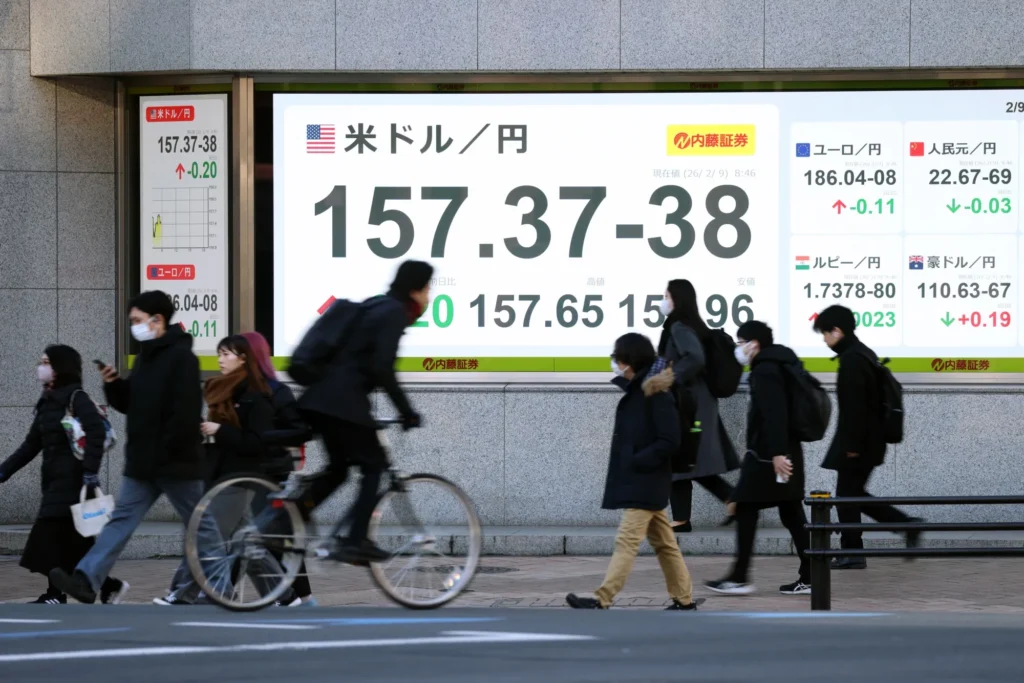
Currency trading showed the U.S. dollar weakening against the Japanese yen. The dollar traded at 158.09 yen, compared with 158.36 yen late Friday.
Meanwhile, the euro strengthened against the American currency, increasing to $1.1188 from $1.1142.
These movements are relevant to international businesses because energy prices and exchange rates can influence transportation expenses, import costs, exports, and investment decisions.
For Canadian investors, international oil prices deserve particular attention because changes in global energy markets can affect Canadian commodity-related businesses and broader economic conditions.
What Investors Should Watch After the Market Rebound
The November 9 recovery provided some relief following a volatile week for technology shares. However, investors still have several developments to monitor before determining whether the improvement can continue.
First, semiconductor companies such as Nvidia and TSMC will remain important indicators of investor confidence in artificial intelligence. Their stock performance and corporate developments could influence the broader technology sector.
Second, political decisions involving AI data center construction deserve attention. Developments in Texas, particularly those involving electricity requirements and infrastructure expansion, could affect companies planning additional investments.
Third, investors should monitor upcoming U.S. employment and inflation reports. These economic indicators can influence expectations about interest rates, borrowing costs, and stock valuations.
Canadian readers following international financial markets can also monitor the S&P 500, Nasdaq Composite, Dow Jones Industrial Average, and global oil prices to understand how overseas developments may affect their investments.
The next several trading sessions will help determine whether the latest gains represent a more sustained improvement or a temporary recovery. Investors will be watching semiconductor company performance, political developments, and economic information for clearer indications of the direction of global markets.
For now, international equities have recovered some of their recent losses, but developments involving artificial intelligence, data center investments, and major technology companies remain important factors shaping investor decisions.
Source: Associated Press, reporting by Elaine Kurtenbach, November 9, 2026, published through BNN Bloomberg.