
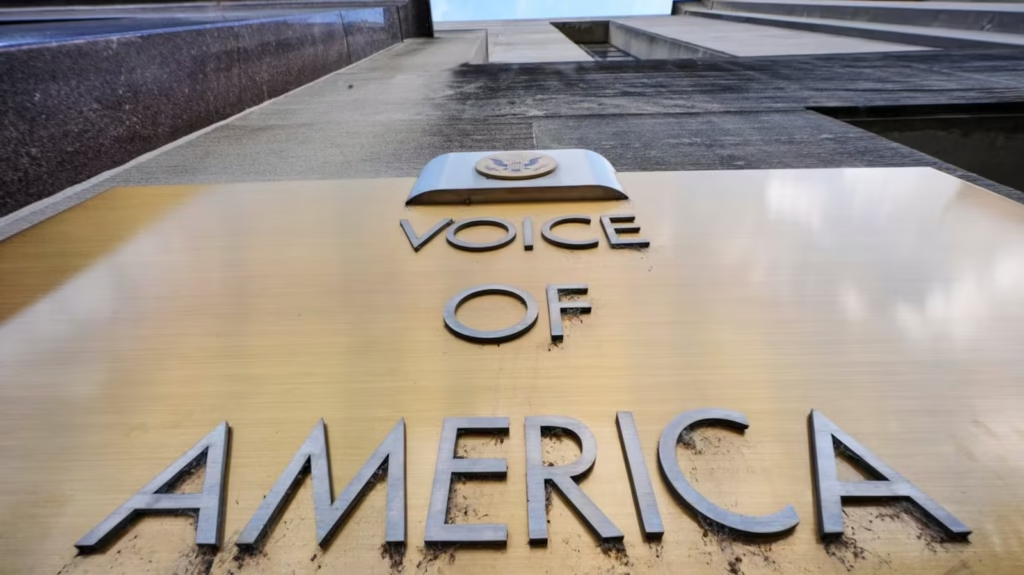
Will the Voice of America Be Restored After Court Order?
In a landmark decision that has sent shockwaves through the worlds of international broadcasting and media law, a federal judge has issued a stunning order: the dismantled pieces of the Voice of America (VOA) must be put back together again. The ruling, handed down in March 2026, strikes at the heart of a years-long political and ideological battle over the future of America’s premier public diplomacy tool. But with the legal victory secured, a daunting question now looms: What are the real chances that the venerable VOA can be truly restored to its former stature and independence?
A Judicial Mandate to Rebuild
The case stemmed from a series of controversial actions taken by the U.S. Agency for Global Media (USAGM) leadership in the early 2020s. Critics alleged that the agency engaged in a systematic effort to undermine the VOA’s editorial firewall, a legal provision designed to protect its journalists from political interference. This included the removal of key network heads, the installation of politically aligned officials, and a perceived chilling effect on reporting deemed unfavorable to certain administrations.
The judge’s order is unequivocal. It demands the restoration of the VOA’s structural and editorial integrity, effectively reversing the consolidations and leadership changes that diluted its mission. The ruling affirms that the VOA’s charter—which mandates accurate, objective, and comprehensive news—is not merely aspirational but legally enforceable. This represents a monumental victory for press freedom advocates and VOA staffers who fought for years from within.
The Core Challenges to Restoration
While the judicial order is clear, the path to compliance is fraught with obstacles. Successfully “putting VOA back together” is not as simple as reinstating a few fired managers. It requires confronting deep-seated institutional and political challenges.
- Institutional Scars and Talent Drain: Years of turmoil led to an exodus of experienced journalists, editors, and language service directors. Rebuilding a world-class newsroom requires more than job offers; it requires restoring trust in an institution that many felt had betrayed its own principles. Can seasoned professionals be lured back?
- Political Will (or Lack Thereof): The court order binds the executive branch, but the enthusiasm with which the current or future administration implements it is a wild card. Compliance could be minimal and technical, or it could be a wholehearted embrace of the VOA’s mission. Funding requests to Congress for a robust revival will be a key indicator.
- The Global Landscape Has Changed: Since the VOA’s weakening, rival global broadcasters like Russia’s RT and China’s CGTN have aggressively expanded their reach. Meanwhile, the digital media ecosystem has evolved at breakneck speed. A restored VOA must not just return to its 2019 form; it must innovate for a 2026+ world of algorithms, disinformation, and fragmented audiences.
- Legal and Bureaucratic Hurdles: The USAGM is a complex federal agency. Unwinding personnel decisions, restructuring offices, and re-establishing protocols will be a slow, bureaucratic process ripe for delays and appeals from opponents of the ruling.
The Stakes: Why a Strong VOA Matters
This fight is about more than an agency’s org chart. The VOA, at its best, is a critical tool of American soft power. It provides uncensored news to people in closed societies, counters authoritarian propaganda with facts, and showcases American values through its journalistic integrity.
During crises—from wars to pandemics—VOA has been a lifeline of reliable information for millions worldwide. Its weakening was celebrated in autocratic capitals, where leaders prefer their populations consume state-controlled narratives without a credible alternative. A neutered VOA doesn’t just mean a smaller U.S. media outlet; it means a global information environment with less truth and more manipulation.
Scenarios for the Future: From Revival to Stalemate
As observers look ahead, several potential outcomes emerge:
The Phoenix Scenario (Strong Revival): With vigorous enforcement of the court order and bipartisan congressional support, VOA receives renewed funding and a mandate to hire top talent and lead in digital innovation. It emerges stronger, with its editorial independence not just restored but fortified against future political winds. This is the ideal outcome for its advocates.
The Compliance-Only Scenario (Hollow Shell): The agency technically complies—rehiring some personnel and adjusting titles—but without the budgetary support or visionary leadership needed for a true renaissance. The VOA exists but struggles to reclaim its authority and reach, operating as a shadow of its former self.
The Stalemate Scenario (Legal Quagmire): The ruling is appealed, or implementation is bogged down in years of bureaucratic wrangling and funding fights. The “restoration” becomes a perpetual process, leaving the VOA in a state of limbo and uncertainty that further erodes its effectiveness.
Conclusion: A Battle Won, The War Continues
The federal judge’s order to restore the Voice of America is a powerful reaffirmation of the principle that journalistic independence is a non-negotiable pillar of effective public diplomacy. It is a decisive win for those who believe in the mission articulated in the VOA Charter.
However, the courtroom victory is just the beginning. The real work of rebuilding trust, revitalizing a newsroom, and adapting to a new media era now begins. The chances of a full and meaningful restoration depend less on a single judge’s order and more on the sustained commitment of policymakers, the resilience of journalists, and the recognition by the American public that in the global battle for truth, a strong and free Voice of America is an asset the nation cannot afford to lose—again.
The world is watching to see if America will heed the court’s call and put its voice back together, not just in name, but in spirit and impact. The answer will resonate far beyond the walls of the VOA newsroom.

