Canada’s Federal Government Sets 2027 Deadline for Alberta Oil Pipeline Without a Private Backer
Ottawa has thrown down an unorthodox gauntlet: a major new oil export pipeline from Alberta will begin construction by the fall of 2027, whether or not a private company steps up to lead it. The declaration, unexpected in both its timing and its audacity, signals a profound shift in how Canada’s federal government views the persistent gridlock around energy infrastructure. For years, regulatory quagmires, fierce legal challenges, and reluctant capital have conspired to stall new proposals. Now, the state appears ready to fill the void itself, betting that a pre-approved corridor and unwavering political backing can attract investment that market forces alone could not mobilize.
A Surprise Mandate with No Named Proponent
The announcement caught industry insiders and political observers off guard. There is no consortium waiting in the wings. No memoranda of understanding with oil sands producers. No preliminary engineering designs publicly circulated. Instead, Ottawa’s pledge rests on a calculated gamble: that the promise of a streamlined regulatory pathway, backed by a firm construction deadline, will coax private capital off the sidelines—or, failing that, justify the creation of a Crown corporation to shepherd the project forward.
Senior officials have framed the initiative in nation-building language, evoking the historic railway and canal projects that knitted Canada together. By setting a hard date for shovels in the ground, the government is effectively offering to absorb the earliest and riskiest stages of development. Pre-consultation with Indigenous communities, environmental baseline studies, and route selection would need to accelerate immediately. The goal is to condense a process that has taken a decade or more into roughly three years.
Why Private Industry Has Held Back
The absence of a private proponent is not accidental. Canada’s energy sector has been scarred by repeated cancellations. Northern Gateway, Energy East, and Keystone XL each fell to a combination of regulatory hurdles, legal activism, and shifting political winds. Even the Trans Mountain expansion, which ultimately reached mechanical completion, required the federal government to purchase the project outright after Kinder Morgan threatened to walk away. That history has left a deep imprint on boardroom risk assessments.
Key deterrents include:
- Regulatory uncertainty: Despite legislative reforms, the timelines for major project reviews remain unpredictable, and judicial challenges can add years of delay even after approvals are granted.
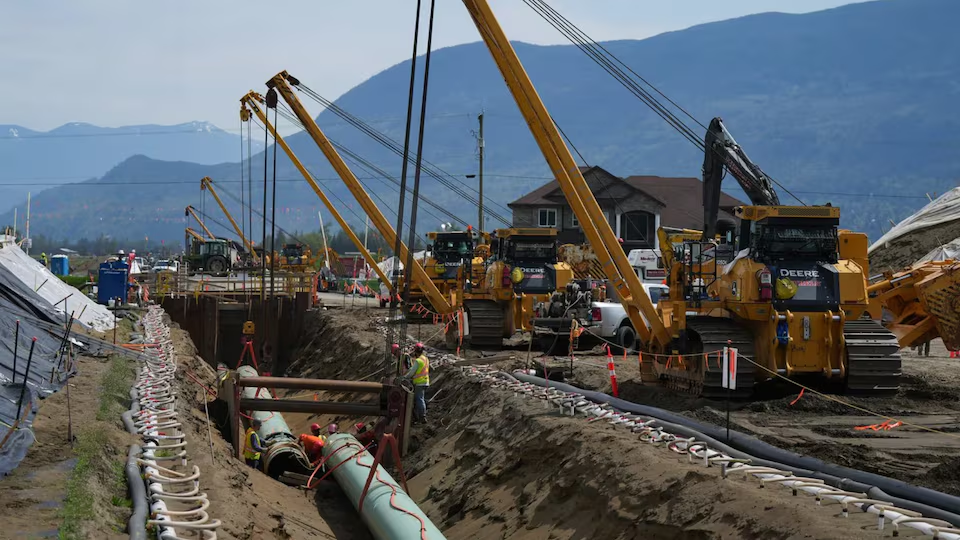
- Capital costs: New export pipelines crossing multiple provinces and sensitive ecosystems now carry price tags in the tens of billions of dollars, a scale that demands ironclad shipping commitments before financing can be secured.
- Indigenous consent: The legal duty to consult and, increasingly, the political expectation of free, prior, and informed consent have proven difficult to navigate when routes traverse unceded territories.
- Climate litigation risk: Investors are increasingly wary of assets that could become stranded under tightening emissions regulations or face lawsuits challenging their alignment with Canada’s net-zero ambitions.
Oil sands output continues to climb slowly, driven by optimization at existing facilities, yet the takeaway capacity has not kept pace. Differentials between Western Canadian Select and global benchmarks periodically widen when pipelines run full, costing producers—and by extension, provincial and federal treasuries—billions in foregone revenue. This economic pain point is precisely what Ottawa aims to address, albeit through a mechanism that short-circuits the usual private-sector-led development model.
The Economic Calculus: Toll Certainty and Global Demand
Any pipeline, regardless of who builds it, must eventually pay for itself. That requires long-term shipping contracts that underwrite the cost of construction and operation. In the absence of a proponent, the critical question is who will commit to the tolls. Without visible commercial backing, the project risks becoming an expensive white elephant. Ottawa appears to be betting that once the route receives cabinet approval and the regulatory path is de-risked, producers and investment funds will negotiate tolling agreements. The government’s willingness to backstop early costs through federal guarantees or a dedicated Crown corporation further sweetens the deal.
Global demand for heavy crude, particularly from Asian refiners, remains robust even as the energy transition accelerates. Analysts project that Canadian oil could command a premium in markets that value supply security from politically stable democracies. A new pipeline heading toward the Pacific coast or Hudson Bay—both routes now under revived scrutiny—would diversify export destinations beyond the United States, reducing the pricing power of Gulf Coast refineries. That diversification premium alone could justify the infrastructure economics for shippers, provided construction timelines hold firm and costs remain within budget.
For institutional investors, a federally anointed pipeline offers a rare profile: long-duration, inflation-protected cash flows backed by a sovereign commitment. Pension funds that have shied away from Canadian energy infrastructure in recent years might re-enter the space if the project can be structured as a predictable, low-controversy asset. The government’s implicit guarantee would lower the risk premium, potentially making debt financing cheaper and equity returns more attractive.
Indigenous Consent and Environmental Flashpoints
No discussion of Canadian pipelines can ignore the tangled issues of land rights and climate accountability. Ottawa insists it will uphold its duty to consult and accommodate Indigenous communities meaningfully, but a compressed timeline raises legitimate concerns about the depth of that engagement. Early reactions from First Nations and environmental groups have been swift and pointed, warning that ramming through a pipeline by decree undermines reconciliation and contradicts Canada’s pledges to cut emissions.
The climate dimension is similarly fraught. The federal government continues to champion net-zero goals while simultaneously enabling an expansion of fossil fuel export capacity. Reconciling those two positions will require extraordinarily careful messaging, potentially accompanied by new sectoral emissions caps on oil and gas or enhanced investments in carbon capture and nature-based solutions. The political calculus seems to be that maintaining Canada’s reputation as a reliable energy supplier, while advancing a just transition, can be achieved if the new pipeline is part of a broader package that accelerates clean electricity, hydrogen, and critical minerals infrastructure.
Marine ecosystems will also return to the spotlight. Whether the terminus lies on the Pacific, with its tanker traffic implications for coastal communities and orca habitats, or on Hudson Bay, with its fragile Arctic ecology, the environmental assessment will be fiercely contested. The government’s ability to design mitigation measures that pass scientific muster and withstand judicial review will be central to keeping the 2027 construction date intact.
What This Means for Investors and the Energy Sector
Markets have reacted cautiously, with initial skepticism reflected in the muted movement of energy equities. The announcement introduces a new variable into portfolio strategies tied to Canadian resources. On the bullish side, a federally backed pipeline could unlock billions in pent-up value for producers, narrowing the differential and raising the netback per barrel. On the bearish side, the project’s execution risks remain extraordinarily high, and any misstep—a court injunction, a cost overrun, a breakdown in negotiations—could poison the investment case.
Key factors investors should monitor:
- Route selection and cabinet approval: The corridor chosen will determine the geological, legal, and political complexity. A public announcement is expected within months, triggering a wave of detailed analysis.
- Emergence of a private partner: Watch for signals that a supermajor or infrastructure fund is in confidential talks with the Crown. Any such development would sharply de-risk the venture.
- Toll framework: The structure and level of shipping tariffs will reveal whether the economics are truly attractive or dependent on perpetual subsidy.
- Indigenous equity partnerships: Meaningful ownership stakes for affected communities could reduce opposition and recast the project as a shared prosperity endeavor, a model successfully tested in other Canadian infrastructure deals.
- Carbon policy alignment: The introduction of stricter emissions caps or offsets mandated for the pipeline’s operational phase could alter the long-term cost profile.
A Political Gamble with High Stakes
The fall 2027 deadline is as much a political milestone as an engineering one. It positions the government as a decisive actor willing to override institutional inertia in pursuit of national economic interest. But the gambit could backfire spectacularly if the project stalls during consultations or if the courts intervene. A failed pipeline would become a symbol of governmental overreach and deepen the rift between resource-producing regions and urban centers skeptical of fossil fuel expansion.
Conversely, if Ottawa succeeds in landing a builder and keeping the project on track, it could reset the template for major energy infrastructure approval in Canada. The Crown corporation model, once considered a temporary expedient, might become a permanent tool for tackling projects that private markets deem too risky. That prospect raises profound questions about the division of risk between taxpayers and investors, and about whether the state should act as a developer of last resort for carbon-heavy infrastructure at a moment when the global imperative is to accelerate decarbonization.
For now, the clock is ticking. Environmental baseline studies, community negotiations, and engineering pre-work must hit aggressive milestones to hold the 2027 target. Industry insiders note that the window to mobilize a project of this scale is vanishingly narrow, and that delays at any stage could push construction into the next decade. The federal government has made its move. Whether the market answers the call—and whether the country’s legal and social fabric can accommodate the answer—remains the defining uncertainty of this audacious experiment.