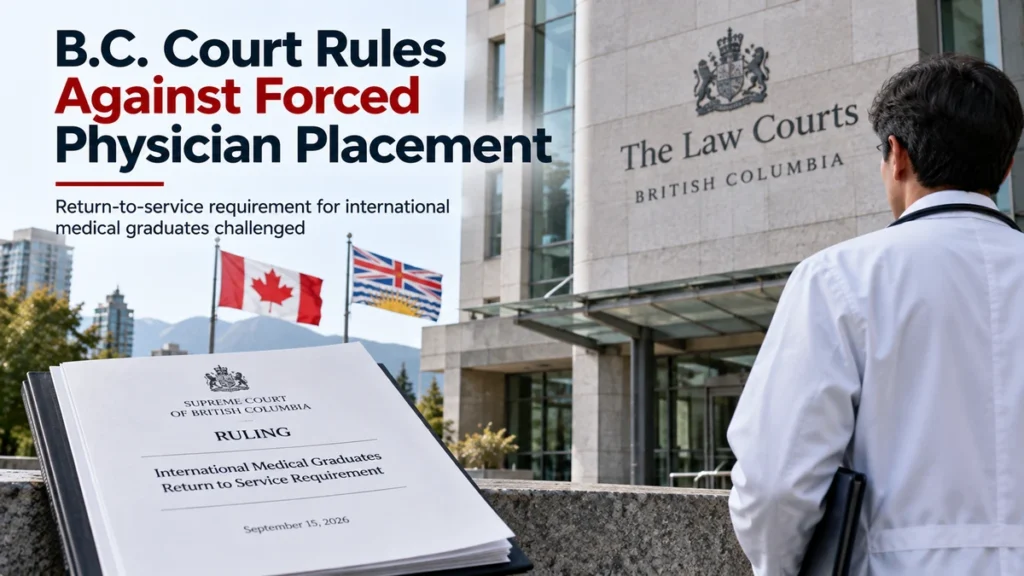
B.C. Courtroom Guidelines In opposition to Pressured Physician Placement
B.C. Supreme Courtroom rejects necessary rural doctor placement coverage. Study what this landmark ruling means for foreign-trained medical doctors.
foreign-trained medical doctors B.C.
When a Province Overreaches: Understanding the B.C. Courtroom Choice
Think about being a professional doctor who educated overseas, cleared Canadian licensing exams, and is able to follow medication—solely to be advised you have to work in a distant group for years earlier than you possibly can select the place to ascertain your follow. This situation grew to become actuality for foreign-trained medical doctors in British Columbia, till a court docket dominated the coverage went too far.
The B.C. Supreme Courtroom just lately decided that the province lacked the authorized authority to power foreign-trained medical doctors into necessary rural placements. This choice essentially challenges how British Columbia has been managing its doctor workforce in distant and underserved areas.
The Coverage That Sparked the Authorized Battle
British Columbia had carried out a requirement forcing internationally educated physicians to follow in designated distant or underserved areas earlier than they may work elsewhere within the province. The reasoning appeared logical on the floor: rural and distant communities throughout B.C. face persistent doctor shortages, and this coverage aimed to handle that hole by making certain foreign-trained medical doctors would contribute to areas that desperately wanted medical providers.
Nevertheless, the court docket discovered a crucial drawback with this method. The provincial authorities merely did not have the constitutional or statutory authority to impose such necessary placement situations on physicians. This wasn’t a debate about whether or not the aim was worthwhile—it was about whether or not the tactic violated the regulation.
Why This Issues for Healthcare Entry
Rural and distant British Columbia already faces important healthcare challenges. Communities in areas just like the Kootenay area, the Okanagan, and Northern B.C. have struggled to draw and retain physicians for many years. Overseas-trained medical doctors have represented a possible answer to those shortages, as they create invaluable medical experience and worldwide healthcare views.
By putting down the necessary placement coverage, the court docket created a direct drawback: how will these communities fill doctor gaps if medical doctors aren’t required to work there? The province now faces a real healthcare entry disaster in areas the place inhabitants bases are smaller and residing situations much less city.
The irony is painful. Distant B.C. communities have been counting on this coverage to construct medical capability, and now that authorized instrument is gone. With out necessary placement necessities, foreign-trained physicians will naturally gravitate towards main city facilities like Vancouver and Victoria the place alternatives are extra ample and existence extra interesting.
What the Courtroom Truly Discovered
The B.C. Supreme Courtroom’s reasoning centered on the boundaries of provincial energy. Whereas provinces do regulate healthcare and doctor licensing, they can not impose employment or placement situations that exceed their constitutional authority. The court docket basically stated: you possibly can require sure {qualifications}, you possibly can set licensing requirements, however you can not power somebody to work in a selected location as a situation of follow.
This distinction issues legally. It protects physicians’ elementary rights to decide on the place they follow whereas concurrently limiting the federal government’s skill to make use of regulatory energy to resolve workforce issues unilaterally.
The Broader Implications for Medical Professionals
This ruling impacts not simply present foreign-trained medical doctors in B.C., but in addition the recruitment pipeline for future physicians from overseas. Medical professionals contemplating working towards in Canada might view B.C. extra favorably now, realizing they will not face necessary rural placement necessities. However this profit comes at the price of the very communities that want physicians most.
Different provinces watching this choice carefully will probably rethink their very own doctor placement insurance policies. Alberta, Saskatchewan, and Manitoba have explored comparable methods to handle rural doctor shortages. The B.C. court docket choice suggests these approaches might face authorized challenges.
Various Options B.C. Should Now Discover
With necessary placement off the desk, British Columbia must develop new methods. These might embrace monetary incentives for physicians keen to follow in distant areas, mortgage forgiveness packages for individuals who decide to underserved communities, or enhanced help providers that make rural follow extra enticing.
The province may additionally spend money on telemedicine infrastructure and specialist rotation packages, permitting distant communities to entry specialist providers with out requiring everlasting doctor relocation. Indigenous communities inside B.C., which face significantly acute doctor shortages, might have specialised recruitment approaches that respect their cultural contexts and healthcare sovereignty.
What Overseas-Educated Medical doctors Ought to Know Proper Now
Should you’re a foreign-trained doctor contemplating B.C. follow, this choice adjustments your panorama considerably. You are now not topic to necessary rural placement necessities that beforehand restricted your skilled freedom. Nevertheless, this doesn’t suggest you need to ignore rural alternatives—many underserved communities provide distinctive medical experiences, stronger affected person relationships, and rising profession development potentialities.
The sensible subsequent step: join with B.C.’s doctor recruitment networks to know present alternatives. The provincial authorities will probably speed up non-mandatory incentive packages to draw physicians to distant areas, and these packages might provide actual advantages price contemplating.
The Financial Actuality of Rural Follow
Monetary incentives turn out to be much more crucial now. B.C. might want to provide aggressive salaries, relocation help, and follow help to draw physicians to distant areas voluntarily. Some provinces have found that providing rural physicians increased compensation, decreased administrative burden, or housing help could be surprisingly efficient.
Moreover, foreign-trained medical doctors ought to know that many rural communities provide life-style benefits city practitioners miss: nearer relationships with sufferers throughout a number of generations, decrease prices of residing, stronger group integration, and sometimes larger medical autonomy.
What Occurs Subsequent in B.C. Healthcare
The provincial authorities should now design compliant insurance policies that deal with rural doctor shortages with out violating doctor rights. This probably means laws clarifying what incentives are permissible and what situations aren’t. Watch for brand new funding bulletins supporting rural doctor recruitment, improved working situations in distant amenities, and presumably mortgage forgiveness packages for graduates keen to follow in underserved areas.
Distant B.C. communities should not lose hope. Whereas necessary placement is gone, voluntary recruitment backed by real help can work. A number of rural practices have efficiently attracted and retained physicians by providing higher amenities, collegial working environments, and communities that genuinely worth their contributions.
Shifting Ahead: Discovering Steadiness
This court docket choice represents a pressure inherent in healthcare coverage: how do you deal with official geographic disparities in doctor distribution with out violating particular person skilled freedom? There isn’t any simple reply, which is why the ruling issues a lot past B.C.
For foreign-trained medical doctors, this implies enhanced freedom but in addition a chance to decide on communities that align with their values. For distant B.C., it means the province should get inventive, spend money on incentives, and construct the sort of healthcare infrastructure that draws physicians by real alternative reasonably than authorized requirement. The actual work is simply starting.