
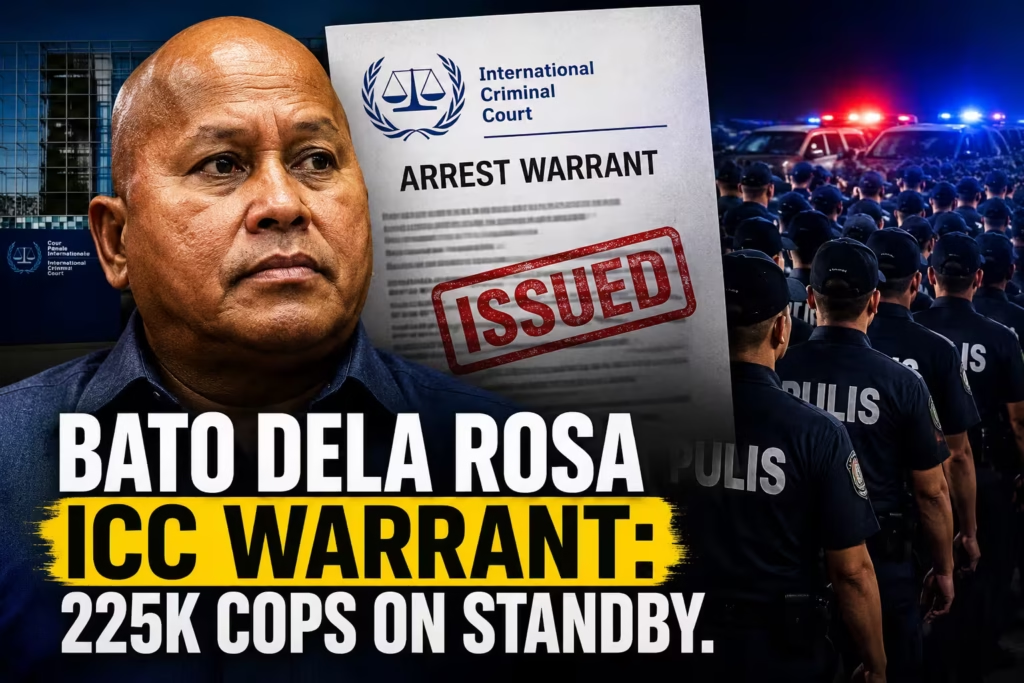
Bato dela Rosa Is Now a Fugitive Senator — The ICC Warrant the Philippines Can No Longer Ignore
Published: May 22, 2026 | Philippines Political Affairs
There’s a particular kind of theater that unfolds when a man who once ran 225,000 police officers finds himself running from two of them.
That’s the image that defined May 11, 2026 — Senator Ronald “Bato” dela Rosa, former chief of the Philippine National Police, scrambling up a Senate staircase in visible panic to escape two female NBI agents who were quietly trying to serve him with an International Criminal Court arrest warrant. He stumbled. He nearly hit his head on the concrete. His aides could barely keep up.
Three days later, he was gone from the Senate entirely.
What the ICC Actually Charged Him With
The warrant didn’t appear out of thin air. ICC Pre-Trial Chamber I — the same all-women chamber that ordered Rodrigo Duterte’s arrest in 2025 — issued a sealed warrant against dela Rosa on November 6, 2025. It was unsealed on May 12, 2026, after its existence was confirmed by the ICC itself.
The charge: crimes against humanity of murder, covering the period from July 3, 2016 to the end of April 2018. The court found reasonable grounds to believe dela Rosa was criminally responsible as an indirect co-perpetrator in the deaths of at least 32 people during the Duterte administration’s drug war.
The warrant didn’t just name him as a bystander. It alleged that dela Rosa, together with co-perpetrators, built “a network of perpetrators” and recruited “individuals they could trust and control” — language that places him at the organizational center of the systematic killings, not at its fringe.
The ICC ordered his arrest — rather than issuing a simple summons — because it found “no reasonable expectation that he would cooperate,” citing his repeated public attacks on ICC investigators and his contemptuous statements about those cooperating with the tribunal.
The Standoff Nobody Expected to Last This Long
On the afternoon of May 11, NBI agents moved to serve the warrant when dela Rosa appeared at the Senate for a session vote. What followed was less a legal proceeding and more a slow-motion institutional crisis.
Dela Rosa pushed past the two agents at the Senate basement entrance and fled into the building. The Senate, led by allies, placed him under “protective custody.” Armed Marines were stationed at the premises. Gunshots were fired on the night of May 13 — authorities later identified an NBI volunteer driver as a suspect. Dela Rosa emerged the next morning, teary-eyed, and said it was “the lowest point of my life.”
By Thursday, May 14, he had slipped out of the Senate compound altogether, reportedly with Senator Robin Padilla. His wife released a message apologizing for “the confusion and havoc.”
Since then, he has been a man without a confirmed address.
The Supreme Court Door Has Closed
Dela Rosa had pinned his legal survival on a petition before the Supreme Court — filed originally in November 2025 — seeking a temporary restraining order to block his ICC arrest. For months, that petition gave him breathing room. The Senate’s protective custody did the rest.
Both shields are now gone.
The Supreme Court denied his petition. The Department of Justice, through Secretary Fredderick Vida, declared on May 22 that the ICC warrant is now “valid and enforceable.” The PNP and NBI have been formally ordered to execute the arrest. Vida confirmed authorities have information on dela Rosa’s whereabouts but declined to specify.
The Davao City Police Office, where dela Rosa has deep political roots, clarified on May 20 that it has received no directive to apprehend him — though local speculation continues about whether he is sheltering in Mindanao.
Why This Case Is Bigger Than Bato
Set aside the politics for a moment. What this case actually tests is whether the Philippines’ ICC cooperation framework, codified under Republic Act 9851, holds any practical weight when the target is not a powerless suspect but a sitting senator with 20.7 million voters behind him.
Duterte’s arrest in March 2025 was shocking in its speed. This one has been slower, messier, and far more revealing. The Senate functioned — however briefly — as a sanctuary. Elected colleagues who claimed the ICC warrant was invalid were, according to legal analysts, simply wrong. The ICC itself confirmed the document’s authenticity in real time.
The question now isn’t whether the warrant is legitimate. That’s settled. The question is who moves first — and whether the country’s institutions, tested in ways they clearly weren’t prepared for, can deliver a senator to The Hague the way they once delivered a president.
Key Facts at a Glance
- Warrant issued: November 6, 2025 (sealed); unsealed May 12, 2026
- Charge: Crimes against humanity — murder (at least 32 victims, July 2016–April 2018)
- Legal status as of May 22, 2026: Valid and enforceable per DOJ; SC petition denied
- Current status: At large; NBI and PNP on active manhunt
- Second ICC suspect from Philippines: First was Rodrigo Duterte, arrested March 2025
This article is based on verified reports from the ICC, Department of Justice, Philippine News Agency, Rappler, Manila Times, and Amnesty International. All facts are drawn from confirmed public statements and official court documents.