🔴 Most Straight Affected International locations (Excessive Impression)
These nations rely closely on Gulf-based cable routes:
- United Arab Emirates
- Oman
- Qatar
- Kuwait
- Bahrain
- Saudi Arabia
- Iran
👉 These nations might expertise:
- Web slowdowns or outages
- Banking and telecom disruptions
- Points with cloud providers and authorities techniques
🟠 Strongly Affected (Asia–Center East Connection)
These nations use routes passing by means of or close to the Gulf:
- India
- Pakistan
- Sri Lanka
👉 Potential results:
- Slower web speeds
- Delays in monetary transactions
- Knowledge rerouting (increased latency)
🟡 Reasonably Affected (Asia–Europe Visitors)
Giant economies with a number of routes however nonetheless uncovered:
- China
- Singapore
- Indonesia
- Malaysia
👉 These nations have backups, however:
- Community congestion might happen
- Cloud providers could decelerate
🔵 Europe (Oblique Impression)
- United Kingdom
- Germany
- France
👉 Results would come with:
- Slower connections to Asia
- Monetary market latency
- Knowledge rerouting through longer paths
🟢 Least Affected (Excessive Redundancy)
- United States
- Japan
- Australia
👉 These nations rely extra on:
- Pacific Ocean cable routes
- Satellite tv for pc backups
So impression can be minimal or oblique.
⚠️ Massive Image
The actual danger just isn’t a complete web shutdown—it’s regional disruption and world slowdown.
If cables in Hormuz are broken:
- The Center East can be hit hardest
- Asia–Europe knowledge visitors would gradual
- Monetary techniques and cloud platforms might really feel ripple results worldwide
International Web at Threat? Iran Targets Subsea Fiber-Optic Cables Working Beneath Strait of Hormuz
For many years, the Strait of Hormuz has been seen primarily because the world’s most harmful oil chokepoint. Roughly one-fifth of worldwide petroleum flows by means of the slender waterway separating Iran from the Gulf states, making it one of the vital strategically delicate corridors on Earth.
However beneath the oil tankers and naval patrols lies one other, much less seen vulnerability—one which powers the trendy digital economic system itself.
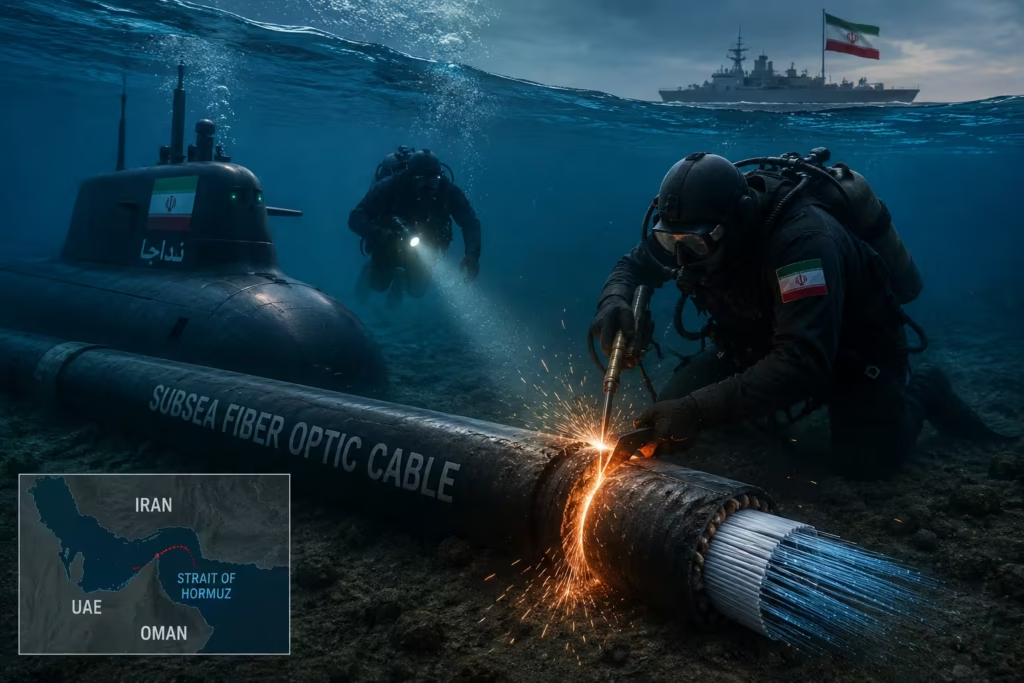
Working throughout the seabed of the Strait of Hormuz is a dense community of subsea fiber-optic cables carrying huge volumes of worldwide web visitors. These underwater strains join Asia, the Center East, and Europe, enabling all the things from cloud computing and worldwide banking to video calls and navy communications. Now, amid rising geopolitical tensions, Iran’s more and more aggressive rhetoric surrounding these cables is triggering alarms far past the Gulf.
The Web’s Hidden Spine
Most individuals think about the web as satellites floating in house or wi-fi indicators shifting invisibly by means of the air. In actuality, almost all world knowledge visitors travels by means of bodily cables laid throughout the ocean flooring.
These subsea fiber-optic cables carry roughly 99% of worldwide web visitors, forming the spine of the worldwide digital economic system.
A number of of the world’s most essential cable techniques go by means of or close to the Strait of Hormuz, together with routes linking Gulf states to Europe and Asia. Main know-how corporations, monetary establishments, and cloud suppliers rely closely on these pathways.
That focus creates a harmful strategic actuality: a disruption in Hormuz wouldn’t merely have an effect on regional communications—it might ripple by means of worldwide monetary markets, logistics networks, AI infrastructure, and world commerce.
Iran’s Rising “Digital Chokepoint” Technique
In latest weeks, Iranian state-linked media and officers have more and more highlighted the strategic worth of the undersea cables crossing the Strait of Hormuz. Some stories linked to the Islamic Revolutionary Guard Corps (IRGC) have brazenly mentioned imposing charges, tighter regulation, or state management over submarine cable visitors.
The messaging seems deliberate.
Iran has lengthy used the Strait of Hormuz as geopolitical leverage by means of threats to grease delivery. However as the worldwide economic system turns into extra depending on digital infrastructure, Tehran could now view web cables as an extra stress level towards Western governments and multinational firms.
Consultants warn that even oblique threats towards cable techniques might have main penalties. Restore vessels could hesitate to function in battle zones, insurers might increase maritime premiums, and firms could speed up contingency planning for different knowledge routes.
Importantly, analysts stress that Iran probably can’t “shut down the worldwide web” outright. The community has built-in redundancies and different routing techniques. Nevertheless, focused disruptions might nonetheless produce extreme regional slowdowns, outages, and financial disruption.
Why These Cables Matter Extra Than Oil
The financial significance of undersea cables is tough to overstate.
Each worldwide monetary transaction, inventory commerce, cloud-based AI course of, encrypted authorities communication, and cross-border company operation is dependent upon quick and steady connectivity.
If main cable techniques in Hormuz had been broken or disabled, the consequences might unfold quickly throughout a number of sectors:
- Monetary buying and selling techniques might face latency spikes or outages
- Cloud providers operated by firms like Google, Amazon, and Microsoft might expertise disruptions
- Gulf-region banking and telecom networks might gradual dramatically
- AI infrastructure depending on high-capacity worldwide knowledge switch may very well be affected
- Worldwide delivery and logistics techniques might encounter communication delays
In trendy economies, digital connectivity is now as strategically essential as vitality provide chains.
That actuality is altering how governments take into consideration nationwide safety.
The Geography of Vulnerability
One motive the Strait of Hormuz presents such a severe danger is geography.
The waterway is slender, shallow, and closely congested with business and navy visitors. Subsea cables passing by means of the area are due to this fact extra uncovered to unintentional harm, sabotage, anchoring incidents, or navy escalation.
Trade analysts be aware that cable faults happen frequently around the globe, typically attributable to fishing tools or ship anchors. Globally, an estimated 150 to 200 cable disruptions occur every year.
Beneath regular circumstances, repairs are manageable. In an lively geopolitical hotspot, nevertheless, restore operations grow to be considerably tougher.
That’s the place the Hormuz situation turns into uniquely harmful.
A cable minimize in a peaceable area could take days to restore. A cable minimize inside a militarized maritime hall might take weeks—or longer—if restore crews face safety threats.
Hybrid Warfare Strikes Underwater
Navy strategists more and more describe subsea infrastructure as the following frontier of hybrid warfare.
Not like missile strikes or direct cyberattacks, interference with undersea cables operates in a grey zone. Attribution is tough, deniability is excessive, and the financial results could be huge with out triggering typical navy escalation.
This isn’t simply an Iran challenge.
Russia, China, and NATO nations have all intensified surveillance and monitoring of important underwater infrastructure in recent times. Undersea communications networks at the moment are seen alongside pipelines and energy grids as high-value strategic belongings.
The priority just isn’t essentially a dramatic “web blackout.” The extra reasonable situation includes slower, fragmented, or unstable worldwide connectivity that quietly disrupts monetary techniques, authorities operations, and company infrastructure.
That refined disruption might nonetheless value billions.
Can the International Web Adapt?
The web was designed with resilience in thoughts. Visitors can typically reroute by means of different pathways when one cable fails.
However redundancy has limits.
The focus of cable techniques by means of main chokepoints just like the Crimson Sea, Suez Canal, and Strait of Hormuz means a number of disruptions occurring concurrently might create substantial bottlenecks. Latest assaults and instability round Crimson Sea delivery routes have already uncovered how fragile components of the world’s digital infrastructure can grow to be throughout regional battle.
Consequently, governments and telecom corporations are more and more investing in diversified cable routes, satellite tv for pc backups, and new infrastructure corridors that bypass geopolitical flashpoints altogether.
The problem is scale. Constructing new subsea techniques takes years and prices billions.
Closing Ideas
The rising concentrate on subsea cables within the Strait of Hormuz displays a bigger transformation in world safety.
The world’s most essential infrastructure is now not restricted to grease pipelines, ports, and delivery lanes. More and more, the worldwide economic system is dependent upon invisible digital arteries working quietly throughout the ocean flooring.
Iran’s rhetoric surrounding these cables could partly be strategic signaling fairly than an instantaneous operational menace. Nonetheless, the priority itself is sufficient to expose a deeper actuality: the trendy web is way extra bodily weak than most individuals notice.
The subsequent main geopolitical confrontation could not start with tanks or missiles.
It might start with a severed cable beneath the ocean.