How BC’s $1 Million Lightning Reduction Investment Could Transform Wildfire Prevention
British Columbia is taking a bold, science-driven step to tackle one of the most unpredictable triggers of catastrophic wildfires: lightning strikes.
The provincial government has announced a $1 million investment in lightning reduction technology, a move aimed at reducing the natural ignition source responsible for nearly half of the province’s annual wildfire starts.
This is more than another budget allocation. It is a strategic investment in emerging atmospheric science that could reshape how fire-prone regions manage wildfire risk.
The Challenge of Lightning-Caused Wildfires
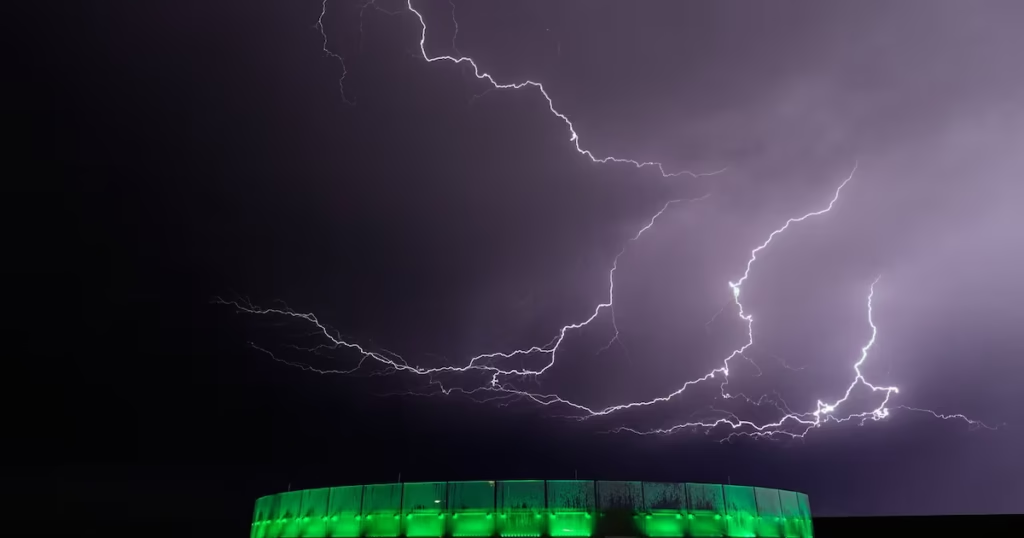
Lightning is far more than a dramatic summer weather event in BC. It is one of the leading causes of large-scale wildfires across the province.
Statistics consistently show that lightning ignitions account for a disproportionate share of total burned area. While human-caused fires are often detected quickly, lightning-started blazes frequently ignite in remote and rugged terrain during hot, dry conditions. Many smolder undetected for days before erupting into major fires.
For example, the 2023 wildfire season saw lightning responsible for more than 60% of the area burned in BC, including several massive fire complexes that cost hundreds of millions of dollars to suppress.
Climate change is intensifying the threat. Warmer, drier summers are extending the lightning season and increasing the frequency of dry lightning storms — thunderstorms that produce lightning with little or no rainfall.
Traditional prevention measures such as fire bans, public education campaigns, and aerial patrols do little to address this natural ignition source. That is why the province is exploring technologies designed to reduce the number of lightning strikes reaching the ground in high-risk areas.
What Is Lightning Reduction Technology?
The term “lightning reduction technology” refers to several emerging systems designed to reduce the electrical buildup inside storm clouds before natural lightning forms.
The core concept is relatively straightforward: by creating a controlled conductive path or releasing ions into the atmosphere, the system can gradually dissipate electrical charge from a storm cloud. This reduces the likelihood of a powerful lightning strike.
Key technologies being explored globally include:
- Ground-based ion generators — Devices that release high-voltage corona discharge into the atmosphere to slowly neutralize storm-cell charge buildup.
- Laser-assisted lightning control — High-frequency lasers that ionize a path through the air, directing low-energy lightning along a controlled route. This remains largely experimental.
- Water-spray triggered lightning — Fine mist systems that create conductive atmospheric columns to trigger controlled discharges.
- Rocket-and-wire systems — Technology used primarily in lightning research to intentionally trigger lightning strikes for scientific analysis.
BC’s investment is expected to focus on deployable ion-generator systems that can operate in high-risk wildfire corridors such as the Cariboo, Okanagan, and Peace regions.
Details of BC’s $1 Million Investment
The funding, allocated through the Ministry of Forests and the BC Wildfire Service, will support a multi-year pilot project.
The investment will fund:
- Installation of three to four ion-generator stations in high-lightning-incidence regions.
- Weather-monitoring integration to activate systems only during elevated lightning-risk conditions.
- Data analysis comparing lightning activity and wildfire starts in treatment zones versus control areas.
- Collaboration with university researchers and atmospheric scientists to refine the technology for BC’s terrain and weather patterns.
Implementation Timeline
The project is expected to begin with site selection and environmental assessments in spring 2025, followed by installation during the summer months.
Operational testing will coincide with peak lightning season between June and August, with preliminary findings anticipated by late 2026.
Potential Impact on Wildfire Prevention
If successful, the pilot program could reduce lightning-caused wildfire ignitions by an estimated 15–30% in targeted areas.
While that figure may appear modest, even a small reduction could prevent dozens of fires annually — particularly the large and difficult-to-control fires that ignite in isolated terrain.
The broader benefits could include:
- Lower wildfire suppression costs.
- Reduced smoke and air-quality impacts.
- Fewer evacuations and infrastructure disruptions.
- Lower carbon emissions from major wildfires.
- Reduced operational strain on firefighting crews and equipment.
Expert Perspectives
Scientists and wildfire experts have responded to the initiative with cautious optimism.
Dr. Sarah Tremblay, a lightning physicist at the University of Victoria, noted that the science behind controlled lightning discharge has existed for decades, but scaling the technology remains the central challenge.
Meanwhile, retired BC Wildfire Service officer Mark Johansen emphasized that the technology should be viewed as one tool among many.
He warned that lightning reduction systems are unlikely to work against lightning generated inside pyrocumulonimbus clouds associated with active megafires, but they could prove useful during typical summer dry-storm events.
Some critics have questioned whether the $1 million would be better spent on drone surveillance, fuel management, or early-detection systems.
However, the province has framed the initiative as a targeted research and development investment rather than a long-term operational replacement for existing wildfire strategies.
A New Tool in the Wildfire Arsenal
BC’s investment reflects a broader recognition that wildfire management cannot rely solely on suppression efforts after fires begin.
Preventing ignitions before they occur is becoming increasingly important as climate-driven fire seasons grow longer and more destructive.
The province’s approach mirrors similar experimental strategies being explored in California, Australia, and parts of the Mediterranean, where authorities are testing advanced atmospheric technologies to reduce wildfire risk near critical infrastructure.
Israel has also used ground-based ion-generator systems near power and industrial facilities to minimize lightning-related hazards.
BC could become one of the first jurisdictions to adapt this concept specifically for large-scale wildfire prevention.
What Comes Next
The success of the pilot project will depend on transparent scientific evaluation and measurable results.
The BC Wildfire Service has committed to monitoring the technology closely and publishing findings that could guide future wildfire-prevention strategies across Canada and other fire-prone regions.
If the pilot proves effective, future expansion could involve partnerships with agencies such as Parks Canada, BC Hydro, and forestry-sector stakeholders operating in lightning-prone regions.
For now, the province’s $1 million investment represents a calculated but potentially transformative experiment — one that reflects how governments are increasingly turning to innovation and advanced climate technology in the fight against extreme wildfires.