
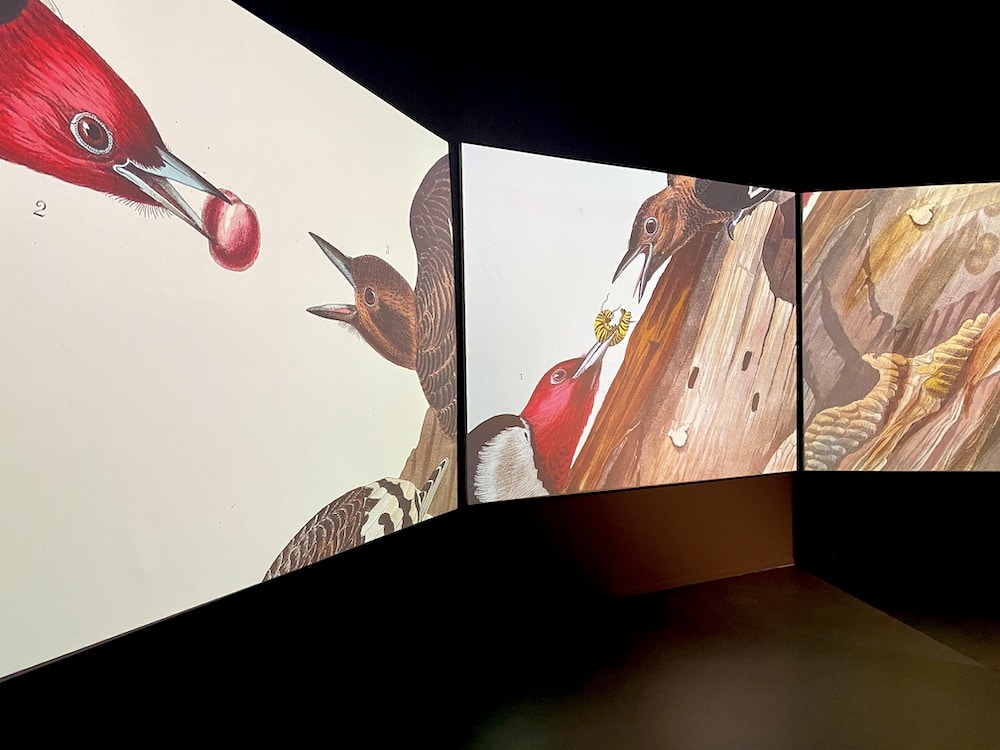
Audubon’s Priceless Birds of America Debuts in Glasgow Exhibition
Most art lovers have stood before a famous painting. Fewer have stood before a single book valued higher than a private island. In Glasgow, visitors now have that rare opportunity.
One of the most extraordinary and valuable books ever created—John James Audubon’s Birds of America—is currently on public display. It is a work of staggering scale, scientific ambition, and artistic precision that continues to defy conventional definitions of a “book.”
This is not a casual reading experience. It is a “double elephant folio,” a technical term for a format so large it requires custom supports, climate-controlled environments, and museum-grade security.
The Unmatched Scale of Audubon’s Masterwork
When Audubon set out to document every bird species in North America, he made a defining decision: each bird would be depicted at life size. That choice dictated everything that followed.
At the time, no printing press could accommodate such enormous pages. The result was the double elephant folio, measuring approximately 39.5 inches by 28.5 inches—larger than most modern television screens.
Handling it is a logistical exercise in itself. Opening a volume typically requires two people and a reinforced display surface.
Why This Book Commands Eight-Figure Values
For collectors and institutions, Birds of America exists in a category of its own. Several factors drive its extraordinary value:
- Extreme rarity: Only around 120 complete sets are known to exist globally, many held in museums or sealed collections.
- Finite production: The original copper plates were destroyed, meaning no further copies can ever be produced.
- Auction history: A complete set sold at Sotheby’s in 2010 for over $11 million, setting a record for a printed book.
- Hand-finished detail: Each plate was individually hand-colored, meaning no two copies are perfectly identical.
For bibliophiles, it represents a convergence of art, science, and printmaking at the highest level.
Art That Redefined Scientific Illustration
Prior to Audubon, ornithological illustration often presented birds in static, lifeless forms—scientifically accurate but visually restrained.
Audubon rejected that approach.
His birds are dynamic, often captured mid-action: hunting, feeding, defending territory, or interacting with their environment. The result is not merely documentation, but narrative composition.
Critics of his time occasionally viewed his work as overly theatrical. Today, that expressive realism is considered one of its defining strengths.
A Window Into a Vanished World
Beyond its artistic importance, Birds of America functions as a powerful ecological record. Audubon’s work predates large-scale industrialization and habitat loss in North America.
Several species he documented are now extinct, including:
- Passenger Pigeon
- Carolina Parakeet
- Great Auk
- Labrador Duck
These species survive today only through museum specimens—and Audubon’s plates, which preserve their appearance in vivid detail.
The Glasgow Exhibition Experience
The Glasgow exhibition offers a rare opportunity to view one of these volumes outside its usual controlled storage environment. Typically, these books are kept under strict environmental conditions due to their fragility and value.
Visitors will see a single volume open to a selected plate, chosen to reflect both artistic and scientific significance.
Expect:
- Monumental scale that immediately dominates perception
- Rich, hand-applied coloration preserved over two centuries
- Detail that far exceeds digital reproductions
No reproduction fully captures the physical presence of these plates. The impact is primarily one of scale, followed by intricate visual complexity.
Why It Matters to Naturalists and Artists
For ornithologists and bird enthusiasts, Audubon remains a foundational reference point in visual natural history.
While modern photography captures precise moments in time, Audubon’s work synthesizes extensive field observation into composed, interpretive studies of behavior and form.
Each illustration reflects not just appearance, but ecological understanding—how species move, interact, and inhabit their environments.
Expert Perspective: Why This Exhibition Stands Out
From an art historical standpoint, Birds of America occupies a position alongside the most significant achievements in printmaking.
From a conservation perspective, it serves as a visual archive of species and ecosystems that have since disappeared.
From a collector’s perspective, it represents one of the rarest intersections of scientific ambition and artistic execution ever produced.
Final Thought
Exhibitions of this calibre are rare. The logistical complexity of transporting and displaying a double elephant folio means public viewings are infrequent and tightly controlled.
This is a work that has endured over two centuries—surviving time, environmental risk, and historical upheaval. It outlives both its creator and many of the species it depicts.
For visitors in Glasgow, it offers a direct encounter with a landmark of natural history and printmaking.
And it leaves a simple, lasting impression: scale, detail, and ambition rarely align this completely in a single work.

