The Canadian Blueprint Behind Nigel Farage’s Reform UK Surge
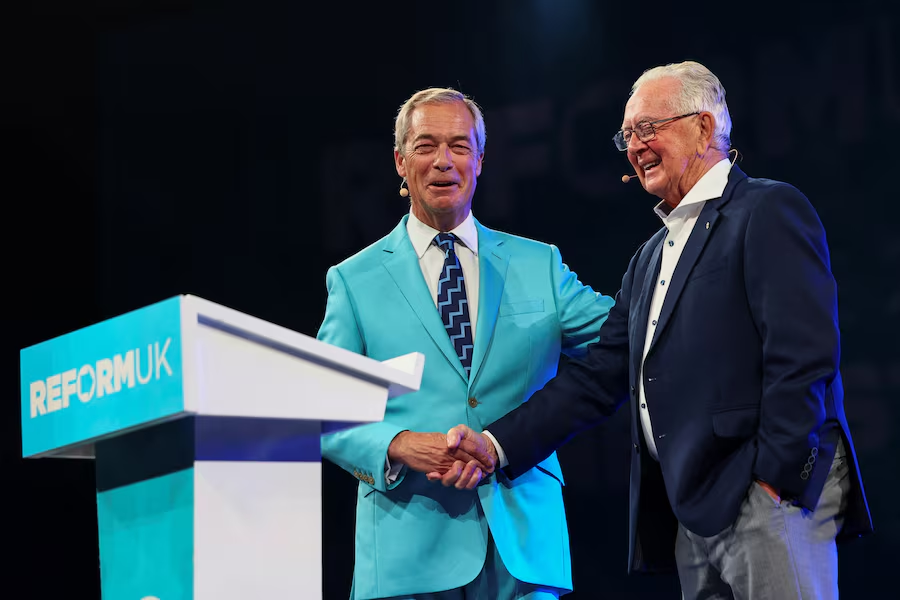
Nigel Farage, the outspoken architect of Brexit, has frequently looked across the Atlantic for political strategy—but not always to the United States. The real blueprint for his surging Reform UK party traces back to the windswept Canadian prairies of the 1990s, where Preston Manning’s populist Reform Party shattered a complacent political establishment and rewrote the rules of grassroots campaigning. Farage’s admiration for Manning is no secret; he has openly hailed the Canadian Reform movement as a direct inspiration, mining its playbook for the battle to upend Britain’s two-party dominance.
The parallels are striking. Manning’s Reform Party of Canada launched in 1987 on a wave of western alienation, channeling anger toward Ottawa elites who, in the eyes of many, ignored the resource-rich provinces in favour of central Canadian interests. Farage’s Reform UK, born from the ashes of the Brexit Party and UKIP, taps into a similar vein of neglected voters—those in post-industrial towns, coastal communities, and rural England who feel abandoned by a London-centric political class. This isn’t a coincidence; it’s a carefully studied migration of a populist formula that turned a fringe protest movement into a government-in-waiting.
Preston Manning’s Populist Laboratory
To understand the DNA of Reform UK, you have to rewind to a Calgary convention hall in 1987. Preston Manning, the son of a former Alberta premier, stood before a crowd of disaffected conservatives and declared that the West wanted in. The Reform Party of Canada wasn’t just another political vehicle—it was a rebellion against a political cartel that treated vast swathes of the country as little more than a resource colony. Manning’s genius lay in framing economic grievances as a crisis of democratic representation. The slogan “The West Wants In” captured a visceral sense of exclusion that transcended traditional left-right labels.
The three pillars of the Canadian Reform playbook that Farage later adopted were:
- Territorial grievance as identity: Manning transformed regional frustration into a unifying political identity, painting Ottawa as a distant, unaccountable power. Farage does the same with Westminster and a London elite detached from “real” Britain.
- Direct democracy and recall: The Canadian Reformers championed citizen-initiated referendums and the right to recall MPs, empowering voters between elections. Farage’s Reform UK promises a “British bill of rights” and citizen-led referendums on major issues, including immigration and net-zero policies.
- Outsider purity over insider compromise: Manning refused to soften his rhetoric to gain media acceptance, betting that authenticity would resonate more than polished messaging. Farage’s pint-in-hand, plain-speaking persona is a direct descendant, engineered to signal that he isn’t one of them.
Manning’s operation didn’t just rail against the system; it built a parallel one. Constituency associations were trained to act less like traditional party branches and more like permanent campaign machines, organizing year-round town halls, community petitions, and membership drives. The goal was to create a self-sustaining ecosystem of engagement that could survive bad election cycles. When Farage launched Reform UK, he inherited this organizational philosophy, emphasizing a mass membership model and grassroots fundraising that bypassed both corporate donors and trade union money.
From Western Alienation to Brexit Rebellion
The 1993 Canadian federal election was Manning’s breakthrough. The Reform Party surged from a single seat to 52, mainly in British Columbia and Alberta, displacing the Progressive Conservatives as the dominant right-of-centre force in much of the country. The Ottawa press corps was stunned, but the warning signs had been flashing for years. Manning’s team had perfected a retail politics style that made every supporter feel like a stakeholder, not just a voter. Town halls were packed with people who had never attended a political meeting before, drawn by the promise that their grievances would finally be taken seriously.
Farage watched this unfold with keen interest. In his memoir and various interviews, he has described the Canadian Reform Party as a model for how a small, ideologically distinct movement could break through. The key insight Farage took was that a populist party doesn’t need to win everywhere; it needs to dominate its geographic and cultural strongholds. Manning taught that a concentrated vote is more efficient than a diffuse one under first-past-the-post systems, a lesson Reform UK is now exploiting in England’s coastal constituencies and former industrial heartlands.
In 2024, Reform UK replicated the Canadian surge pattern almost perfectly. The party won five parliamentary seats but, more importantly, secured second-place finishes in 98 constituencies, collecting over four million votes nationally. This mirrors the Reform Party of Canada’s 1993 breakthrough, where second-place showings laid the groundwork for future gains and, crucially, reshaped the policy agenda of the mainstream conservative party. The mere threat of Reform forced the Progressive Conservatives to adopt tougher stances on fiscal policy and decentralization; Farage’s presence is already pulling the British Conservatives toward harder lines on migration and cultural issues.
The Manning-Farage Philosophical Overlap
Beyond electoral mechanics, the philosophical alignment between Manning and Farage runs deep. Both men understood that populism without a policy engine is just noise. Manning invested heavily in policy development, producing detailed “Blue Books” that translated grassroots sentiment into actionable legislation. Farage’s Reform UK has mimicked this approach, issuing a “contract with the people” that outlines specific proposals—freezing non-essential immigration, scrapping net-zero targets, and reforming the House of Lords—rather than just airing grievances.
The Power of Language and Symbolism
Manning’s communication strategy was deceptively simple: never speak down to voters, never apologize for being angry, and always frame the enemy as a system, not an individual. This created a narrative glue that held together a coalition of fiscal conservatives, social traditionalists, and protest voters who might otherwise have little in common. Farage’s Reform UK operates on the same principle, training candidates to be relatable rather than slick and to avoid the jargon that makes people feel excluded from politics.
The Canadian Reform Party’s use of direct mail and talk radio in the 1990s—bypassing what Manning called the “national media filter”—was the precursor to Farage’s mastery of social media and alternative media platforms. Manning built a communication network that went directly to supporters’ letterboxes, creating an information bubble that mainstream journalists struggled to penetrate. Farage took that model digital, harnessing YouTube channels, podcasts, and TikTok to speak unfiltered to an audience that distrusts BBC editorial lines as much as western Canadians once distrusted the CBC.
The Electoral Realignment No One Saw Coming
Perhaps the most profound lesson Farage drew from Canadian history is that populist movements can permanently realign political landscapes without ever forming a majority government. The Reform Party of Canada never won power under its original banner, but its ideas and personnel eventually absorbed the old Progressive Conservative Party, leading to the creation of the Conservative Party of Canada in 2003. Stephen Harper, a former Reform policy wonk, became prime minister, and Manning’s fiscal conservatism, decentralizing instincts, and skepticism of institutional authority became governing doctrine.
Farage clearly envisions a similar trajectory for Reform UK. He has been explicit that the Conservative Party is beyond repair and must be replaced, not merely pressured. Reform UK is positioning itself as the authentic conservative alternative, betting that the Tories will eventually collapse under the weight of their internal contradictions—much as the Progressive Conservatives did after being reduced to two seats in 1993. Farage doesn’t need to win a general election outright; he needs to make Reform UK the default conservative party in the public imagination, at which point the remnants of the old Tory establishment will either surrender or become irrelevant.
Managing the Contradictions
Both movements faced a recurring challenge: how to maintain populist purity while becoming a credible party of government. Manning’s Reform Party struggled constantly with candidates who made controversial remarks, testing the leadership’s ability to enforce discipline without alienating the base. Farage faces the same tightrope, dealing with a highly energized but sometimes fractious membership that resists central control. The Canadian experience suggests that the parties that survive populist adolescence are those that professionalize without losing their outsider soul—a transition Manning managed only partially and Farage is still navigating.
What Britain Can Learn from Canada’s Populist Experiment
The Canadian Reform Party’s legacy offers a cautionary tale as much as an inspiration. After the merger with the Progressive Conservatives, many Reform veterans felt the movement had been co-opted, its radical edge blunted by the compromises of power. The grassroots energy that had propelled the party dissipated into the machinery of a more generic conservative establishment. Farage will be acutely aware of this risk: he walked away from UKIP partly because it lacked the structural integrity to outlast its own electoral breakthroughs. Reform UK’s constitution—which gives Farage significant control as a majority shareholder—is designed to prevent the party from being captured by careerists who didn’t endure the early battles.
There is another parallel worth watching: the Canadian Reform Party’s impact on the national conversation extended well beyond its voter base. Issues like Senate reform, fiscal transparency, and provincial rights were pushed from the fringes to the centre of public debate, forcing mainstream parties to respond. Reform UK has already shifted the terms of debate on immigration, energy policy, and Britain’s relationship with the European Court of Human Rights. Even voters who would never consider casting a ballot for Farage are living in a political reality his movement has helped shape.
The Canadian prairie fire that Preston Manning lit in 1987 ultimately transformed a country’s political architecture. Nigel Farage has carried those embers across the ocean, convinced that a similar blaze can engulf Westminster. Whether Reform UK follows the Canadian trajectory toward absorption or manages to replace the Tories entirely remains uncertain, but the strategic lineage is unmistakable. Farage isn’t just borrowing slogans and tactics; he’s replicating a comprehensive insurgency model that proved, on the frozen plains of Alberta and Saskatchewan, that political establishments are never as permanent as they appear.