
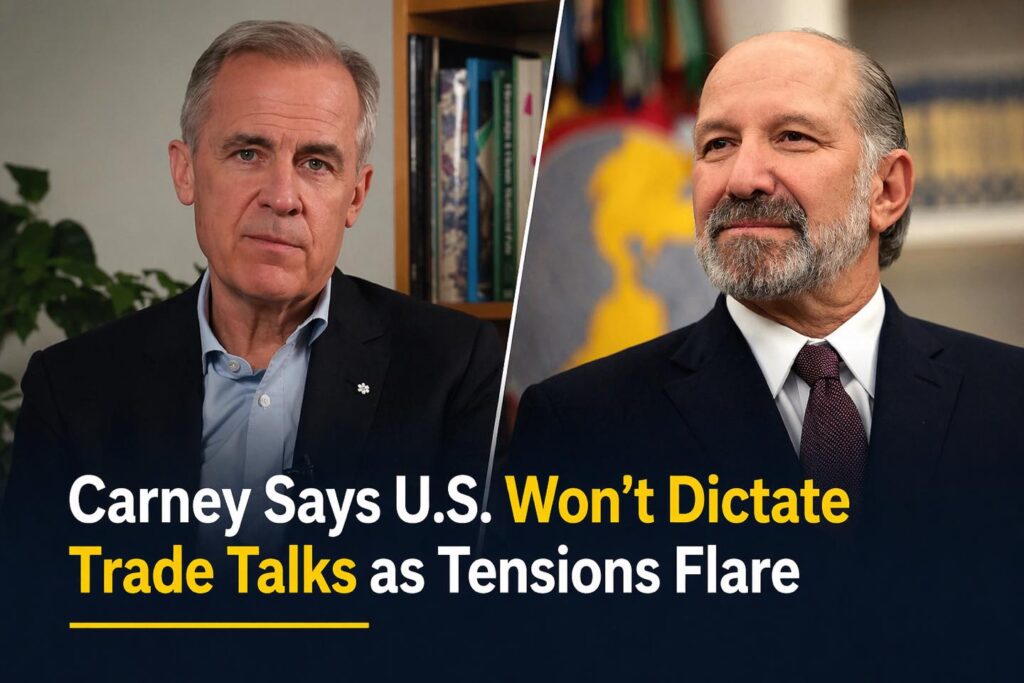
# Navigating U.S.-Canada Trade Tensions with Mark Carney
The economic partnership between the United States and Canada is one of the largest and most integrated in the world, a relationship built on decades of cooperation and mutual benefit. Yet, even the strongest alliances face moments of friction. Recent discussions on trade policy have brought these tensions to the fore, with former Bank of Canada Governor Mark Carney offering a characteristically measured and insightful perspective. His key observation—that trade irritants flow both ways across the 49th parallel—serves as a critical starting point for understanding the current state of North American commerce.
In an era where economic headlines are often dominated by protectionist rhetoric, Carney’s reminder that “we have some on our side as well” is more than just diplomatic nuance. It is a foundational truth for any productive negotiation. This article delves into the complex landscape of U.S.-Canada trade, exploring the specific points of contention, their broader economic implications, and the path forward for preserving this vital partnership.
## The Two-Way Street of Trade Irritants
The term “trade irritants” perfectly captures the persistent, sometimes nagging disputes that exist within an otherwise healthy relationship. These are not typically existential threats to the bilateral partnership but rather specific policy differences that require constant management and negotiation. Mark Carney’s acknowledgment of this mutual reality underscores that no country holds a monopoly on trade concerns.
### Key U.S. Concerns with Canadian Trade Policy
From Washington’s perspective, several longstanding issues regularly surface in trade talks. These often stem from differences in domestic policy and economic structure.
* Supply Management in Dairy (and Poultry): This is perhaps the most perennial issue. Canada’s system of supply management, which controls the production and price of dairy, eggs, and poultry through tariffs and quotas, is frequently cited by U.S. farmers and officials as a barrier to market access. American producers argue it limits their ability to sell into the Canadian market.
* Softwood Lumber: This dispute spans decades and multiple agreements. The U.S. industry contends that Canadian lumber is unfairly subsidized through low provincially-set stumpage fees (the price paid to harvest trees on public land), leading to periodic impositions of countervailing and anti-dumping duties. It is a classic example of a deeply entrenched irritant.
* Digital Services Tax and Tech Policy: As the digital economy grows, new areas of potential friction emerge. Canada’s proposed Digital Services Tax on large tech companies, primarily American, has been a point of contention, with the U.S. viewing it as discriminatory.
### Key Canadian Concerns with U.S. Trade Policy
Conversely, Ottawa and Canadian businesses have their own list of concerns regarding American trade practices. These often relate to U.S. domestic policies that have extraterritorial impact.
* “Buy American” Provisions: These policies, which mandate the use of U.S.-made materials and products in federal infrastructure projects, are a significant hurdle for Canadian companies. They can effectively lock competitive Canadian firms out of lucrative public procurement opportunities, despite the integrated nature of North American supply chains.
* Tariffs on Steel and Aluminum: While largely suspended under current agreements, the legacy of Section 232 tariffs on Canadian steel and aluminum under the previous U.S. administration left a deep scar. It demonstrated how national security justifications could be used against a close ally, creating uncertainty for vital Canadian export sectors.
* Dispute Resolution and Protectionism: There is an ongoing Canadian concern about the stability of trade rules and the potential for abrupt U.S. policy shifts. The strength and independence of dispute settlement mechanisms under the USMCA are closely watched by Canada to ensure a level playing field.
## The High Stakes of Economic Interdependence
To view these irritants in isolation is to miss the larger, more important picture. The U.S. and Canada don’t just trade with each other; they *build things* together. The economic relationship is defined by deeply integrated supply chains, particularly in industries like automotive, aerospace, and energy.
A tariff or trade barrier is rarely a surgical instrument; it is more like throwing a stone into a densely connected web. The ripples are felt on both sides of the border:
* Increased costs for manufacturers who rely on cross-border components.
* Higher prices for consumers.
* Reduced competitiveness for North American industries on the global stage.
* Investment uncertainty that can stall growth and innovation.
This interdependence is the most compelling argument for diligent management of trade disputes. The cost of escalation almost always outweighs the perceived benefit of protectionism. The modern North American economy is a single, highly efficient production platform, and its strength relies on the relatively seamless flow of goods, services, and investment.
## The Framework for Resolution: The USMCA and Beyond
The existence of irritants is normal. The test of the relationship is how they are managed. Here, the modernized United States-Mexico-Canada Agreement (USMCA) plays a crucial role. It provides the established, rules-based framework for addressing disputes.
Channels like the USMCA’s dispute settlement panels are not signs of failure but of institutional strength. They offer a legal and diplomatic alternative to tit-for-tat tariffs, allowing for evidence-based rulings. Carney’s commentary implicitly supports this approach: using the agreed-upon systems to work through issues methodically, preserving the overall health of the partnership.
Looking beyond specific disputes, both nations share broader strategic interests that should guide their approach:
* Joint Competitiveness with China: Presenting a united North American front on trade and technology is strategically vital.
* Energy Security and the Green Transition: Canada is a critical supplier of energy and critical minerals essential for everything from electric vehicles to renewable infrastructure.
* Defense and Security Cooperation: The economic relationship is underpinned by an unparalleled security partnership within NATO and NORAD.
## The Path Forward: Pragmatism and Partnership
So, what does the path forward look like, guided by the pragmatic perspective offered by Mark Carney?
1. Acknowledge Mutual Interests: Leadership in both capitals must consistently communicate that the overall partnership is far more valuable than any single irritant. The economic and strategic well-being of both countries is enhanced by cooperation.
2. Utilize the Established Systems: Commit to resolving disputes through the mechanisms painstakingly built into the USMCA. This depoliticizes issues where possible and leads to more stable, predictable outcomes.
3. Focus on Modern Challenges: While managing legacy issues like softwood lumber, negotiators must also proactively address emerging areas like digital trade, intellectual property in AI, and coordinated approaches to supply chain resilience.
4. Engage in Constant Dialogue: Beyond formal disputes, maintaining open lines of communication at all levels of government and industry is essential to prevent small issues from becoming major crises.
The U.S.-Canada trade relationship is not a static entity but a dynamic, living partnership. It requires active stewardship. Mark Carney’s simple yet profound point—that irritants are a shared experience—cuts through the noise and refocuses the conversation on what matters: constructive engagement. By continuing to talk, negotiate, and resolve differences within a rules-based system, both nations can ensure that the world’s longest undefended border remains the foundation of one of its most prosperous economic alliances. The goal is not a friction-free relationship, which is impossible, but a resilient one where disputes are managed intelligently in service of a much larger shared future.

