Mark Carney’s Fiscal Strategy: Deficit Spending to Buy Time for Canada’s Economy
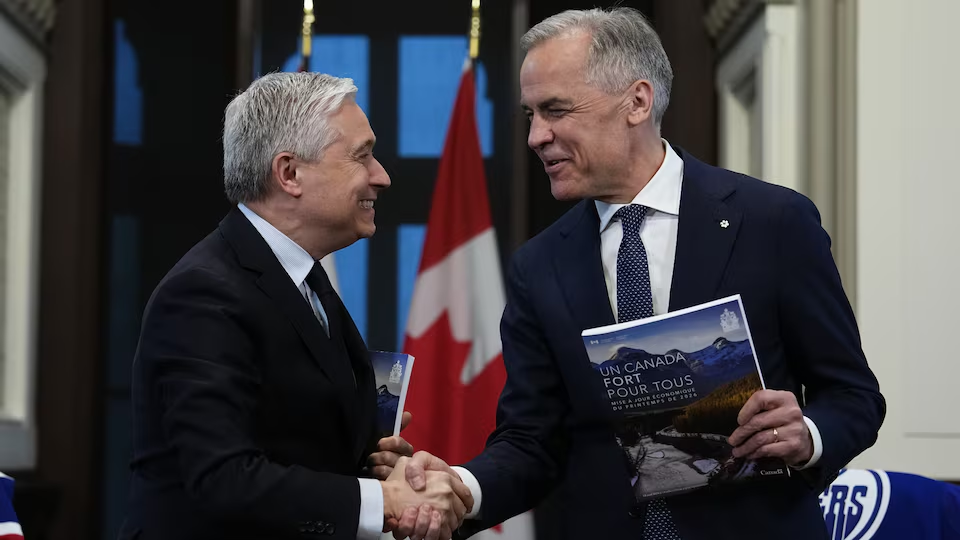
Canada’s latest fiscal update has landed, and with it comes a familiar narrative: the government is leaning heavily on deficit spending to keep the economy afloat. But this time, there is a new face steering the conversation—Mark Carney. The former Bank of Canada and Bank of England governor, now chairing the Liberal Party’s economic growth task force, is effectively buying time for Ottawa. The question is whether that time will be used wisely or will simply deepen the country’s fiscal hole. In this blog post, we break down the key takeaways from the update, Carney’s role in the strategy, and what rising deficits mean for Canadian households and businesses.
What the Fiscal Update Reveals: Deficit Numbers That Raise Eyebrows
The fall fiscal statement—or mini-budget—paints a picture of a government that is spending aggressively to stimulate growth, even as revenues fall short of projections. The core numbers are stark:
Key deficit figures from the update:
- The projected deficit for the current fiscal year has ballooned to $41 billion, up from the earlier forecast of $35 billion.
- Over the next five years, cumulative deficits are expected to exceed $200 billion, a figure that includes new spending on housing, clean energy, and defence.
- The debt-to-GDP ratio is ticking upward, hovering near 43%—a level that, while manageable for now, erodes Canada’s fiscal flexibility.
The spending is not incidental. It is targeted at what the government calls generational priorities: building millions of homes, scaling up battery manufacturing, and modernizing the military. Yet critics argue that these ambitions are being funded with borrowed money at a time when interest rates remain elevated. The cost of servicing the national debt now consumes roughly $54 billion annually—more than the federal government spends on the Canada Health Transfer.
Carney’s Playbook: Buying Time Through Stimulus
Mark Carney’s fingerprints are all over this update. Since being appointed to lead the economic growth task force, Carney has advocated for a “spend now, balance later” approach. His argument is simple: Canada faces structural challenges—low productivity, a housing crisis, and a green transition—that require upfront investment. If the government waits for perfect fiscal conditions, it will never act.
Why “Buying Time” Makes Sense in Carney’s View
Carney’s economic philosophy, shaped by his experience steering two central banks through crises, is that deficit spending during a period of weak private-sector demand can be self-financing if it unlocks long-term growth. The logic goes like this:
- Government investment in infrastructure and housing supply reduces bottlenecks, which in turn lowers cost pressures and boosts potential GDP.
- Targeted spending on clean energy and critical minerals positions Canada to capture global supply chain shifts, attracting private capital that would otherwise flow elsewhere.
- By front-loading spending now, the government aims to avoid a recession that would cause even greater fiscal damage through lost tax revenues and higher social support costs.
In Carney’s framework, the deficit is not a sign of fiscal irresponsibility; it is a deliberate tool to reset the economy’s growth trajectory. He believes that without this injection, Canada risks falling behind the United States and other peer nations that are aggressively subsidizing their own industrial strategies.
The Risks: Mounting Debt and the Credibility Question
While Carney’s reasoning is coherent, it comes with considerable risk. The fiscal update has drawn sharp criticism from economists and opposition parties who warn that Canada is drifting toward a debt trap.
Rising Interest Costs Crowd Out Other Priorities
The most immediate danger is the growing burden of debt service. With longer-term bond yields still above 3.5%, each additional billion dollars borrowed adds tens of millions in annual interest payments. Over time, this crowd out spending on programs that Canadians rely on—healthcare, education, and transfers to provinces.
Key risk factors to watch:
- Inflation re-ignition: If deficit spending coincides with a tight labour market, the Bank of Canada may be forced to keep interest rates higher for longer, which would choke off private investment.
- Loss of fiscal credibility: Global bond markets punish governments that appear to lack a credible path to balance. A downgrade by rating agencies could raise borrowing costs even further.
- Political uncertainty: With a federal election looming in 2025, the fiscal update is seen by some as a pre-election spending spree rather than a disciplined growth plan. This perception could undermine Carney’s message of strategic patience.
Comparing Carney’s Approach to Global Trends
Canada is not alone in embracing deficit spending. The United States, under the Inflation Reduction Act and CHIPS Act, is running deficits of about 6% of GDP. The European Union has relaxed its fiscal rules to allow green investment. Carney points to these examples to argue that Canada must play catch-up.
However, there is a crucial difference: Canada’s economy is smaller and more commodity-dependent. Its borrowing is in a currency that, while stable, does not enjoy the global reserve status of the US dollar. This means that Canadian bonds are more sensitive to changes in investor sentiment. A sudden loss of confidence could lead to a sharp rise in yields, as seen in the UK’s mini-budget crisis of 2022.
What the Fiscal Update Means for Your Wallet and Business
For Canadian households and business owners, the implications of this deficit-heavy strategy are mixed in the short term but uncertain in the long term.
Short-Term Benefits
- Housing programs: Increased federal spending on housing—including low-cost loans for apartment construction and tax incentives for rental development—could gradually ease supply constraints, though effects will take years to materialize.
- Clean energy incentives: Expanded tax credits for carbon capture, hydrogen, and nuclear power offer opportunities for businesses in the energy sector to access capital and grow.
- Stabilized demand: Government spending helps prop up GDP in a period when consumer spending is slowing due to high interest rates, preventing a sharper downturn.
Long-Term Risks
- Higher taxes down the road: Chronic deficits eventually require fiscal consolidation. Whether through higher personal income taxes, corporate taxes, or a new consumption tax, future governments will have to raise revenue or cut services.
- Currency depreciation: If foreign investors become wary of Canadian debt, the loonie could weaken, raising the cost of imports and contributing to inflation.
- Reduced fiscal firepower: When the next recession hits, Canada’s high debt level will leave Ottawa with less room to stimulate—exactly the problem Carney’s plan seeks to avoid.
Can Carney’s Strategy Work? The Verdict Is Pending
Mark Carney is betting that a period of bold deficit spending will catalyze the kind of structural transformation Canada has long needed: more housing, greener industry, and a diversified export base. He is buying time for these investments to bear fruit, hoping that growth will eventually outpace debt accumulation.
But time is a scarce commodity. The fiscal update does not include a concrete timeline for balancing the budget, nor does it spell out what happens if growth disappoints. Carney’s reputation as a steady hand during financial crises gives the plan credibility, but credibility alone does not pay bills.
The bottom line: Canada is rolling the dice on deficit-financed growth. For businesses and investors, the key is to watch three metrics carefully: debt-to-GDP trends, bond yields, and inflation. If these remain stable, Carney’s strategy may well be vindicated. If they deteriorate, the time he hoped to buy will be consumed by crisis management instead.