Hezbollah’s New Fiber-Optic Drones: A Ukraine War Lessons-Learned That Bypasses Israeli Jamming
The battlefield is no longer just a contest of steel and explosives—it is a war of signals. For years, Israel’s electronic warfare dominance has given it a decisive edge against adversaries like Hezbollah, allowing its forces to jam, spoof, or hijack enemy drones before they can strike. That era of easy denial just ended.
Hezbollah has now fielded a weapon that flies beneath the electronic warfare umbrella: the fiber-optic drone. This is not a theoretical prototype or a distant rumor. It is operational, and it was perfected in the crucible of the Ukraine war.
Let’s examine the technology, the tactical implications, and why this development demands a complete reassessment of air defense strategies in the Middle East.
What Is a Fiber-Optic Drone? A Wired Killer with No Radio Signature
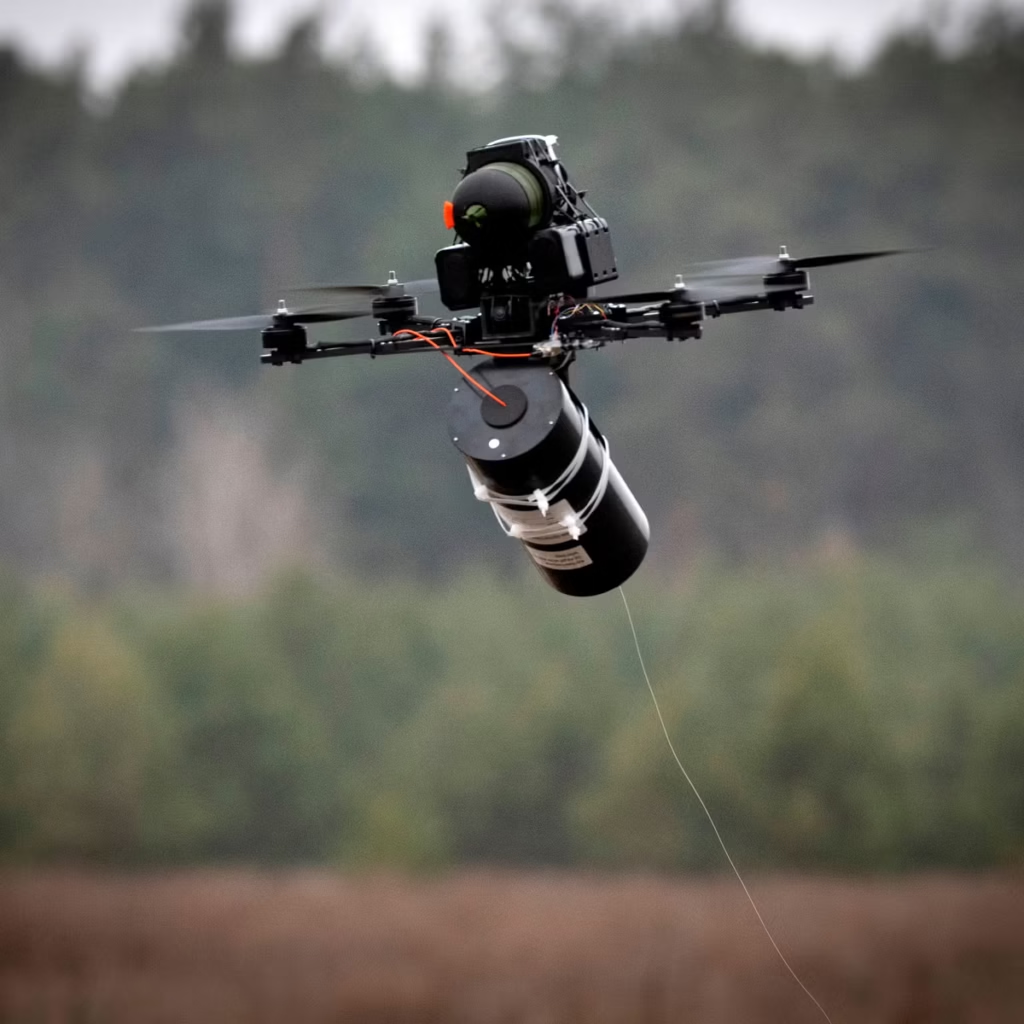
A fiber-optic drone looks like a standard first-person-view (FPV) quadcopter, but with one critical difference. Instead of communicating with its pilot via radio waves, it is physically connected to the ground by an ultra-thin fiber-optic cable that spools out as the drone flies.
- No radio frequency (RF) emissions. The drone is effectively invisible to electronic warfare sensors because it is not broadcasting any signals.
- Zero latency. The video feed and flight commands travel through glass fiber at the speed of light, meaning the pilot sees exactly what the drone sees in real time.
- Jam-proof. Radio jammers, GPS spoofers, and signal blockers are useless. Commands travel through a physical cable that cannot be intercepted electronically.
- Crystal-clear targeting. High-resolution video allows precise identification and engagement of targets, even in cluttered environments.
The trade-off is range limitation, since the cable typically extends only a few kilometers, and the logistical challenge of managing the spool. But in southern Lebanon, where distances to Israeli positions are relatively short, that limitation is less significant.
Why Hezbollah Made This Leap: The Iron Dome Problem
Hezbollah has long maintained a drone arsenal supplied mainly by Iran and supported by local production. However, Israel’s layered air defense and electronic warfare systems have repeatedly neutralized these platforms.
- Jamming disrupts communication between operator and drone.
- Spoofing misleads navigation systems and diverts drones off course.
- Detection systems locate RF emissions and expose launch positions.
Fiber-optic drones eliminate these vulnerabilities by removing the radio link entirely. They bypass the electronic warfare environment that systems like Iron Dome and associated EW units are designed to dominate.
Tactical Advantages for Hezbollah
- Precision strikes against fortified positions
- Penetration of protected infrastructure such as radar sites and command centers
- Ambush capability through silent hovering without RF exposure
This makes the system primarily offensive, focused on penetrating defended airspace rather than simple surveillance.
The Ukrainian Laboratory: How a War Two Thousand Miles Away Changed the Middle East
The war in Ukraine has become a large-scale testing ground for drone warfare innovation.
- Russia introduced fiber-optic FPV drones in 2023 to bypass Ukrainian electronic warfare systems.
- Ukraine rapidly replicated and adapted the technology using commercially available components.
- Both sides shared designs and tactics through open-source channels, including encrypted messaging platforms.
This rapid exchange of battlefield innovation has made the technology widely accessible. Hezbollah, known for adapting external battlefield lessons, has incorporated these developments into its own arsenal.
The result is a transfer of innovation from Eastern Europe to the Middle East, accelerated by openly shared technical knowledge.
What This Means for Israel and the Future of Air Defense
The emergence of fiber-optic drones challenges long-standing assumptions about electronic warfare superiority.
- Iron Dome limitations. It is optimized for rockets and missiles, not small, non-emitting drones.
- Reduced effectiveness of electronic warfare. Systems designed to disrupt radio communication are bypassed entirely.
- Shift toward kinetic countermeasures. Future defenses may rely more on lasers, interceptors, and physical engagement systems.
This represents a structural shift rather than a temporary tactical challenge. The assumption that electronic dominance guarantees drone control is no longer valid in all scenarios.
Regional Ripple Effect
The implications extend beyond Israel and Hezbollah:
- Houthi forces in Yemen could enhance strike effectiveness against regional targets.
- Iranian-aligned groups in Iraq and Syria could adopt similar systems against coalition forces.
- Non-state actors globally may gain access to advanced drone capabilities previously limited to state militaries.
The accessibility of the technology makes it difficult to contain once introduced.
A New Battlefield Reality
Hezbollah’s adoption of fiber-optic drones reflects a broader transformation in modern warfare driven by Ukraine’s drone-intensive conflict.
Electronic warfare superiority is no longer sufficient on its own. Systems that rely on radio disruption can be bypassed by physically tethered control methods.
This shift forces a reassessment of air defense strategies, where detection, interception, and physical neutralization become increasingly important.
Israel and other military powers are now adapting to a battlefield where silence in the electromagnetic spectrum is no longer a guarantee of safety, and where control of the air depends on more than just signal dominance.