
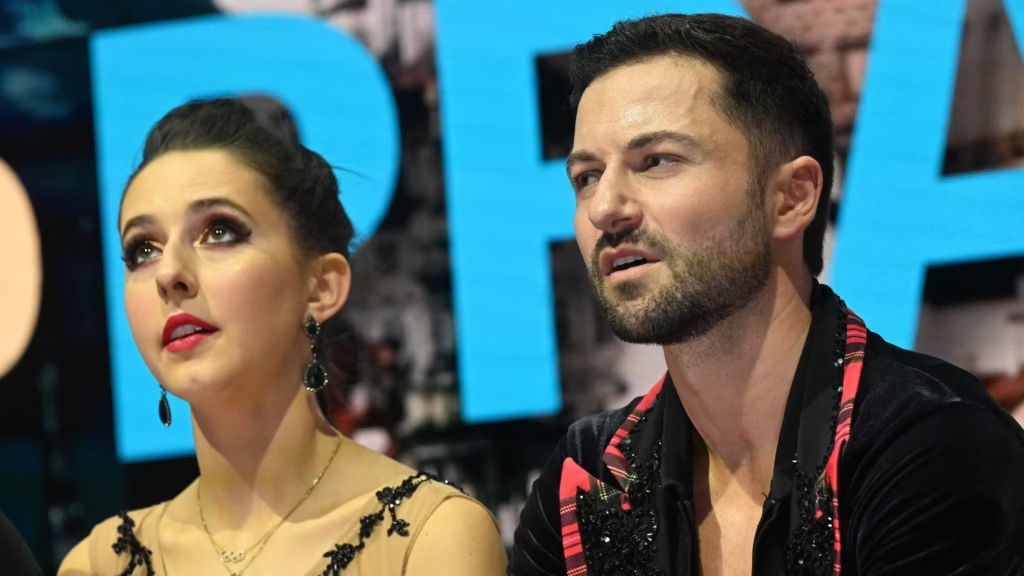
British Ice Dancers Fear and Gibson Denied World Championships Bronze by Crucial Penalty
The world of ice dance is built on precision, artistry, and the relentless pursuit of perfection. At the highest level, the margin between triumph and heartbreak can be vanishingly thin, measured in tenths of a point and the interpretation of complex rules. At the 2024 ISU World Figure Skating Championships in Montreal, British ice dancing sensations Lilah Fear and Lewis Gibson experienced this brutal reality firsthand. After delivering what many believed to be a medal-worthy performance, their dream of a first world championship podium was shattered by a single, costly deduction.
A Stellar Season Culminates in Montreal
Fear and Gibson entered the World Championships as one of the sport’s most exciting and consistent teams. Their dynamic, theatrical free dance to a Queen medley had captivated audiences all season, earning them Grand Prix medals and cementing their status as Britain’s leading ice dance hope. They arrived in Montreal riding a wave of momentum, having secured a strong fourth-place finish in the rhythm dance, putting them firmly in the hunt for a bronze medal.
The stage was set for a dramatic finale. As they took to the ice for their free dance, the pressure was immense, but the British duo appeared ready to seize the moment.
The Performance: High Stakes and High Drama
From the opening chords of “I Want It All,” Fear and Gibson commanded the ice. Their program was a masterclass in speed, intricate footwork, and charismatic performance. They executed their demanding technical elements with apparent confidence, and their connection with the music and each other electrified the arena. When they struck their final pose, the crowd erupted, and the pair embraced, their faces a mix of exhaustion and elation. The score flashed on the board: a strong personal best for their free dance. They had moved into first place, guaranteeing a top-four finish with only the final group to skate.
For a thrilling period, they sat in the coveted virtual bronze medal position. The dream of standing on the world podium, a feat not achieved by a British ice dance team since 2014, was agonizingly close.
The Crucial Penalty That Changed Everything
However, in ice dance, the final story is told not just by the elements performed, but by the judges’ detailed scrutiny. As the last teams delivered their routines, the leaderboard shifted. The ultimate blow came not from a rival’s higher score, but from a mark against their own.
A critical one-point deduction was applied to Fear and Gibson’s score for a Extended Lift violation. In ice dance, lifts have strict duration limits. The technical panel ruled that one of their spectacular lifts was held for a fraction too long, exceeding the permitted time. This single penalty was the difference between a historic bronze medal and a devastating fourth-place finish.
Dissecting the Rule and Its Impact
The Extended Lift violation is a clear but often agonizing rule. The lift duration is meticulously timed, and exceeding the limit—even by a mere half-second—triggers an automatic one-point deduction from the total score. In a discipline where medals are regularly decided by hundredths of a point, a full point is a monumental loss.
- The Technical Panel’s Role: A dedicated technical panel reviews every element in real-time, using replay technology to make split-second calls on violations.
- No Room for Subjectivity: Unlike component scores for artistry, this is a binary rule. It was either within the time limit, or it wasn’t.
- The Brutal Outcome: Without the deduction, Fear and Gibson’s total score would have been enough to secure the bronze medal. With it, they finished 0.02 points behind the third-place Italian team, Charlène Guignard and Marco Fabbri.
The result was a crushing disappointment for a team that had skated to the peak of their abilities on the world’s biggest stage.
Reaction: Grace in the Face of Heartbreak
In the aftermath, Fear and Gibson displayed tremendous grace and professionalism. While the disappointment was palpable, their focus was on the quality of their performance and the support they received.
Lilah Fear reflected on the bittersweet nature of the competition, stating, “We put out two incredible skates that we’re really proud of. We left everything on the ice. Of course, it’s tough to miss a medal by such a small margin, but we know we couldn’t have done anything more in that moment.” Lewis Gibson echoed the sentiment, emphasizing their growth and the positive trajectory of their career, while acknowledging the sting of the penalty.
The skating community rallied around them. Fans, commentators, and fellow athletes expressed sympathy and outrage at the razor-thin margin of defeat, with many arguing that the performance itself deserved a medal, regardless of the technical infraction.
Looking Forward: Resilience and the Road to Milano-Cortina 2026
While the pain of Montreal will linger, this chapter is far from the end of Fear and Gibson’s story. If anything, it has solidified their position as true contenders on the global stage.
- Proven World-Class Status: Finishing fourth at the World Championships is a monumental achievement and proves they can compete with the very best.
- A Powerful Motivator: This experience will undoubtedly fuel their training. They will return with even greater attention to technical detail, ensuring every second of every lift is perfected.
- The Olympic Horizon: All roads now lead to the 2026 Winter Olympics in Milano-Cortina. This experience, as heartbreaking as it is, provides invaluable lessons for the ultimate pressure cooker of Olympic competition.
Conclusion: A Story of “What If” and “What Next”
The story of Lilah Fear and Lewis Gibson at the 2024 World Championships is a poignant reminder of the unforgiving nature of elite sport. It is a tale of breathtaking skill, passionate performance, and a rulebook that offers no concessions. They were denied a bronze medal not by a fall or a major error, but by a stopwatch.
Yet, within this heartbreak lies the foundation for an even stronger comeback. They have captured the hearts of skating fans worldwide with their resilience and talent. The question is no longer *if* they can win a world medal, but *when*. The journey continues, and the skating world will be watching, eager to see this brilliant British duo ascend the podium they came so close to touching in Montreal. Their pursuit of perfection, now sharpened by experience, is far from over.

