Ottawa Pivots to CER-Led Pipeline Reviews, Sidestepping the Impact Assessment Agency
The federal government is initiating a fundamental shift in how major energy infrastructure projects are evaluated in Canada. In a move poised to reshape the regulatory landscape, Ottawa has signaled its intention to have new pipeline projects reviewed exclusively by the Canada Energy Regulator (CER), effectively bypassing the Impact Assessment Agency of Canada (IAAC). This strategic pivot aims to eliminate jurisdictional duplication, accelerate timelines, and bring a new level of regulatory certainty to a sector that has long argued the process is unpredictable and politically charged.
For project proponents, investors, and provincial governments that depend on resource development, this decision represents a seismic change—one that could unlock billions of dollars in stalled or hesitant investment. But for environmental groups and Indigenous communities who have relied on the broader scope of the Impact Assessment Act, it raises urgent questions about transparency, public participation, and the depth of climate scrutiny.
Below, we unpack the mechanics of this policy shift, the legal and political context driving it, and what it means for the future of major energy projects in Canada.
The Regulatory Tug-of-War: Why the Shift Is Happening Now
To understand the government’s rationale, we first need to examine the duplicate review structure that has frustrated industry since the Impact Assessment Act (IAA) came into force in 2019. Under the current regime, a proposed interprovincial or international pipeline could be subject to two parallel, and sometimes conflicting, review processes:
- Life-cycle regulation by the CER: As the lifecycle regulator, the CER assesses everything from safety and engineering to tolls and abandonment costs. Its review includes a detailed public hearing and a consideration of environmental and socio-economic effects, culminating in a Certificate of Public Convenience and Necessity.
- Impact Assessment by the IAAC: The IAAC conducts a broader, more holistic review that factors in everything from upstream greenhouse gas emissions to gender-based analysis and Indigenous rights. This process involves multiple federal departments and can significantly expand the timeline and evidence required.
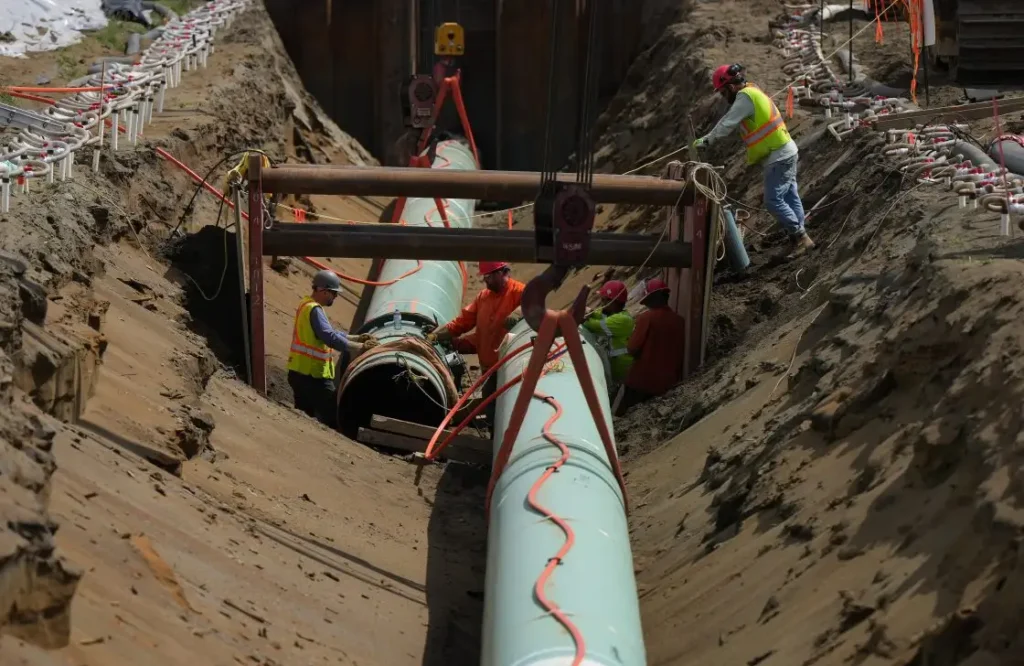
Proponents like the Pathways Alliance, whose proposed carbon capture trunkline would require a 400-kilometre pipeline, have been caught in this exact dilemma. A project designed exclusively to transport captured CO₂ for permanent sequestration is fundamentally different from an oil pipeline, yet it still faced the prospect of a full-scale impact assessment on top of an already rigorous CER review. The government’s new direction seeks to remove that added layer.
Legislative Tools: How Ottawa Plans to Circumvent the IAA
The change is not coming through a full-blown legislative amendment—at least, not yet. Instead, the federal cabinet is leaning on two existing instruments that allow it to carve out exemptions without reopening the politically volatile text of the Impact Assessment Act.
Section 43 of the Impact Assessment Act
This section gives the federal cabinet the authority to exempt a designated project from impact assessment if the minister is of the opinion that the assessment would be redundant because the project’s effects are already being addressed through another process. The government’s position is that the CER’s comprehensive lifecycle review satisfies that condition for federally regulated pipelines. By designating a project’s assessment as “duplicative,” cabinet can effectively hand the entire review file to the CER.
Ministerial Orders Under Section 67 of the CER Act
To further streamline the process, Ottawa is also looking to issue orders requiring a CER-led assessment to explicitly consider factors normally examined under the IAA—such as the Crown’s duty to consult Indigenous peoples and impacts on Indigenous rights. This is a critical provision because it aims to ensure that the shift to a single-review process does not leave constitutional or social gaps. The CER would become the sole window, but with a broadened mandate to incorporate IAA-style factors.
The success of this approach hinges on whether the CER’s existing processes, combined with these additional ministerial directives, can withstand legal challenges that will almost certainly argue the government is attempting an end-run around a Supreme Court decision.
The Supreme Court Shadow: Navigating the Reference Ruling
No analysis of this shift is complete without addressing the October 2023 Supreme Court reference opinion that found substantial portions of the IAA unconstitutional. The court ruled that the federal government had overreached by designating certain projects for impact assessment based on overly broad “public interest” grounds that intruded on provincial jurisdiction.
Key takeaways from the ruling that are driving today’s policy pivot:
- Federal jurisdiction must be tied to enumerated heads of power. For interprovincial pipelines, federal jurisdiction is clear under the Constitution’s “interprovincial undertakings” clause. This gives Ottawa a much more solid legislative backbone for pipeline regulation than for intraprovincial projects like a new mine or LNG facility.
- The IAA’s “designated projects” list must be narrowed. By shifting pipelines to a CER-only review, the government is voluntarily narrowing the scope of the IAA in a way that aligns with the court’s guidance, reducing the risk of future constitutional challenges.
The government is framing its move as a direct response to that ruling—presenting the CER as the appropriate, constitutionally bulletproof vehicle for pipeline assessment. But opponents will argue that simply re-branding the process under the CER does not cure the underlying issue if the scope of review remains overly prescriptive. It’s a delicate legal dance, and one that promises to keep lawyers busy for years.
Project Spotlight: The Pathways Alliance and the CO₂ Pipeline Precedent
The immediate catalyst for this announcement is the Pathways Alliance, a consortium of the six largest oil sands producers, which is proposing a massive carbon capture and storage network. The most contentious piece is a 400-kilometre pipeline that would transport compressed CO₂ from over 20 facilities to a sequestration hub in northeastern Alberta. The project is covered by an existing federal-provincial agreement designed to accelerate decarbonization, but it has been stuck in regulatory limbo because of uncertainty over whether it triggers a federal impact assessment.
Under the new direction, the CO₂ pipeline would be treated as an interprovincial and lifecycle-regulated pipeline under the CER’s exclusive purview. This sets a critical precedent: decarbonization infrastructure will be regulated by the energy regulator, not the impact agency.
For investors in CCUS (carbon capture, utilization, and storage) technology, this clarity is monumental. It signals that Canada is willing to build a regulatory pathway that matches the pace of its industrial decarbonization ambitions, rather than letting process uncertainty kill business models before they can even be tested.
Winners and Losers: An Expert Assessment
This policy shift creates a clear dividing line among stakeholders. As an energy policy analyst, I see distinct impacts:
Industry and Investors: A Shot of Confidence
The most immediate beneficiary is the pipeline and energy export sector. For years, boardroom decisions have been haunted by the concept of “regulatory risk”—the fear that even a technically sound, economically viable project could die a death by a thousand process delays. A single, expert-led review by the CER, with defined timelines and a focused mandate, dramatically reduces that risk. Expect to see a re-evaluation of Canadian assets by global infrastructure funds.
Indigenous Communities: A Double-Edged Sword
For some Indigenous nations, the CER process offers a clearer path to capacity funding and participation in a single proceeding rather than navigating two separate bureaucracies. The ministerial orders explicitly requiring the CER to consider Crown obligations could, if executed genuinely, deepen consultation. Others, however, will see the loss of the IAAC’s broad socio-cultural impact analysis as a diminishment of their ability to have rights fully considered outside a purely engineering and economic lens. The proof will be in whether the CER genuinely expands its cultural competency or simply conducts a box-ticking exercise.
Environmental Non‑Governmental Organizations (ENGOs): Strategic Playbook Reset
ENGOs have long used the impact assessment process as a platform to litigate upstream and downstream greenhouse gas emissions, species-at-risk concerns, and cumulative effects. A CER review, while still considering environmental matters, is less expansive. Groups like Ecojustice and the West Coast Environmental Law Association are already signaling potential judicial reviews, arguing that exempting a project from an impact assessment because the government deems it redundant is an abuse of discretion. Their challenge will be to prove that the CER’s scope is insufficient, not merely that it is different.
Provinces: A Welcome Devolution, to a Point
Resource-producing provinces like Alberta and Saskatchewan have long called for a “one project, one review” model. They will welcome Ottawa’s retreat from what they view as federal overreach into their resource management jurisdiction. However, provinces like Quebec and British Columbia, which have their own rigorous environmental assessment regimes and have been less enthusiastic about pipeline expansion, may view the shift as Ottawa removing a lever they could pull to shape, delay, or block projects that lack local social license.
The Risk of Regulatory Capture: Is the CER Ready?
A crucial question that panels and parliamentary committees will have to tackle is whether the Canada Energy Regulator has the institutional culture and technical capacity to absorb the IAA’s functions. The CER was historically an energy safety and economics tribunal. While it has modernized, adding environmental and Indigenous advisory committees, its core DNA is project facilitation under a public interest mandate. Critics will argue that moving assessment to the CER is a form of regulatory capture—putting the fox in charge of the henhouse.
To counter this, the government must adequately resource the CER’s recently created Indigenous Advisory and Monitoring Committees, and it must entrench quantitative climate metrics into the regulator’s decision-making framework. Without a statutory requirement to measure a project’s emissions against Canada’s 2030 and 2050 climate targets, the new single-window approach could become a shortcut to approval rather than a robust, integrated review.
Looking Ahead: A Permanent Structural Change?
This policy, initially implemented through ministerial orders and cabinet exemptions, is likely a waypoint to permanent legislative reform. When Parliament eventually opens the IAA for amendment—which it must do to fix the provisions struck down by the Supreme Court—the government will have the opportunity to formally codify the CER’s exclusive jurisdiction over pipelines. The practical experience gained from projects like the Pathways Alliance CO₂ trunkline will be critical in shaping that final legislative text.
For now, project proponents waiting on the sidelines should engage proactively with the CER as the single decision-maker, front-load their engagement with potentially affected Indigenous communities, and prepare for a process that will be faster but will not sacrifice the rigor of technical and environmental review. The era of dual-track pipeline assessment is closing, and Canada’s energy regulatory map is being redrawn in real time.