
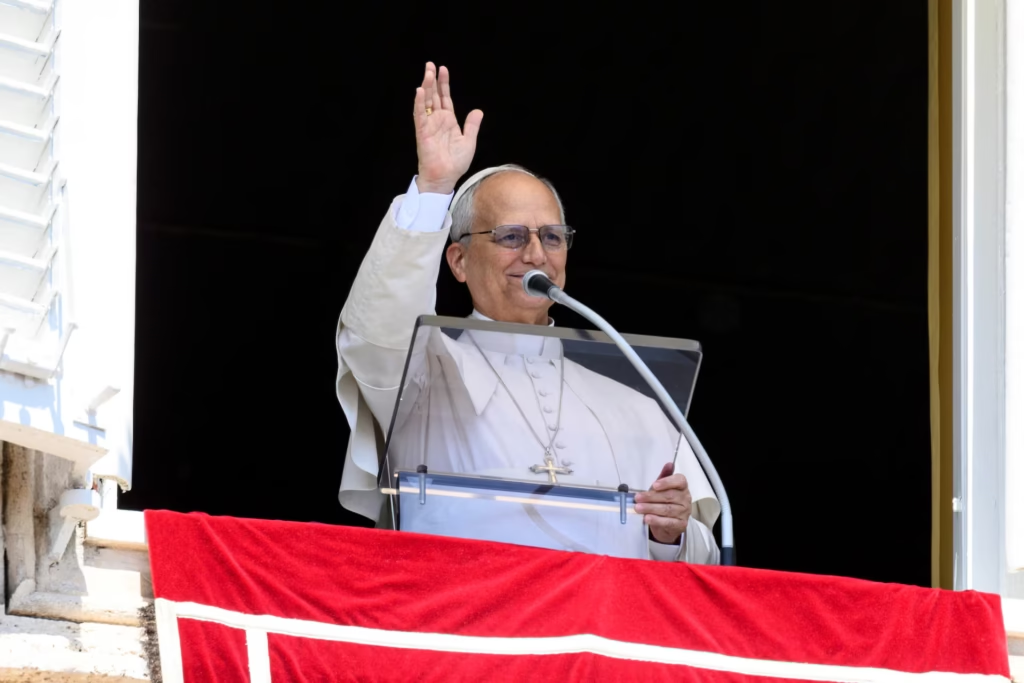
Pope Francis Commemorates Fallen War Reporters on World Press Freedom Day: An Urgent Call to Protect Truth
On World Press Freedom Day, observed annually on May 3, Pope Francis delivered a poignant message from the Vatican, honoring journalists who lost their lives while covering conflicts in war zones. The pontiff’s remarks come amid a year of unprecedented danger for media professionals, with the 2025 global death toll for journalists surpassing 120—the deadliest year in over a decade. Speaking to a gathering of Catholic media leaders and advocates for press freedom, the Pope described these reporters as “martyrs of truth” and urged governments to do more to ensure their safety.
The Rising Toll on War Correspondents
The Pope’s address zeroed in on the escalating risks faced by journalists in conflict zones, particularly in Gaza, Ukraine, Sudan, and Myanmar. According to the latest data from the Committee to Protect Journalists (CPJ), nearly 40 percent of all journalist deaths in 2025 occurred in active war zones, a statistic that has more than doubled since 2020. Pope Francis specifically mentioned several recent tragedies:
- Gaza Strip: At least 15 Palestinian journalists have been killed since October 2023, many in Israeli airstrikes targeting residential buildings that housed press offices.
- Ukraine: Three Ukrainian camerapersons died in February 2026 while documenting frontline clashes near Bakhmut, struck by a Russian drone strike.
- Sudan: Two Sudanese radio reporters were abducted and executed in Khartoum in March 2026 by Rapid Support Forces militia members.
“These are not just numbers,” the Pope said. “They are sons, daughters, fathers, and mothers who gave their lives so that the world could see what many preferred to ignore.”
The Spiritual and Moral Imperative
Pope Francis framed the killing of journalists as a direct assault on the common good, drawing a theological parallel to the biblical concept of the “watchman” (Ezekiel 33:6) who must warn the people of danger. He declared that silencing a reporter is akin to “extinguishing the lamp that illuminates the path to justice.” This is not the first time the Pope has weighed in on press freedom; in 2023, he released an apostolic exhortation titled *“The Truth Will Make You Free,”* which called for ethical and courageous journalism.
During his World Press Freedom Day homily at the Basilica of St. John Lateran, the Pope also lamented the weaponization of disinformation in war zones. He noted that journalists are often targeted not just physically but also through smear campaigns that label them as “enemy propagandists” or “spies.” This dual attack—on the person and on their credibility—represents, in his words, “a sin against the Holy Spirit of truth.”
What the Vatican Is Doing to Protect Journalists
The Holy See announced a new initiative during the same event: the Vatican Observatory for Press Safety, a permanent monitoring office within the Dicastery for Communication. This office will:
- Track journalist deaths and abductions globally, with a focus on conflict zones.
- Provide emergency psychological and material support to families of slain reporters.
- Publish an annual “Red List” of countries where press safety conditions are most dire.
Cardinal Michael Czerny, prefect of the Dicastery for Promoting Integral Human Development, told the audience that the Vatican is also in talks with the International Committee of the Red Cross (ICRC) to create a dedicated safe passage corridor for journalists in active war zones. “We have safe zones for humanitarian aid workers. Why not for those who document the war?” the cardinal asked.
A Call for International Accountability
The Pope did not shy away from naming specific actors. While he avoided direct accusations, he strongly implied that state forces and armed groups alike must be held accountable for targeting journalists. He called on the United Nations to strengthen enforcement of UN Security Council Resolution 2222 (2015), which explicitly mandates the protection of journalists in armed conflict. However, the resolution remains largely toothless, with no enforcement mechanism for violations.
Pope Francis also appealed to media owners and editors to prioritize safety over speed. He criticized the trend of “parachute journalism”—sending inexperienced reporters into high-risk areas without adequate training or equipment—and urged newsrooms to invest in hostile environment training for all war correspondents.
The Broader Context of Press Freedom in 2026
World Press Freedom Day 2026 comes at a critical inflection point. The annual World Press Freedom Index, released by Reporters Without Borders (RSF) on the same day, shows a global decline for the fifth consecutive year. Key findings include:
– 54 countries now rank in the “bad” or “very bad” categories for press freedom.
– 250 journalists are currently imprisoned worldwide, the highest number since 2019.
– 7 out of 10 killings of journalists in 2025 were perpetrated by non-state armed groups, but state forces remain the primary source of impunity, with over 85 percent of cases unresolved.
The RSF report particularly flagged Venezuela, Belarus, and Eritrea as “absolute black holes” for press freedom, while noting that even in democracies like India, Mexico, and the Philippines, journalists face growing threats from politicians and organized crime.
Why the Pope’s Voice Matters
As the leader of 1.4 billion Catholics worldwide, the Pope’s statements carry substantial moral weight—but critics argue they often lack concrete political follow-through. However, recent moves suggest the Vatican is becoming more proactive. In November 2025, the Holy See sponsored a closed-door meeting in Geneva between UN special rapporteurs and families of slain journalists in Gaza. That meeting led to the Geneva Statement on Journalist Protection, a non-binding agreement now signed by 32 nations.
The Pope’s emphasis on empathy and remembrance also resonates beyond Catholic circles. At the end of his homily, he read aloud the names of 10 journalists killed in 2025, pausing after each name to let the congregation acknowledge their sacrifice. Among them was Rania al-Balaawi, a 29-year-old Lebanese videographer who died in an Israeli airstrike in southern Lebanon in July 2025, and Oleksandr Danylenko, a Ukrainian editor executed by Russian forces in occupied Kherson.
What Comes Next: Practical Steps for Journalists and Civil Society
For working journalists covering conflict zones, the Pope’s speech serves as both a moral boost and a practical warning. The following recommendations emerged from panel discussions held after the homily at the Vatican:
– Document Everything: Keep records of threats, harassment, and near-misses. These can be crucial for future prosecutions.
– Use Digital Security Tools: Encrypted messaging apps, VPNs, and two-factor authentication are now non-negotiable for field reporters.
– Build Local Partnerships: International media should share satellite phones, armored vehicles, and medical supplies with local journalists who often lack resources.
– Support Trauma Care: Many conflict reporters suffer from PTSD. The Vatican’s new observatory will offer free counseling helplines starting June 2026.
A Final Reflection on Truth in the Shadows
Pope Francis concluded his address with a reflection that tied press freedom to the core Christian virtue of charity. “Truth is not a luxury for the powerful,” he said. “It is the bread of the poor, the water of the weary, the medicine for the wounded. When a journalist dies, it is not just a professional loss. It is a hole in the fabric of our shared humanity.”
As the world marked World Press Freedom Day under the shadow of ongoing wars, the Pope’s words reminded the global community that the fight for press freedom is ultimately a fight for the right of every human being to know what is being done in their name. Whether governments will heed that call remains uncertain, but for one day, at least, the names of the fallen were spoken aloud—and a silent audience listened.

