
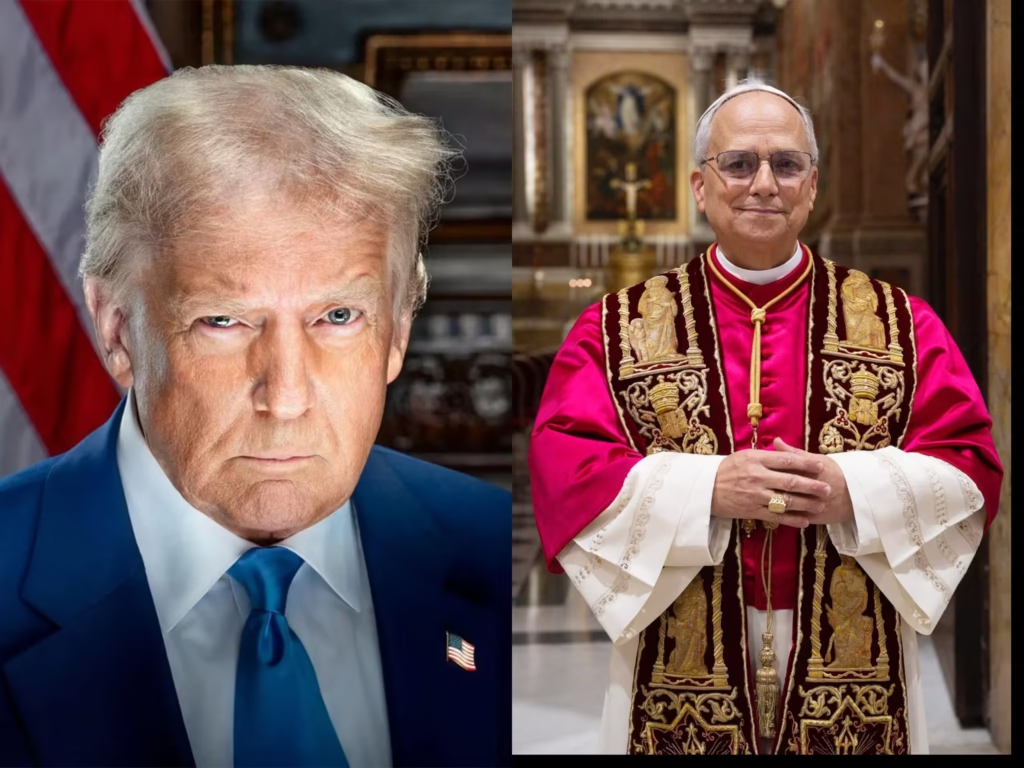
Trump and Pope Leo XIV Clash Over Iran War and U.S. Politics
In a stunning collision of faith, politics, and global power, former U.S. President Donald Trump has launched a fierce public rebuke of Pope Leo XIV, escalating a simmering feud into an unprecedented diplomatic and theological firestorm. The core of the conflict lies in the Pontiff’s vocal opposition to potential U.S. military action in Iran, but the subtext cuts even deeper, touching on the Pope’s unique status as the first American to lead the Catholic Church and his perceived interventions in the domestic politics of his homeland.
A Pontiff Like No Other: The Rise of Pope Leo XIV
The very existence of this controversy underscores a historic shift within the Vatican. The election of Cardinal Michael O’Malley of Boston as Pope Leo XIV shattered centuries of tradition. For the first time, the Chair of St. Peter is occupied by a native-born American, a reality that has fundamentally altered the dynamic between the Holy See and the United States.
This unprecedented papacy has been marked by two defining pillars:
- Progressive Doctrine: Leo XIV has pushed for significant modernization within Church teachings on social justice, economic inequality, and environmental stewardship.
- Unflinching Political Engagement: Unlike predecessors who often wielded influence through subtle diplomacy, Leo XIV has adopted a more direct, vocal approach to global affairs, particularly concerning U.S. foreign policy.
It is this second pillar that has now placed him on a direct collision course with Donald Trump and his political movement.
The Iran Flashpoint: A War of Words Over War
Tensions reached a boiling point following the Pope’s recent Sunday address from St. Peter’s Square. In his homily, Leo XIV issued a stark, unequivocal condemnation of the escalating rhetoric towards Iran, labeling a potential conflict as “a unjust war of aggression that would unleash untold suffering and destabilize the world.” He called for immediate de-escalation and dialogue, framing the issue as a profound moral failing.
Trump’s response was swift and characteristically blistering. In a series of posts on his Truth Social platform and during a rally in Michigan, the former President lambasted the Pontiff.
Trump’s core accusations included:
- Overstepping spiritual authority to engage in “globalist politics.”
- Displaying “weakness” and misunderstanding of national security threats.
- Leveraging his American background to illegitimately criticize U.S. policy, with Trump quipping, “He might be from Boston, but he sure doesn’t remember what country he’s supposed to be for.”
This direct criticism of a sitting Pope by a major U.S. political figure is virtually without modern precedent, highlighting the raw nerve the Iran issue and Leo XIV’s identity have touched.
The Underlying Fault Line: An American Pope in Trump’s America
The dispute over Iran, while serious, is merely the symptom of a deeper ideological chasm. For Trump and his supporters, an American Pope is a paradoxical figure. There is an inherent expectation, often unspoken, that his nationality might translate to sympathy for American strategic interests. Leo XIV’s refusal to conform to this expectation—choosing instead to critique U.S. policy from a universal, Catholic moral framework—is seen as a profound betrayal.
Conversely, the Pope’s supporters argue that his American experience uniquely equips him to understand the consequences of U.S. action and obligates him to speak prophetic truth to power. They see his stance not as anti-American, but as a higher form of patriotism that prioritizes peace and human dignity over partisan or nationalist agendas.
Global and Domestic Repercussions of the Feud
The Trump-Leo XIV clash sends shockwaves far beyond news headlines, with significant implications on multiple fronts.
1. For the Catholic Church in the United States:
The American Church is now in an extraordinarily awkward position. The faithful are forced to navigate allegiance to their Pontiff and their political affiliations in a highly polarized environment. Bishops and clergy face increased pressure to either defend the Pope or quietly distance themselves, potentially deepening existing divides within the U.S. congregation.
2. For International Diplomacy:
The Pope’s moral authority remains a potent force globally. His condemnation strips potential military action in Iran of any perceived moral high ground, making it harder for the U.S. to build an international coalition. It also empowers diplomatic efforts by other nations seeking a peaceful resolution.
3. For the U.S. Political Landscape:
Trump’s lambasting of the Pope further cements his alignment with a strand of conservative thought that views traditional institutions—including, now, a progressive papacy—with deep suspicion. It transforms a foreign policy debate into a potent culture-war issue, mobilizing his base by framing the Pope as an emblem of a global elite opposed to “America First” principles.
A Historic Juncture With No Clear Path Forward
We are witnessing a historic juncture where the lines between spiritual authority, national identity, and geopolitical strategy are irreversibly blurred. The feud between Donald Trump and Pope Leo XIV is more than a personal spat; it is a dramatic manifestation of the world’s current ideological battles.
The critical questions that now loom are:
- Will the Pope moderate his political commentary in the face of such intense criticism from a potential future U.S. president?
- Will Trump’s attacks resonate with Catholic voters, or will they backfire, solidifying support for a Pontiff seen as standing on principle?
- How will this very public rift affect the Vatican’s ability to act as a moral mediator in future global crises?
One thing is certain: the era of an American Pope was always destined to be complex. The open conflict with a figure like Donald Trump ensures that this papacy will be defined not only by its theological direction but by its fraught and unavoidable relationship with the turbulent politics of its pontiff’s native land. As both men hold firm to their diametrically opposed visions, the world watches, waiting to see whether this clash will forge a new path for peace or deepen the divisions it seeks to address.

