
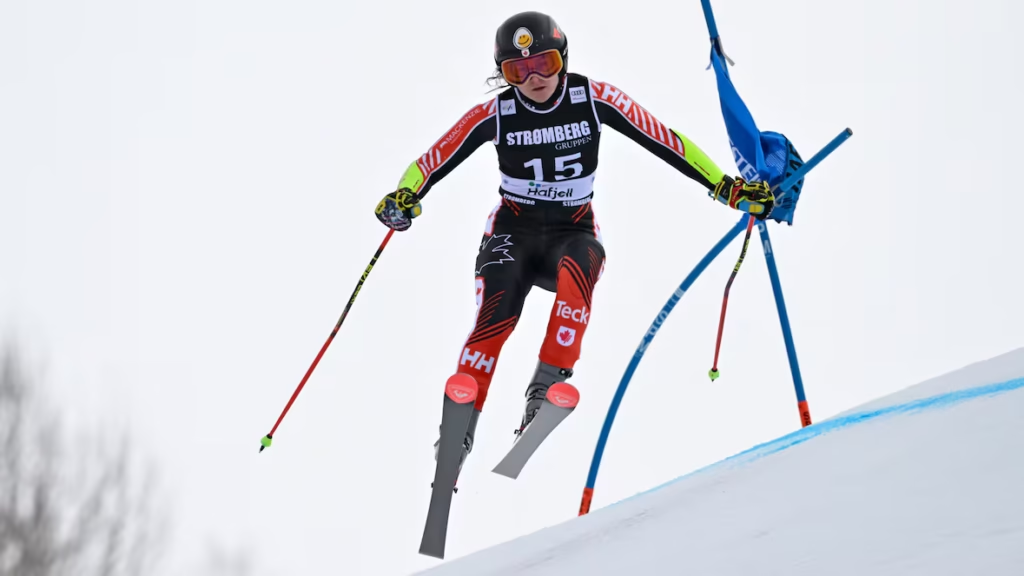
Valérie Grenier Soars to Giant Slalom Victory as Mikaela Shiffrin Clinches Historic World Cup Crown
The final World Cup giant slalom of the season in Saalbach, Austria, delivered a perfect blend of triumph and destiny. In a stunning performance, Canada’s Valérie Grenier carved her way to a monumental victory, while American superstar Mikaela Shiffrin, finishing fifth, mathematically secured an unprecedented ninth career overall World Cup crystal globe, cementing her status as the greatest of all time.
A Day of Dual Celebrations on the Slopes
Under challenging conditions with flat light and a tough, icy course, the race was a test of technical precision and mental fortitude. For Valérie Grenier, it was a day where everything clicked. The 27-year-old from Ottawa, who has battled significant injuries in her career, put down two flawless, aggressive runs to claim only her second career World Cup win—both in giant slalom.
“It feels amazing,” Grenier said post-race. “The first run I was really pushing and I had a good one. Second run, I just wanted to do the same. I knew the snow was a bit more difficult, but I just trusted myself.” That trust paid off, putting her 0.29 seconds ahead of Switzerland’s Lara Gut-Behrami in second, with Norway’s Thea Louise Stjernesund completing the podium.
Meanwhile, all eyes were also on Mikaela Shiffrin. Needing just a handful of points to lock up the overall title, her consistent fifth-place finish was more than enough. The achievement is staggering: a ninth overall title, breaking her own record and moving her further into statistical territory that may never be matched.
Mikaela Shiffrin: Securing a Record-Shattering Ninth Globe
Shiffrin’s ninth overall crown adds another exclamation point to a career defined by relentless excellence and resilience. This season’s title chase was particularly dramatic, coming after a scary crash in Cortina d’Ampezzo in January that left her with a knee injury and forced a six-week break from competition.
The Comeback and the Calculus
Her return in late February was tentative, but Shiffrin quickly found her podium-contending form. The overall title, a season-long marathon measuring consistency across all disciplines, was ultimately won through her dominant pre-injury performances. She built such a substantial points lead that even her closest rival, Lara Gut-Behrami, could not close the gap in the final weeks.
This title is a testament not just to her skiing genius, but to her strategic mastery of the World Cup calendar and her physical and mental toughness. She now stands alone, far above legends like Annemarie Moser-Pröll (6 overall titles) and Marcel Hirscher (8).
“It’s a very different feeling winning this one,” Shiffrin reflected. “After the injury, I wasn’t even sure if I could keep racing this season, and then to come back and have it be enough to take the overall title… it’s surreal.”
Valérie Grenier: A Breakthrough Built on Perseverance
While Shiffrin’s story captured the historical narrative, Valérie Grenier’s victory was the emotional highlight of the day. Her journey has been a rollercoaster of devastating setbacks and hard-fought comebacks.
- 2023 Breakthrough: Grenier earned her first World Cup win in Kranjska Gora just over a year ago, a breakthrough that announced her as a true force in giant slalom.
- Overcoming Adversity: Her career has been punctuated by a horrific crash in 2019 that resulted in a broken femur, tibia, fibula, and severe ankle damage—injuries that required multiple surgeries and a long, painful rehabilitation.
- Technical Prowess: Known for her powerful and clean technique, Grenier excels on the icy, steep pitches where precision is paramount. Her victory in Saalbach proved her first win was no fluke and that she is a consistent threat for the podium.
This win solidifies her position as the leader of the Canadian Alpine Ski Team and a major contender heading into future World Championships and the 2026 Olympics.
What This Means for the Alpine Skiing Landscape
This race served as a fascinating snapshot of the current and future state of women’s alpine skiing.
The Shiffrin Era Continues
Despite the injury, Shiffrin’s securing of the overall title so early underscores her continued dominance. The question is no longer if she will break records, but by how much she will extend them. Her focus now shifts to adding to her record 96 World Cup race wins and preparing for the upcoming World Championships in 2025.
The Rise of New Challengers
Grenier’s victory, along with the consistent presence of Gut-Behrami and the emergence of younger skiers, shows a deep and competitive field. The narrative is evolving from “Shiffrin vs. the field” to a dynamic battle where multiple athletes can win on any given day, even as Shiffrin continues to collect the biggest season-long prizes.
Momentum for Canada
For Canadian skiing, Grenier’s win is a massive boost. It provides inspiration for the entire program and proves that athletes from the nation can stand atop the podium in technical events against the very best.
Looking Ahead: The Final Descent and Beyond
With the overall title decided, the final races of the season will now focus on discipline-specific crystal globes and individual victories. Lara Gut-Behrami, by finishing second in the giant slalom, tightened her grip on the GS season title, setting up a thrilling finale.
For Mikaela Shiffrin, she can race with the freedom of a champion secured. For Valérie Grenier, she skis with the confidence of a proven winner. Their parallel stories of triumph in Saalbach—one of historic culmination, the other of a hard-earned peak—remind us why alpine skiing captivates: it is a sport where legacy and breakthrough can shine on the very same mountain.
The 2023-24 World Cup season will be remembered as the year Mikaela Shiffrin ascended to a lonely peak with her ninth overall title, and the year Valérie Grenier reinforced that the view from the top is worth every struggle of the climb.